
Australia Electric Vehicle Charging Market Is Accelerating Toward a Clean Mobility Future
Powered by government incentives, smart infrastructure, and rising EV adoption, Australia’s EV charging ecosystem is entering a rapid expansion phase

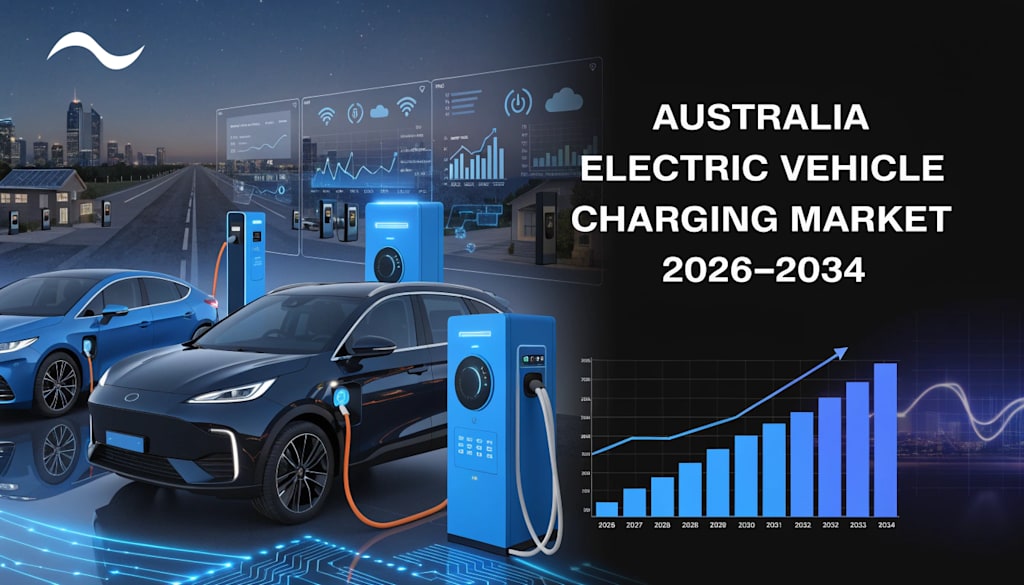
Australia’s transition toward electric mobility is no longer a distant vision—it is becoming a national infrastructure movement. According to IMARC Group, the Australia electric vehicle (EV) charging market reached a value of USD 304.4 million in 2025 and is projected to surge to USD 1,692.2 million by 2034, expanding at a remarkable CAGR of 21.00% during 2026–2034.
This explosive growth reflects the country’s accelerating commitment to clean transportation, renewable energy integration, and smart mobility infrastructure. As electric vehicles become increasingly mainstream, charging infrastructure is rapidly evolving from a convenience feature into a critical national utility.
From metropolitan charging hubs to remote highway fast-charging corridors, Australia is investing heavily in creating an EV ecosystem capable of supporting millions of future electric vehicles. The result is a market filled with innovation, public-private collaboration, and long-term investment potential.
Request a Business Sample Report for Procurement & Investment Evaluation
Why the Market Is Growing So Rapidly
One of the strongest drivers of market growth is the rapid expansion of charging infrastructure across urban and regional Australia. Governments, utilities, and private charging operators are aggressively deploying public charging stations to reduce range anxiety and encourage EV adoption. Fast-charging corridors connecting major cities and regional destinations are significantly improving accessibility for long-distance EV travel.
Government policies and incentives are also playing a transformative role. Federal and state governments are supporting EV adoption through rebates, tax benefits, stamp-duty exemptions, and strategic investments in charging infrastructure. Programs linked to the National Electric Vehicle Strategy are increasing investor confidence while creating a more favorable environment for large-scale charging network deployment.
Another major factor is the integration of renewable energy and smart charging technologies. Australia’s strong rooftop solar penetration creates ideal conditions for solar-powered charging stations, battery-backed systems, and vehicle-to-grid (V2G) technologies. These innovations allow EVs to become part of the energy ecosystem, enabling bidirectional energy flows that can support grid stability and renewable energy optimization.
Corporate fleet electrification is also accelerating demand. Logistics companies, utilities, government fleets, and commercial operators are increasingly transitioning to electric vehicles to reduce emissions and operating costs. This shift is driving demand for workplace charging systems, depot charging infrastructure, and subscription-based charging-as-a-service (CaaS) models.
In addition, digital innovation is reshaping the user experience. Smart charging platforms now allow drivers to locate chargers, reserve charging slots, manage payments, and monitor charging sessions in real time. These technologies are improving convenience and making EV ownership more practical for everyday consumers.
Segmentation of the Market
By Charging Station Type:
AC Charging, DC Charging
By Vehicle Type:
Battery Electric Vehicle (BEV), Plug-in Hybrid Electric Vehicle (PHEV), Hybrid Electric Vehicle (HEV)
By Installation Type:
Portable Charger, Fixed Charger
By Charging Level:
Level 1, Level 2, Level 3
By Connector Type:
Combines Charging Station (CCS), CHAdeMO, Type-1 (SAE J1772), Tesla Supercharger, Type-2 (IEC 62196-2), Others
By Application:
Residential, Commercial
By Region:
Australia Capital Territory & New South Wales, Victoria & Tasmania, Queensland, Northern Territory & Southern Australia, Western Australia
What the Opportunities Are
The rapid expansion of Australia’s EV charging market is opening major opportunities across industries:
• Regional charging corridor development: Australia’s vast geography creates strong demand for fast-charging networks connecting regional and tourism destinations.
• Solar-powered charging stations: Renewable-powered charging infrastructure presents a major opportunity as Australia continues expanding clean energy adoption.
• Vehicle-to-grid (V2G) ecosystems: Companies developing bidirectional charging technologies can benefit from the convergence of transport and energy systems.
• Commercial fleet electrification: Logistics operators and government fleets require large-scale depot charging infrastructure, creating long-term recurring demand.
• Smart charging software platforms: Digital platforms offering interoperability, payment integration, and load management are becoming essential parts of the ecosystem.
• Retail and property partnerships: Shopping centers, office buildings, hotels, and retailers are increasingly installing EV chargers to attract customers and tenants.
• Charging-as-a-service (CaaS) models: Subscription-based charging solutions are lowering upfront costs for businesses while creating scalable revenue opportunities for operators.
Recent News & Developments in Australia Electric Vehicle (EV) Charging Market
• February 2025: The Australian government expanded support for the National Electric Vehicle Strategy by announcing additional funding for regional EV charging infrastructure. The initiative prioritizes highway fast-charging corridors and remote-area accessibility to support nationwide EV adoption. The program is expected to accelerate charger deployment across tourism and regional transport routes.
• June 2025: Several major retailers and charging network operators announced partnerships to install EV charging stations across commercial locations nationwide. The rollout includes high-speed chargers at shopping centers and retail hubs to improve charging accessibility for urban consumers. These partnerships are helping integrate EV charging into everyday consumer activity.
• September 2025: Industry reports highlighted significant growth in Australia’s EV ecosystem, with public fast-charging locations and high-power charging plugs recording strong year-on-year expansion. EVs accounted for more than 12% of new vehicle sales, while the national EV fleet surpassed 410,000 vehicles. The data reinforced confidence in the long-term growth trajectory of charging infrastructure investments.
Why Should You Know About Australia Electric Vehicle (EV) Charging Market?
The Australia electric vehicle charging market is becoming one of the country’s most important infrastructure and sustainability opportunities. It sits at the intersection of clean energy, transportation, digital technology, and climate policy—making it a high-impact sector for the future economy.
For investors, the market offers exceptional long-term growth potential supported by policy momentum and rising EV adoption. For businesses, it creates opportunities in infrastructure deployment, software platforms, renewable integration, and fleet electrification. For policymakers, it represents a crucial pathway toward reducing emissions and modernizing transport systems.
As electric vehicles move from early adoption into mainstream mobility, charging infrastructure will become as essential as fuel stations once were. Australia’s EV charging market is not simply growing—it is helping redefine how the nation moves, powers, and connects its future.
About the Creator
Rashi Sharma
I am a market researcher.
Enjoyed the story? Support the Creator.
Subscribe for free to receive all their stories in your feed.
Comments
There are no comments for this story
Be the first to respond and start the conversation.