
Australia Electric Motor Market Powers Ahead with EV Growth and Industrial Automation
Australia’s electric motor industry is expanding steadily as electric vehicles, smart manufacturing, renewable energy, and energy-efficient technologies drive nationwide demand.

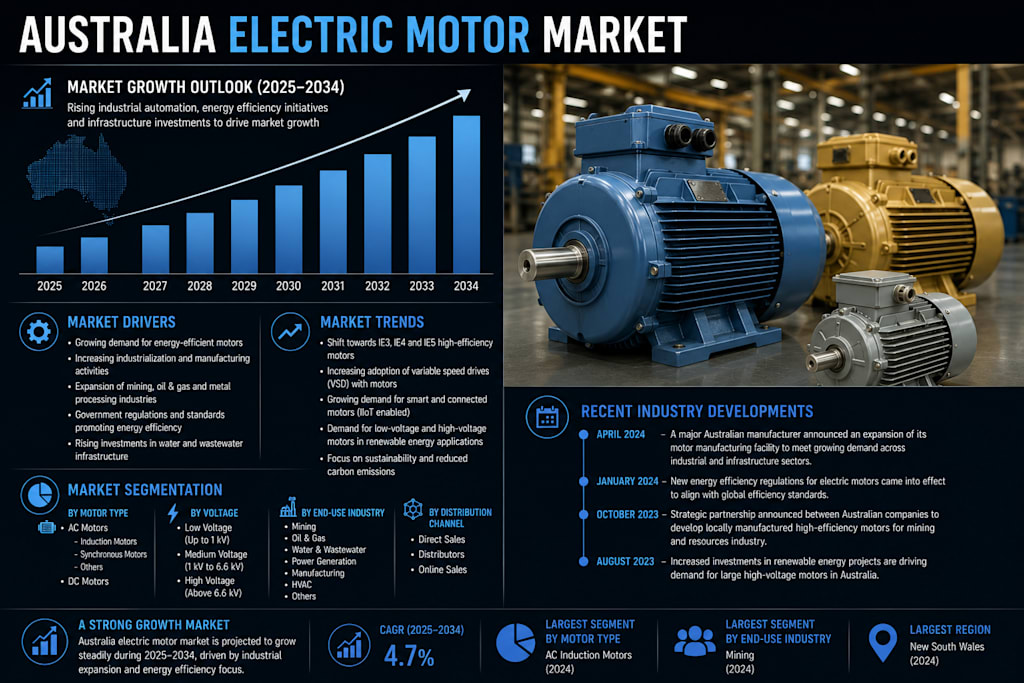
Australia’s transition toward electrification, industrial modernization, and clean energy adoption is creating significant momentum for the electric motor industry. Electric motors are now central to everything from electric vehicles and industrial robotics to HVAC systems, renewable energy infrastructure, and household appliances. According to IMARC Group, the Australia electric motor market reached USD 3.3 billion in 2025 and is projected to grow to USD 4.6 billion by 2034, expanding at a CAGR of 3.33% during 2026–2034.
Electric motors have become one of the most important technologies supporting Australia’s broader energy transition and industrial efficiency goals. As businesses and consumers increasingly move toward low-emission technologies, electric motors are being integrated into transportation systems, automated production facilities, mining equipment, robotics, and renewable energy installations. Their ability to deliver higher efficiency, lower maintenance costs, and improved operational performance makes them essential for Australia’s evolving economy.
The market is also benefiting from growing government support for electric mobility and sustainable infrastructure. Australia’s National Electric Vehicle Strategy (NEVS) has accelerated attention on EV adoption and charging infrastructure development, directly increasing demand for advanced electric motor systems. Automakers, industrial equipment manufacturers, and technology firms are investing heavily in next-generation motor technologies including brushless DC motors, permanent magnet motors, and smart motor control systems.
At the same time, industrial sectors are modernizing operations through automation and robotics. Electric motors are critical components in conveyor systems, robotic machinery, CNC equipment, industrial pumps, and automated manufacturing systems. Australia’s growing focus on Industry 4.0 technologies is expected to strengthen long-term demand for high-performance motors across multiple sectors.
Request a Business Sample Report for Procurement & Investment Evaluation:
Why the Market Is Growing So Rapidly
One of the biggest growth drivers is the rapid expansion of the electric vehicle ecosystem. Electric motors are the core propulsion technology used in EVs, and rising adoption of battery-powered vehicles is creating sustained demand across the automotive supply chain. Government incentives, charging infrastructure investments, and stricter emissions targets are accelerating the transition away from conventional combustion engines. Australia’s EV strategy is helping manufacturers and suppliers scale motor production capabilities for transportation applications.
Industrial automation is another major catalyst reshaping the market. Manufacturing plants, logistics centers, mining facilities, and food processing operations are increasingly adopting automated machinery to improve productivity and reduce operational costs. Electric motors power robotic arms, conveyor systems, automated packaging equipment, and precision manufacturing tools. The integration of AI and IoT-enabled industrial systems is also increasing demand for intelligent motor technologies capable of advanced monitoring and energy optimization.
Australia’s renewable energy transition is further strengthening market growth. Solar farms, wind energy installations, and battery storage systems rely heavily on electric motor-driven systems for operational efficiency and infrastructure support. Renewable energy projects require highly reliable motors for turbines, cooling systems, pumps, and energy management applications. As Australia accelerates clean energy deployment, demand for energy-efficient motor technologies is expected to rise steadily.
Rising fuel prices are also encouraging businesses and consumers to shift toward electric-powered systems. Electric motors offer lower operating costs, higher efficiency, and reduced maintenance requirements compared to combustion-based technologies. Many industries now view electrification as both a sustainability initiative and a long-term cost-saving strategy. This trend is particularly visible in transportation fleets, HVAC systems, and industrial pumping operations.
In addition, the expansion of mining, infrastructure, and smart construction projects is increasing demand for high-performance motors capable of operating in harsh and energy-intensive environments. Australia’s industrial economy remains heavily dependent on motor-driven systems across mining, marine, transportation, and construction sectors. Investments in infrastructure modernization and industrial expansion continue to support market stability and long-term growth.
Segmentation Categories
Motor Type:
• AC Motor
• Induction AC Motor
• Synchronous AC Motor
• DC Motor
• Brushed DC Motor
• Brushless DC Motor
• Others
Voltage:
• Low Voltage Electric Motors
• Medium Voltage Electric Motors
• High Voltage Electric Motors
Rated Power:
• Fractional Horsepower Motors
• Integral Horsepower Motors
Magnet Type:
• Ferrite
• Neodymium (NdFeB)
• Samarium Cobalt (SmCo5 and Sm2Co17)
Weight:
• Low Weight Motors
• Medium Weight Motors
• High Weight Motors
Speed:
• Ultra-High-Speed Motors
• High-Speed Motors
• Medium Speed Motors
• Low Speed Motors
Applications:
• Industrial Machinery
• HVAC
• Transportation
• Household Appliances
• Motor Vehicles
• Aerospace
• Marine
• Robotics
• Others
Regions:
• Australia Capital Territory & New South Wales
• Victoria & Tasmania
• Queensland
• Northern Territory & Southern Australia
• Western Australia
What the Opportunities Are
1. Electric Vehicle Manufacturing Growth
Australia’s EV expansion is creating substantial opportunities for motor manufacturers, battery system suppliers, and automotive component companies. Advanced propulsion systems and lightweight motors are expected to see rising demand.
2. Smart Factory and Automation Integration
Industry 4.0 adoption is increasing investment in robotics and intelligent manufacturing systems. Companies specializing in smart motors and AI-integrated control technologies may gain significant competitive advantages.
3. Renewable Energy Infrastructure
Solar farms, wind projects, and energy storage facilities require durable and energy-efficient motors for operations and maintenance systems. Suppliers aligned with renewable energy expansion could benefit from long-term contracts and infrastructure demand.
4. HVAC and Energy Efficiency Solutions
Energy-efficient HVAC systems are becoming increasingly important in residential, commercial, and industrial buildings. High-efficiency motors designed for reduced energy consumption are expected to experience strong adoption.
5. Mining and Heavy Industrial Equipment
Australia’s mining sector relies heavily on robust electric motor systems for conveyors, drilling equipment, pumps, and extraction machinery. The industry’s modernization efforts present major opportunities for high-performance industrial motor suppliers.
6. Advanced Magnet Technologies
Demand for neodymium and rare-earth magnet motors is growing due to their efficiency and compact design advantages. Manufacturers investing in advanced magnet technologies may capture premium market segments.
7. Robotics and Precision Engineering
The expansion of robotics in logistics, healthcare, aerospace, and manufacturing is creating opportunities for precision motor systems with enhanced control and reliability capabilities.
Recent News & Developments in Australia Electric Motor Market
• February 2025: The Australian Government continued expanding support for electric vehicle adoption through infrastructure funding and implementation initiatives tied to the National Electric Vehicle Strategy. New charging network projects and fleet electrification programs were announced across multiple states to accelerate EV accessibility and reduce transportation emissions. Industry analysts noted that increased EV deployment is expected to significantly boost long-term demand for electric propulsion motors and related components. The policy momentum reinforced investor confidence across Australia’s electrification ecosystem.
• June 2025: EMP announced a collaboration with the University of Adelaide to develop high-performance and sustainable electric motor technologies under the Defence Trailblazer’s Accelerating Sovereign Industrial Capabilities program. The partnership aims to strengthen Australia’s domestic manufacturing capabilities in advanced electric motor systems while supporting innovation in defense and industrial applications. Researchers and engineers involved in the project are focusing on improving efficiency, durability, and sustainability outcomes. The initiative highlights growing national investment in sovereign manufacturing and advanced engineering capabilities.
• September 2025: Australia’s industrial automation sector recorded strong growth as manufacturers increased investments in robotics, automated production systems, and AI-enabled machinery across mining, logistics, and manufacturing facilities. Market participants reported rising procurement volumes for high-efficiency electric motors integrated into conveyor systems, robotic equipment, and industrial automation technologies. Analysts linked the growth to labor optimization strategies and increasing demand for energy-efficient industrial operations. The momentum further strengthened Australia’s position as a rapidly evolving smart manufacturing market.
Why Should You Know About Australia Electric Motor Market?
The Australia electric motor market sits at the center of some of the country’s most important economic and technological transformations. Electrification, renewable energy deployment, industrial automation, and sustainable transportation all depend heavily on reliable and energy-efficient motor systems.
For investors, the sector offers exposure to long-term themes such as EV adoption, robotics, advanced manufacturing, and energy transition infrastructure. For manufacturers and technology companies, rising demand for intelligent and high-performance motors creates opportunities for innovation, localization, and export expansion. Policymakers also recognize electric motors as critical technologies supporting emissions reduction, industrial productivity, and energy efficiency goals.
As Australia continues modernizing its economy and accelerating clean technology adoption, electric motors will remain foundational to the country’s industrial growth and sustainable development strategy for years to come.
About the Creator
Rashi Sharma
I am a market researcher.
Enjoyed the story? Support the Creator.
Subscribe for free to receive all their stories in your feed.
Comments
There are no comments for this story
Be the first to respond and start the conversation.