
Australia Egg Powder Market 2026: Avian Influenza Resilience, Shelf Stable Supply & Sports Nutrition Ascent
How a 7% production shock, high Aussie consumption and functional protein demand are driving food manufacturers towards powdered egg alternatives

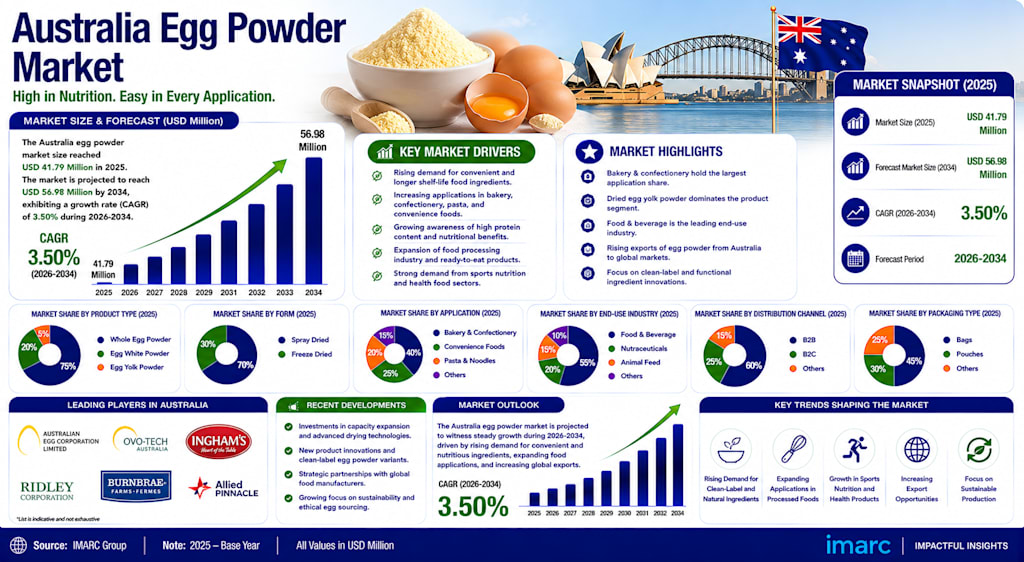
The Australia egg powder market is experiencing steady, strategic growth as food manufacturers, ingredient suppliers and health conscious consumers increasingly turn to a shelf stable, cost effective alternative to fresh eggs. Egg powder — available in whole egg, egg yolk and egg white (albumen) forms — is deployed across bakery and confectionery, sauces, pasta, ready to eat meals, meat processing, and a rapidly expanding sports nutrition segment. According to IMARC Group, the market size reached USD 41.79 Million in 2025 and is projected to reach USD 56.98 Million by 2034, exhibiting a compound annual growth rate (CAGR) of 3.50% during 2026 2034. While price sensitive and reliant on import competition, the Australian market is benefitting from a perfect storm of domestic supply disruption, soaring fresh egg prices, and a sustained shift toward functional, high protein ingredients. As the processed egg sector navigates recovery and global trade pressures, egg powder is quietly becoming an industrial backstop, insulating commercial bakers and product formulators from the volatility of the shell egg market.
What's Driving Market Growth?
Avian Influenza Reshaping Fresh Egg Supply Dynamics. Since 2024, Australia has grappled with a nationwide egg shortage triggered by large scale culling of hens following outbreaks of Highly Pathogenic Avian Influenza (HPAI), particularly in Victoria and New South Wales. The national layer flock suffered losses estimated at approximately 7% of Australia’s egg production capacity, with the impacts of H7 HPAI extending into early 2025. While Australia remains free of the more severe H5 strain, the biosecurity threat has fundamentally altered the cost and reliability of fresh egg supply. In response, the industry is accelerating its transition away from conventional cages toward barn laid and free range systems, raising the cost floor for fresh eggs while increasing the appeal of pasteurised egg powders. For food manufacturers, egg powder offers a practical solution to production uncertainty: unlike fresh eggs, powders are largely unaffected by seasonal demand spikes or disease outbreaks, providing consistent availability, long shelf life (12 24 months), and reduced handling costs.
Sustained High Fresh Egg Prices Boosting Powder Competitiveness. With retail egg prices rising 12% year on year in 2024 25, the unit economics of egg powder — typically used in 10 15kg commercial bags — have become increasingly attractive. Retail prices for free range and barn laid eggs have increased by as much as 20 21% year on year, further widening the cost gap that favours bulk powder procurement. At a national level, Australia’s egg gross value of production (GVP) is estimated at $451 million in 2024 25, up 8% from the prior year, with average farm gate egg prices rising 12%. Egg powder, which eliminates the logistical expense of cold chain storage and transport, allows manufacturers to lock in predictable pricing through bulk contracts, insulating them from the rapid price fluctuations still affecting supermarket egg aisles.
Rising Sport Nutrition and Functional Protein Demand. A powerful growth vector is the incorporation of egg based protein into the health and fitness segment. Egg white powder is widely considered a reference standard for protein quality, with a biological value of 100 — superior to beef (80) and whole milk (91). It is a rich source of branched chain amino acids (BCAAs) and essential amino acids, making it highly valued for muscle repair, weight management and post exercise recovery. Egg protein provides a dairy free, lactose free alternative to whey, appealing to consumers with food intolerances and those seeking variety in their supplementation. Eggs have already been identified as “expected to remain the key growth driver” in Australia’s protein powder market, and the broader Australia protein supplements market — of which egg powders are a small but fast growing segment — reached USD 562.2 Million in 2025 and is projected to grow at a CAGR of 6.72% through 2034. As consumers incorporate egg powder into shakes, smoothies, low fat omelettes and high protein baking, the sports nutrition channel is creating incremental, premium price volume for the category.
Convenience, Safety and Scale in Food Manufacturing. Beyond specific protein formulations, a universal driver is the industrial appeal of egg powder for commercial food preparation. Food manufacturers, bakeries and ingredient suppliers consistently cite six operational advantages: reliable supply unaffected by seasonal spikes; long shelf life and reduced waste; consistent quality across batches; hygiene and safety through pasteurisation; logistical savings from ambient storage; and precise, shell free use in automated mixing lines. In Australia, players such as Pace Farm offer locally manufactured dried whole egg powder (white and yolk) in bulk multi walled bags, sold directly to commercial cake and muffin mix producers, crumb manufacturers, biscuit makers, cosmetics companies, and health drink formulators. This embedded industrial base, validated by rigorous certifications (SQF, HACCP, NSW Food Authority, Export Accredited), ensures that egg powder is not merely a short term substitute but a strategic long term ingredient for scale up food production.
Market Segmentation & Key Insights
By Type, the market is segmented into whole egg powder, egg yolk powder and egg albumen (white) powder. Egg albumen powder commands a premium due to its use in sports nutrition and specialised foaming applications in bakery (meringues, macarons, angel food cake). Whole egg powder remains the largest volume segment, widely deployed as a direct 1:1 substitute for fresh eggs in pastry, pasta and sauce production.
By End User, the market spans food and beverage, nutraceutical (sports nutrition), pharmaceutical, personal care and cosmetics, and animal feed. The bakery and confectionery sector anchors demand, followed by a fast growing health and fitness segment purchasing egg white isolate as a functional protein.
By Distribution Channel, key routes include hypermarkets/supermarkets, specialty stores, online sales channels and business to business (B2B). B2B is the dominant channel by volume, given that the majority of egg powder is sold as an industrial ingredient.
By Region, major markets include New South Wales & ACT, Victoria & Tasmania, Queensland, Western Australia, South Australia and the Northern Territory. Victoria and NSW, home to the largest egg processing facilities and population dense bakery and food production hubs, constitute the primary demand centres. The Australia egg processing market is forecast to see a tapered growth pattern, beginning with strong momentum (6.34% in 2025) and stabilising as domestic egg production recovers and import competition persists.
What the Opportunities Are?
Egg White Isolate for Premium Sports Nutrition. The growing mainstream acceptance of protein supplementation creates strong opportunities for specialised egg white powder brands targeting gym goers and functional food formulators. Australia’s protein powder market is expanding, and egg protein is uniquely positioned as a dairy free, high bioavailability alternative. Developers can launch flavoured egg protein isolates, ready to mix egg based meal replacements and convenient protein omelette premixes, capitalising on both domestic demand and export potential to Asian markets where whey allergies are more common.
Cage Free and Free Range Egg Powder Differentiation. With Australia’s food industry transitioning away from conventional cages — barn eggs accounted for 28% of major supermarket sales in 2024 25 (up from 21%), while cage eggs fell to 13% — there is growing demand for egg powders produced from cage free or free range certified flocks. Suppliers that can offer “cage free pasteurised egg powder” will secure premium B2B contracts with food manufacturers who need to validate their own sustainable sourcing credentials. Pace Farm already offers cage free, free range and barn laid designations across its commercial egg products, signalling clear commercial viability.
Baking and Gluten Free Specialty Formulations. As the gluten free sector matures, egg white powder’s unique foaming, gelling and emulsifying properties become essential for replicating the structure of gluten in baked goods. For plant based and allergen free bakeries, egg powder serves as a reliable, label friendly functional ingredient, free from the complex additives found in some synthetic replacers. Manufacturer launches of certified gluten free or organic egg powder — particularly for home baking subscription kits — are likely to capture premium shelf space.
Export Market Development and Niche Offerings. Although Australia’s processed egg costs remain above those of major global competitors such as the US, India, Brazil and the EU, there is still a viable export niche for premium, traceable egg powders backed by superior animal welfare and biosecurity standards. Australian imports of processed egg products increased 57% year on year to $26.9 million in 2024 25, with 52% sourced from the Netherlands. This suggests clear import dependency that could be reversed with targeted export strategies focused on high margin, specialty egg powders.
By product Valorisation and Hydrolysate Innovation. Egg powder production generates protein rich streams that can be enzymatically hydrolysed into bioactive peptides with potential applications in functional beverages, therapeutic nutrition and cosmetic formulations. While still an emerging field, investment in egg protein hydrolysate R&D — particularly in collaboration with Australian food science institutes — can open new, high value revenue lines beyond commodity egg powder sales.
Recent News and Developments in Australia Egg Powder Market
March 2026: Australia’s egg industry was forecast to produce 5 billion eggs in 2026, marking a steady recovery from past HPAI disruptions. Growth was expected to continue through 2031, driven by strong domestic demand and evolving consumer preferences.
May 2025: National egg supply disruptions from avian influenza had reduced production capacity by approximately 7%, with retail egg prices surging 9 12% over the preceding year, exceeding broader food category inflation. Food manufacturers increasingly viewed egg powders as a stable, pasteurised and cost effective alternative.
2025: The Australia egg market was valued at AUD 572.79 Million, with projections to reach AUD 671.32 Million by 2034 at a CAGR of 1.60%. The sector supported more than 3,800 jobs, from large scale integrated farms to small local producers.
2025: Australian imports of processed egg products increased 57% year on year to $26.9 million, underscoring import dependence that domestic egg powder producers could address through premium local manufacturing.
2025: Pace Farm continued to offer locally manufactured dried whole egg, egg yolk and egg white powder in bulk multi walled bags for commercial customers, maintaining its position as a leading Australian egg product manufacturer.
Why Should You Know About Australia Egg Powder Market?
You should know about this market because it captures how biosecurity disruption, industrial efficiency imperatives and functional nutrition trends intersect to transform a small but strategically important ingredient category. Egg powder is no longer viewed as a simple shelf stable emergency ration — it is increasingly a biosafe, consistent and logistics friendly input that protects food manufacturers from the inherent volatility of the fresh egg market. In a country where Australians consume 250 260 eggs per person annually (well above global averages), the pressure to stabilise egg based ingredient supply has never been greater.
For investors, the egg powder market offers exposure to a modest but resilient industrial ingredient category anchored in Australia’s large scale egg processing and baking sector. The projected CAGR of 3.50% masks a more dynamic underlying story: the high value sports nutrition sub segment (egg white protein) is growing substantially faster, while recovery from the avian influenza driven 7% production loss will continue to lift interest in supply chain hardened alternatives.
For food manufacturers, procurement managers and ingredient formulators, understanding egg powder segmentation, the functional distinctions between whole egg, yolk and albumen powders, and the new opportunities in cage free and organic certifications helps shape intelligent sourcing, product reformulation and supply chain risk management strategies. In essence, the Australia egg powder market captures how farm gate resilience, commercial food science and premium protein demand converge — making it a compelling area for manufacturers, nutrition brands and investors seeking smarter approaches to cost effective, consistent and functional egg derived nutrition.
About the Creator
Thomas
Market Research Analyst | Industry Trends & Forecasting | Turning market data into clear, actionable business insights across global sectors.
Enjoyed the story? Support the Creator.
Subscribe for free to receive all their stories in your feed.
Comments
There are no comments for this story
Be the first to respond and start the conversation.