
Australia E-Invoicing Market Is Powering the Next Phase of Digital Finance
Government mandates, automation, and SME adoption are accelerating Australia’s transition toward a fully digital invoicing ecosystem.

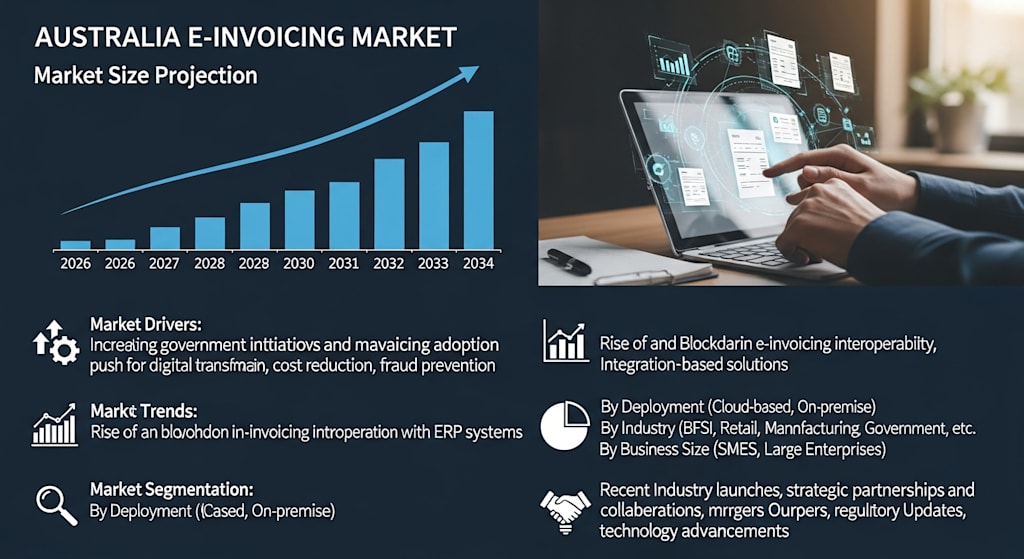
The Australia e-invoicing market is rapidly evolving into a cornerstone of the country’s digital economy. According to IMARC Group, the market reached USD 512.9 Million in 2025 and is projected to grow to USD 1,854.5 Million by 2034, expanding at a CAGR of 14.89% during 2026–2034.
This strong growth reflects a structural shift away from manual and paper-based invoicing toward automated, secure, and real-time financial processes. E-invoicing—enabled through standardized frameworks such as Peppol—is no longer just a back-office function. It is becoming a strategic enabler of efficiency, compliance, and digital integration across industries.
As businesses seek faster payment cycles, lower administrative costs, and improved financial transparency, e-invoicing is emerging as a critical infrastructure layer for modern enterprise operations in Australia.
Market Segmentation
• Channel: B2B; B2C; Others
• Deployment Type: Cloud-based; On-premises
• Application: Energy and Utilities; FMCG; E-Commerce; BFSI; Government; Others
• Region: Australia Capital Territory & New South Wales; Victoria & Tasmania; Queensland; Northern Territory & Southern Australia; Western Australia
Request a Business Sample Report for Procurement & Investment Evaluation:
Why the Market Is Growing So Rapidly
One of the most significant drivers of market growth is strong government support and regulatory alignment. The Australian government has mandated e-invoicing capability across federal agencies and promoted the adoption of Peppol standards. This top-down approach is creating a foundational network that encourages businesses—especially suppliers—to adopt digital invoicing systems to remain competitive and compliant.
Another major factor is the clear cost and efficiency benefits for businesses, particularly small and medium-sized enterprises (SMEs). Organizations can eliminate manual data entry, reduce administrative overhead, and minimize human errors. Studies cited in the IMARC report indicate that SMEs can save up to A$40,000 annually by transitioning to e-invoicing, making it a financially compelling decision.
The need for faster payment cycles is also accelerating adoption. Traditional invoicing methods often result in delays, disputes, and inefficiencies. E-invoicing streamlines approval workflows and enables near real-time processing, significantly improving cash flow management. This is especially important for SMEs and suppliers that depend on predictable payment timelines.
Technological advancements—particularly in artificial intelligence (AI) and automation—are further transforming the market. AI-powered systems can extract, validate, and process invoice data with minimal human intervention, improving accuracy and reducing fraud risks. Robotic process automation (RPA) is also being used to optimize workflows, enabling businesses to handle high invoice volumes efficiently.
Finally, the growing emphasis on cybersecurity and fraud prevention is shaping the market. With rising digital transactions, businesses are investing in secure invoicing systems that incorporate encryption, multi-factor authentication, and real-time fraud detection. This focus on security is essential to building trust and ensuring widespread adoption across industries.
What the Opportunities Are
The Australia e-invoicing market offers a wide spectrum of strategic opportunities:
1. End-to-End Digital Procurement Integration
Companies can embed e-invoicing into broader procure-to-pay systems, enabling seamless automation across purchasing, invoicing, and payments.
2. Cloud-Based Platform Expansion
The shift toward cloud deployment models creates scalable opportunities for SaaS providers offering subscription-based invoicing solutions.
3. SME Enablement and Onboarding Services
Helping small businesses adopt e-invoicing systems presents a high-growth opportunity, especially as government mandates expand.
4. AI-Driven Financial Automation
Advanced analytics, predictive cash flow insights, and automated compliance solutions are becoming premium offerings in the market.
5. Cross-Border Trade Enablement
E-invoicing platforms aligned with global standards can facilitate international trade and improve interoperability between markets.
6. Cybersecurity and Compliance Solutions
As fraud risks increase, there is strong demand for secure invoicing systems with advanced verification and monitoring capabilities.
7. Sustainability-Focused Solutions
Digital invoicing reduces paper usage and supports ESG goals, creating opportunities for providers to position themselves as sustainability enablers.
Recent News & Developments in Australia E-Invoicing Market
• February 2025: The Australian government expanded its e-invoicing adoption strategy by introducing new compliance incentives for SMEs. These measures included financial support programs and simplified onboarding processes aimed at accelerating adoption across smaller businesses. The initiative also reinforced the use of Peppol standards to ensure interoperability across systems. This move is expected to significantly increase participation in the national e-invoicing network.
• June 2025: A leading fintech company launched an advanced e-invoicing platform in Australia, integrating AI-driven automation and real-time analytics. The platform enables businesses to automate invoice validation, reduce errors, and gain insights into cash flow patterns. Early adopters reported improved operational efficiency and faster payment cycles. This development highlights the growing role of technology innovation in shaping the market.
• September 2025: Industry data revealed a sharp increase in e-invoicing adoption across sectors such as BFSI, retail, and government services. Businesses reported measurable reductions in processing times and administrative costs after transitioning to digital invoicing systems. The report also highlighted increased adoption among SMEs, signaling a broader shift toward digital financial ecosystems. This momentum underscores the market’s strong growth trajectory.
Why Should You Know About Australia E-Invoicing Market?
The Australia e-invoicing market represents a fundamental shift in how businesses manage financial transactions. It is not just about replacing paper invoices—it is about creating a fully connected, automated, and transparent financial ecosystem.
For businesses, e-invoicing delivers tangible benefits: faster payments, reduced costs, improved accuracy, and enhanced compliance. For investors, it offers exposure to a high-growth segment driven by regulatory support and technological innovation. For policymakers, it provides a powerful tool to improve economic efficiency, reduce fraud, and support digital transformation at a national level.
As Australia continues to embrace digital infrastructure, e-invoicing is set to become a standard business practice. Organizations that adopt early will not only gain operational advantages but also position themselves at the forefront of a rapidly evolving financial landscape.
About the Creator
Rashi Sharma
I am a market researcher.
Enjoyed the story? Support the Creator.
Subscribe for free to receive all their stories in your feed.
Comments
There are no comments for this story
Be the first to respond and start the conversation.