
Australia Dust Control Solutions Market Expands as Safety Regulations and Infrastructure Projects Drive Demand
Stricter silica exposure laws, mining expansion, and smart environmental technologies are accelerating Australia’s dust control solutions industry.

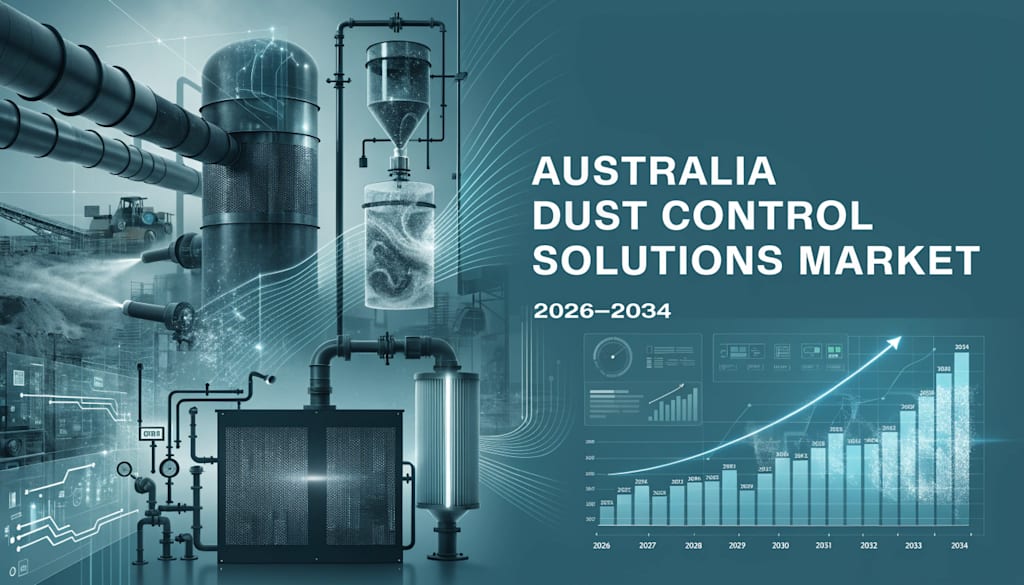
Australia’s dust control solutions market is entering a period of sustained expansion as industries across mining, construction, manufacturing, and infrastructure development intensify their focus on workplace safety and environmental compliance. According to IMARC Group, the Australia dust control solutions market was valued at USD 360.44 million in 2025 and is projected to reach USD 520.02 million by 2034, growing at a CAGR of 4.16% during 2026–2034.
The market’s momentum reflects a broader shift toward safer industrial operations and more sustainable environmental management. Dust suppression is no longer viewed as a secondary operational requirement; it has become a strategic necessity for companies seeking to comply with tightening regulations, reduce health risks, and improve operational efficiency. Across Australia, industries are adopting advanced dust management systems to control airborne particulates generated by mining operations, quarrying, road construction, demolition, manufacturing, and bulk material handling.
IMARC highlights that wet dust control solutions dominate the market with a 60% share in 2025 due to their superior ability to capture fine particles in mining and construction environments. By application, the construction segment leads with a 32% market share, driven by major infrastructure projects and increasingly strict silica dust regulations. The market is segmented by product type into wet and dry dust control solutions, while application categories include construction, mining, oil and gas, chemical, food and beverage, and others. Regional demand spans New South Wales, Victoria, Queensland, Western Australia, South Australia, Tasmania, and the Northern Territory.
Request a Business Sample Report for Procurement & Investment Evaluation:
Why the Market Is Growing So Rapidly
One of the biggest growth drivers is Australia’s tightening workplace safety and environmental regulations. New crystalline silica protection measures introduced in recent years have significantly increased pressure on companies to reduce airborne dust exposure across construction, mining, tunnelling, and industrial operations. Businesses now face stricter compliance requirements involving risk assessments, dust monitoring, worker training, and advanced suppression technologies. These regulatory changes are accelerating investments in modern dust control systems nationwide.
The country’s expanding mining and infrastructure sectors are also fueling demand. Australia remains one of the world’s leading mining economies, with extensive operations involving coal, iron ore, lithium, and mineral processing. Mining sites generate substantial particulate emissions through blasting, crushing, transportation, and material handling activities. At the same time, large infrastructure projects such as metro rail systems, airports, renewable energy installations, and highway developments continue generating strong demand for industrial-grade dust suppression solutions.
Technological innovation is reshaping the competitive landscape. Companies are increasingly deploying IoT-enabled monitoring systems, automated suppression units, drone-based environmental surveillance, and real-time analytics platforms. These intelligent technologies allow operators to monitor airborne particulate levels continuously and respond instantly when dust concentrations rise above safety thresholds. Automation also improves water efficiency and operational precision, particularly in remote mining regions.
Sustainability is becoming another central growth theme. Traditional water-intensive suppression methods are being replaced or enhanced with biodegradable chemical formulations, polymer-based stabilizers, and low-water consumption technologies. Australian industries are under growing pressure from regulators, communities, and investors to reduce environmental impact while maintaining effective dust management practices. Eco-friendly suppression products are therefore gaining significant traction across industrial sectors.
Health awareness is also influencing market expansion. Respiratory illnesses linked to silica and industrial dust exposure have become a major concern across Australia’s workforce. Public attention on occupational diseases has increased significantly, encouraging businesses to prioritize employee safety and adopt proactive dust mitigation strategies. This growing awareness is expected to sustain long-term demand for advanced suppression technologies and monitoring systems.
What the Opportunities Are
1. Expansion of Smart Dust Monitoring Systems
The integration of IoT sensors, cloud-based monitoring, and AI-driven analytics creates substantial opportunities for technology providers delivering automated environmental compliance solutions.
2. Eco-Friendly Dust Suppression Technologies
Demand for biodegradable and water-efficient suppression products is rising as industries seek sustainable alternatives that align with environmental regulations and ESG goals.
3. Mining Sector Modernization
Australia’s large-scale mining industry continues investing heavily in advanced suppression infrastructure, particularly in regions with harsh climate conditions and strict environmental oversight.
4. Infrastructure Development Projects
Ongoing transportation, energy, and urban development initiatives are generating long-term demand for construction-focused dust control technologies and compliance services.
5. Remote Operations and Automation
Automated dust suppression systems capable of remote operation are becoming increasingly valuable for mining and industrial sites operating in isolated regions.
6. Occupational Health Compliance Services
Businesses now require integrated workplace safety programs that combine air quality monitoring, training, maintenance, and compliance reporting services.
7. Water Conservation Technologies
Australia’s arid conditions create strong commercial opportunities for innovative suppression solutions that minimize water usage while maintaining operational effectiveness.
Recent News & Developments in Australia Dust Control Solutions Market
• February 2025: RST Solutions introduced DEM Hydroboost Pro, a new dust suppression product designed specifically for mining operations seeking improved moisture management and reduced water consumption. The solution was developed to optimize dust control while protecting material integrity during transportation and processing activities. Industry analysts noted growing interest in water-efficient suppression technologies due to increasing sustainability requirements across Australia’s mining sector. The launch reinforced broader industry movement toward environmentally responsible dust management systems.
• July 2025: Mideco launched the “Bat Booth,” an advanced personnel de-dusting system capable of removing up to 88% of respirable dust from workers’ clothing within seconds. The compact low-pressure compressed air system was designed to reduce worker exposure risks across mining, construction, and heavy industrial operations. Occupational safety experts highlighted the growing importance of wearable and personnel-focused dust mitigation technologies as regulatory scrutiny intensifies. The innovation reflected Australia’s broader push toward stronger worker protection standards.
• September 2025: Australia’s industrial sector reported increased adoption of automated dust monitoring systems across major infrastructure and mining projects. Companies accelerated deployment of IoT-enabled sensors and real-time environmental analytics platforms to improve compliance with stricter silica exposure regulations. Market participants also reported stronger demand for integrated suppression systems combining automated monitoring, sustainable chemical formulations, and remote operational controls. Analysts projected continued growth in intelligent environmental management technologies through the remainder of the decade.
Why Should You Know About Australia Dust Control Solutions Market?
Australia’s dust control solutions market sits at the intersection of industrial growth, workplace safety, environmental sustainability, and technological innovation. As industries modernize operations and governments strengthen health regulations, dust management systems are becoming critical infrastructure rather than optional operational tools.
For investors, the sector offers stable long-term opportunities driven by infrastructure expansion, mining activity, and rising compliance requirements. For technology providers, demand for automation, AI-enabled monitoring, and eco-friendly suppression solutions continues creating new commercial potential. Policymakers and environmental agencies also recognize dust control as a key factor in protecting public health, improving workplace conditions, and supporting sustainable industrial development.
With Australia continuing to expand its infrastructure and resource sectors while tightening environmental standards, the dust control solutions industry is positioned to become an increasingly important component of the country’s industrial future.
About the Creator
Rashi Sharma
I am a market researcher.
Enjoyed the story? Support the Creator.
Subscribe for free to receive all their stories in your feed.
Comments
There are no comments for this story
Be the first to respond and start the conversation.