
Australia Domestic Air Cargo Transport Market Set to Reach 671.8 Thousand Metric Tons by 2034 Amid E-Commerce and Logistics Expansion
Rising demand for faster deliveries, regional connectivity, and supply chain modernization is driving sustained growth in Australia's domestic air cargo transport industry.

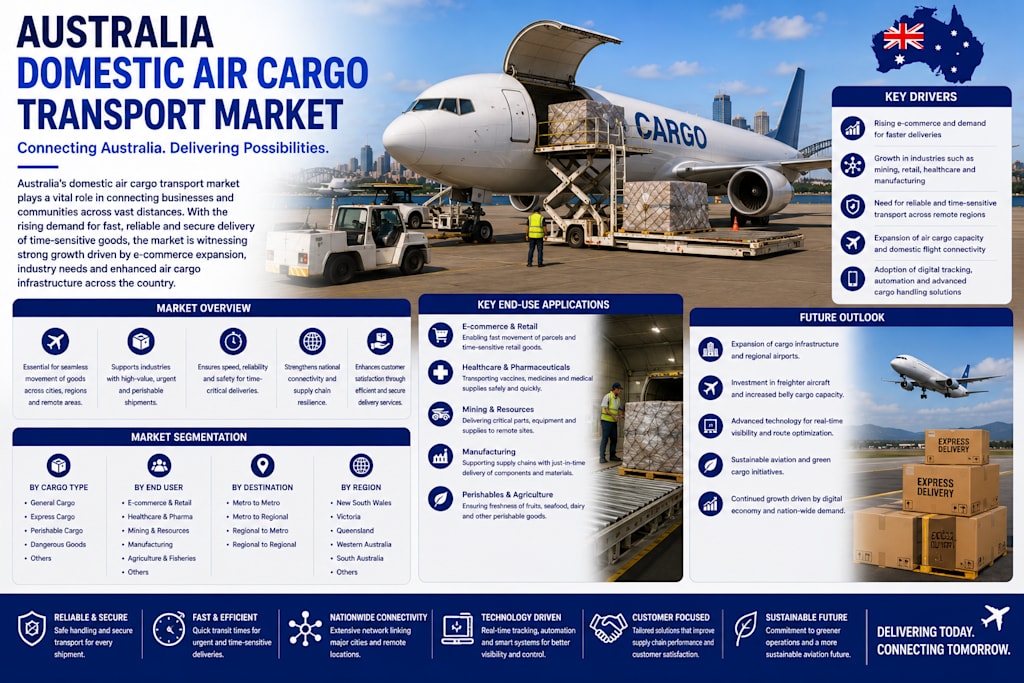
The Australia domestic air cargo transport industry is playing an increasingly important role in supporting the country's modern economy. As businesses and consumers continue to prioritize speed, reliability, and efficient distribution networks, air freight has emerged as a critical component of Australia's logistics infrastructure. From e-commerce fulfillment and healthcare deliveries to industrial supply chains and regional connectivity, domestic air cargo services are becoming indispensable across multiple sectors.
According to IMARC Group, the Australia domestic air cargo transport market reached 475.7 Thousand Metric Tons in 2025. Looking ahead, the market is projected to expand to 671.8 Thousand Metric Tons by 2034, exhibiting a compound annual growth rate (CAGR) of 3.79% during 2026–2034. This steady growth reflects the increasing need for time-sensitive transportation solutions and the continued modernization of logistics networks throughout the country.
The market encompasses various service types, cargo categories, aircraft types, and end-use industries, highlighting the broad range of applications that domestic air freight supports across Australia.
Request a Business Sample Report for Procurement & Investment Evaluation:
Why the Market Is Growing So Rapidly
One of the primary growth drivers is the continued expansion of e-commerce across Australia. Consumers increasingly expect next-day or even same-day delivery services, prompting retailers and logistics providers to strengthen their air cargo capabilities. Domestic air freight enables businesses to meet these expectations while maintaining inventory efficiency and reducing delivery times.
Australia's vast geography also makes air cargo a practical and often essential transportation option. Many remote and regional communities rely on air freight for access to critical goods, including medical supplies, fresh produce, and industrial equipment. As regional economic activity expands, demand for dependable domestic cargo services continues to rise.
Another important factor is the growing need for resilient supply chains. Businesses are increasingly investing in logistics strategies that prioritize flexibility and speed. Air cargo provides a valuable alternative when road or rail transportation faces disruptions, helping companies maintain operational continuity and customer satisfaction.
Technological advancements are further supporting market growth. Digital freight management systems, real-time cargo tracking, automated sorting facilities, and data-driven route optimization are improving operational efficiency. These innovations allow cargo operators to reduce transit times, enhance visibility, and improve service reliability.
The healthcare and pharmaceutical sectors are also contributing significantly to demand. Temperature-sensitive medicines, vaccines, diagnostic materials, and emergency medical supplies often require rapid transportation. Domestic air cargo networks provide the speed and reliability needed to support these critical shipments across Australia's healthcare ecosystem.
What the Opportunities Are
1. E-Commerce Fulfillment Expansion
The continued growth of online retail creates substantial opportunities for air cargo operators. Faster delivery expectations will encourage investment in dedicated cargo networks, fulfillment centers, and express freight services.
2. Regional and Remote Area Connectivity
Australia's remote communities depend heavily on reliable logistics services. Expanding domestic cargo routes can improve access to essential goods while creating new revenue opportunities for operators.
3. Pharmaceutical Logistics Growth
The increasing demand for temperature-controlled and time-sensitive healthcare shipments presents attractive opportunities for specialized air freight providers with advanced handling capabilities.
4. Digital Logistics Platforms
Companies that adopt advanced digital technologies, including AI-powered scheduling, cargo visibility solutions, and predictive analytics, can improve efficiency and strengthen customer relationships.
5. Airport Infrastructure Investments
Upgrades to cargo terminals, warehousing facilities, and handling equipment can significantly improve throughput capacity and support long-term market growth.
6. Sustainable Aviation Initiatives
As environmental considerations become increasingly important, investments in fuel-efficient aircraft, sustainable aviation fuels, and carbon reduction programs can create competitive advantages for industry participants.
7. High-Value and Time-Critical Freight
Industries such as electronics, mining, manufacturing, and healthcare continue to require rapid transportation solutions. Specialized services targeting these sectors represent an important growth avenue.
Recent News & Developments in Australia Domestic Air Cargo Transport Market
• March 2025: Australian transportation authorities announced new initiatives aimed at strengthening domestic freight efficiency and regional logistics connectivity. The program includes investments in airport cargo infrastructure and operational improvements designed to reduce freight bottlenecks. Industry participants welcomed the measures as a positive step toward supporting long-term supply chain resilience and economic growth.
• July 2025: Several logistics and cargo operators expanded their domestic air freight capabilities by adding new cargo capacity and enhancing distribution networks across major Australian cities. These investments were intended to address growing demand from e-commerce, healthcare, and industrial customers. Industry stakeholders reported improved delivery performance and greater network flexibility following the expansion efforts.
• September 2025: Domestic air cargo volumes continued to show healthy momentum as businesses increasingly prioritized rapid transportation services. Growth in online retail activity and time-sensitive shipments contributed to higher freight movement across key domestic routes. Market participants highlighted strong customer demand and increasing adoption of premium logistics solutions throughout the year.
Why Should You Know About Australia Domestic Air Cargo Transport Market?
The Australia domestic air cargo transport market represents a vital component of the country's economic and logistics ecosystem. As consumer expectations evolve and businesses seek faster, more resilient supply chains, air freight is becoming increasingly important for maintaining competitiveness and operational efficiency.
For investors, the market offers exposure to long-term trends such as e-commerce growth, logistics modernization, regional development, and healthcare expansion. For businesses, improved air cargo services can enhance customer satisfaction, accelerate distribution, and strengthen supply chain performance. Policymakers also recognize the sector's importance in supporting national connectivity, economic development, and access to essential goods.
With cargo volumes expected to grow from 475.7 Thousand Metric Tons in 2025 to 671.8 Thousand Metric Tons by 2034, the Australia domestic air cargo transport market is positioned for sustained expansion. Companies that embrace innovation, infrastructure development, and customer-focused logistics solutions are likely to be well positioned to capitalize on the opportunities emerging across this dynamic sector.
About the Creator
Rashi Sharma
I am a market researcher.
Enjoyed the story? Support the Creator.
Subscribe for free to receive all their stories in your feed.
Comments
There are no comments for this story
Be the first to respond and start the conversation.