
Australia Concrete Reinforcement Market Accelerates as Infrastructure and Modular Construction Boom
Rising transport investments, renewable energy projects, and sustainable building practices are reshaping Australia’s concrete reinforcement industry and creating long-term growth opportunities.

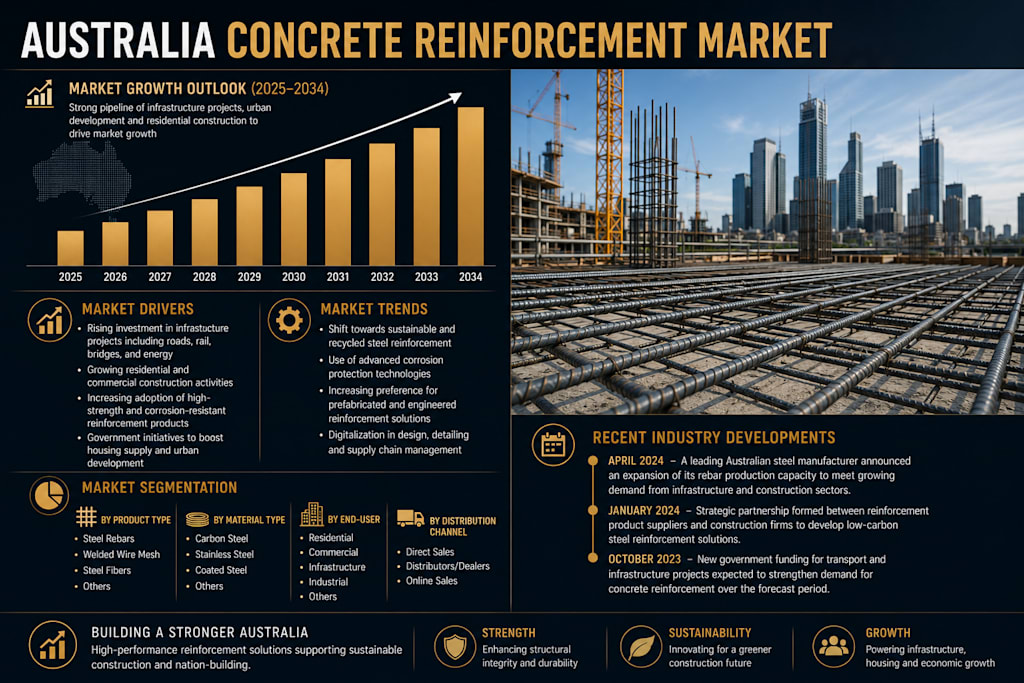
Australia’s construction and infrastructure ecosystem is entering a transformative phase, and the concrete reinforcement market is emerging as one of the biggest beneficiaries of this shift. According to IMARC Group, the Australia concrete reinforcement market reached a value of USD 158.3 million in 2025 and is projected to grow to USD 326.0 million by 2034, expanding at a CAGR of 8.11% during 2026–2034. The market’s rapid expansion reflects the country’s increasing investments in transport infrastructure, urban housing, renewable energy facilities, and modern construction technologies.
Concrete reinforcement products — including steel rebars, polypropylene fibers, steel fibers, basalt fibers, and advanced reinforcement systems — are becoming indispensable for large-scale infrastructure and commercial projects. Reinforced concrete remains central to roads, bridges, tunnels, industrial plants, airports, and high-rise developments because of its durability, strength, and long-term cost efficiency.
Australia’s growing focus on resilient infrastructure and sustainable urban expansion is also changing how reinforcement materials are designed and manufactured. Builders and contractors are increasingly seeking corrosion-resistant, lightweight, and environmentally sustainable reinforcement solutions that can withstand extreme weather conditions and support low-carbon construction goals.
At the same time, modular construction and prefabrication are reshaping supply chains across the industry. Reinforcement suppliers are adapting rapidly by producing precision-engineered reinforcement systems suitable for factory-built components and off-site construction models. This transition is creating a new generation of opportunities for material suppliers, manufacturers, and investors throughout the Australian construction ecosystem.
Request a Business Sample Report for Procurement & Investment Evaluation:
Why the Market Is Growing So Rapidly
One of the strongest growth drivers is Australia’s massive infrastructure modernization program. The federal government continues to allocate billions of dollars toward road, rail, airport, and public transport upgrades. IMARC highlights that the Australian Government allocated USD 17.1 billion for road and rail infrastructure in the 2025–26 Budget. Projects such as highway upgrades, regional road developments, and transport corridor expansions are significantly increasing demand for reinforced concrete systems.
Urban population growth is another major catalyst. Cities including Sydney, Melbourne, Brisbane, and Perth are witnessing rising residential and commercial construction activity as migration and urbanization intensify. Developers are increasingly constructing high-rise and mixed-use projects that require stronger reinforcement systems capable of handling vertical loads, safety standards, and long-term durability requirements. Reinforced concrete continues to serve as the backbone of these developments.
The expansion of renewable energy infrastructure is also transforming market dynamics. Australia’s push toward solar farms, wind energy projects, and battery storage facilities has created strong demand for heavy-duty reinforced concrete foundations and support systems. Wind turbines, substations, and energy storage facilities all require highly durable reinforcement materials capable of operating in remote and challenging environments.
Another key factor is the growing adoption of prefabrication and modular construction techniques. Factory-built construction components require highly precise reinforcement products such as welded wire fabrics, custom reinforcement cages, and engineered reinforcement grids. These methods reduce labor costs, shorten construction timelines, and improve quality control, making them increasingly attractive across both public and private sector projects.
Sustainability goals are further accelerating innovation within the industry. Builders and developers are exploring recycled steel, fiber-reinforced polymers, and corrosion-resistant reinforcement technologies to reduce environmental impact while improving structural performance. Green building certifications and sustainability regulations are encouraging manufacturers to invest in eco-friendly production processes and advanced reinforcement materials.
Segmentation Categories
Product Types:
• Steel Rebars
• Concrete Reinforcing Fibers
• Polypropylene Fibers
• Steel Fibers
• Basalt Fibers
• Others
Applications:
• Infrastructure
• Residential Construction
• Commercial Construction
• Industrial Construction
Regions:
• Australia Capital Territory & New South Wales
• Victoria & Tasmania
• Queensland
• Northern Territory & Southern Australia
• Western Australia
What the Opportunities Are
1. Renewable Energy Infrastructure Expansion
Australia’s renewable energy transition is creating substantial demand for reinforced concrete systems in solar farms, wind projects, and energy storage facilities. Suppliers specializing in corrosion-resistant and high-strength reinforcement materials are positioned for long-term growth.
2. Smart Cities and Transport Corridors
Government-backed transport modernization programs are increasing the need for durable reinforced structures across roads, tunnels, bridges, and railway networks. Long-term infrastructure spending provides predictable demand pipelines for manufacturers and contractors.
3. Modular and Off-Site Construction
Prefabricated construction is rapidly gaining traction due to faster project timelines and labor efficiency. Reinforcement companies that develop factory-ready and precision-engineered reinforcement products can secure a competitive advantage in this evolving segment.
4. Sustainable Construction Materials
The growing focus on low-carbon construction presents opportunities for recycled steel products, fiber-reinforced polymers, and sustainable reinforcement technologies. Companies aligned with environmental standards are likely to attract institutional and government-backed projects.
5. Mining and Industrial Facility Development
Australia’s mining and industrial sectors continue to expand, particularly in resource-rich regions. Heavy industrial facilities require reinforced concrete systems capable of supporting extreme operational loads and harsh environmental conditions.
6. Coastal Infrastructure Protection
Many Australian regions face high salinity and coastal exposure challenges. This is increasing demand for advanced reinforcement products with improved corrosion resistance and longer lifecycle performance.
7. Advanced Manufacturing and Automation
Automation in reinforcement manufacturing and digital fabrication technologies can improve production precision, reduce waste, and support large-scale infrastructure projects more efficiently. Companies investing in smart manufacturing systems could achieve stronger profitability and scalability.
Recent News & Developments in Australia Concrete Reinforcement Market
• January 2025: The Australian Government announced a USD 17.1 billion infrastructure allocation under the 2025–26 federal budget to support major rail and road projects nationwide. The investment includes highway modernization, regional transport upgrades, and urban connectivity initiatives across multiple states. Industry experts believe this funding package will significantly increase demand for reinforced concrete systems over the coming decade. The policy is also expected to accelerate procurement opportunities for domestic reinforcement manufacturers and suppliers.
• May 2025: Commonwealth Bank of Australia expanded its support for modular housing projects through a collaboration with prefabAUS aimed at improving financing accessibility for prefabricated homes. The initiative introduced revised lending frameworks that allow construction funding before homes are permanently attached to land. Industry participants expect the move to boost off-site construction adoption and increase demand for factory-engineered reinforcement systems. Several modular construction firms have already announced plans to scale production capacity in response.
• September 2025: Australia’s renewable energy sector recorded strong growth in utility-scale solar and wind farm development, driving increased demand for reinforced concrete foundations and structural supports. Multiple energy infrastructure projects across Queensland and Western Australia moved into active construction phases during the third quarter. Industry analysts reported rising procurement volumes for steel rebars and fiber reinforcement materials tied to energy transition projects. The expansion reflects Australia’s broader commitment to energy security and low-carbon infrastructure investment.
Why Should You Know About Australia Concrete Reinforcement Market?
The Australia concrete reinforcement market represents far more than a construction materials segment — it is becoming a critical pillar of the country’s economic modernization strategy. Infrastructure resilience, renewable energy expansion, urban housing demand, and sustainable construction goals are all converging to create long-term opportunities across the industry.
For investors, the sector offers exposure to multiple high-growth themes including smart infrastructure, energy transition, and advanced manufacturing. For construction companies and suppliers, evolving building methods and sustainability requirements are opening doors to innovation and product differentiation. Policymakers also view reinforced infrastructure as essential for supporting population growth, transportation efficiency, and climate resilience.
As Australia continues investing in future-ready infrastructure and cleaner development models, concrete reinforcement technologies will remain central to building safer, stronger, and more sustainable cities for decades to come.
About the Creator
Rashi Sharma
I am a market researcher.
Enjoyed the story? Support the Creator.
Subscribe for free to receive all their stories in your feed.
Comments
There are no comments for this story
Be the first to respond and start the conversation.