
Australia Commercial Vehicle Market: Powering Logistics, Infrastructure, and Economic Growth
Driven by e-commerce, infrastructure investment, and electrification, Australia’s commercial vehicle sector is accelerating into a new era

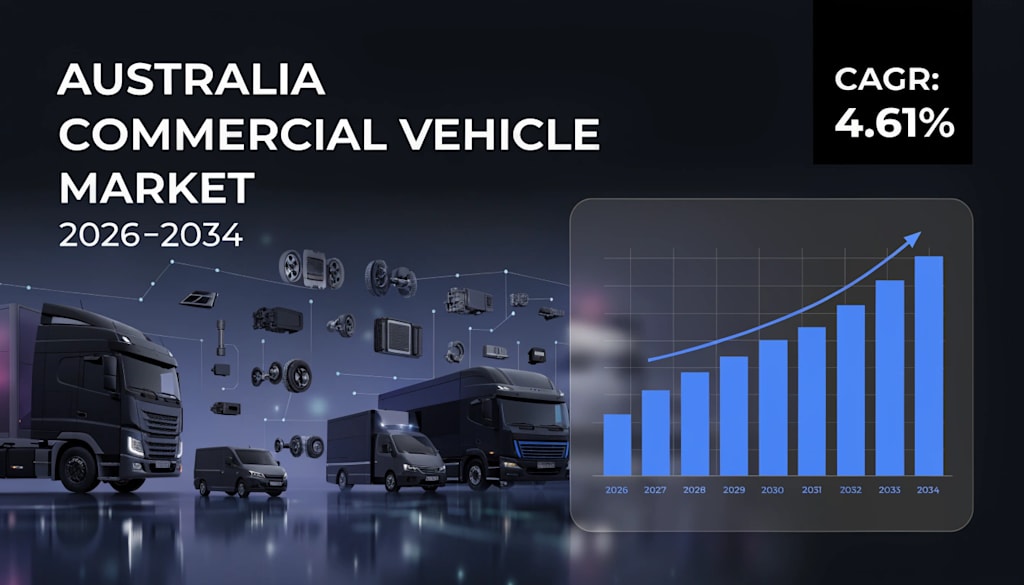
The Australia commercial vehicle market is gaining strong momentum as the backbone of the country’s logistics, construction, and industrial ecosystem. According to IMARC Group, the market was valued at USD 24.45 billion in 2025 and is projected to reach USD 39.01 billion by 2034, growing at a CAGR of 4.61% during 2026–2034.
This steady expansion reflects the increasing importance of commercial vehicles in enabling economic activity across vast geographies. From urban delivery vans supporting e-commerce to heavy-duty trucks powering mining operations, commercial vehicles are central to Australia’s supply chains and infrastructure development.
The market is also undergoing a structural shift. Traditional diesel-powered fleets continue to dominate, but the industry is gradually transitioning toward hybrid and electric vehicles. At the same time, digital technologies such as telematics and AI-driven fleet management are redefining efficiency, safety, and cost optimization across the sector.
Request a Business Sample Report for Procurement & Investment Evaluation:
Segmentation Categories:
• Vehicle Body Type: Buses, Heavy-Duty Commercial Trucks, Light Commercial Pick-Up Trucks, Light Commercial Vans
• Propulsion Type: Hybrid and Electric Vehicles (BEV, FCEV, HEV, PHEV), ICE (CNG, Diesel, Gasoline, LPG)
• Region: Australia Capital Territory & New South Wales, Victoria & Tasmania, Queensland, Northern Territory & Southern Australia, Western Australia
Why the Market Is Growing So Rapidly
One of the primary growth drivers is Australia’s large-scale infrastructure development. Government investments in roads, rail corridors, airports, and urban development projects are generating consistent demand for commercial vehicles. These projects require fleets of trucks, vans, and specialized vehicles for transporting materials, equipment, and labor, creating a strong multiplier effect across the market.
The mining and resource sector is another major contributor. Australia’s position as a global leader in mining—particularly in iron ore, lithium, and rare earth minerals—demands robust transport solutions. Commercial vehicles play a crucial role in connecting remote mining sites to processing facilities and export hubs, sustaining demand for heavy-duty trucks and utility vehicles.
E-commerce growth is reshaping logistics and driving demand for light commercial vehicles. Rising online shopping, same-day delivery expectations, and the expansion of urban fulfillment centers are increasing the need for efficient last-mile delivery solutions. Vans and pick-up trucks are becoming indispensable for navigating dense urban environments and meeting customer expectations.
Fleet modernization is also accelerating market growth. Businesses are increasingly upgrading their fleets to improve fuel efficiency, reduce emissions, and comply with regulatory standards. This includes adopting advanced safety systems, connected technologies, and fuel-efficient engines that enhance operational performance and reduce long-term costs.
Another key driver is the transition toward cleaner mobility. Government policies, corporate sustainability goals, and rising fuel costs are encouraging the adoption of hybrid and electric commercial vehicles. For instance, hybrid vehicle sales and plug-in hybrid adoption have surged significantly, reflecting growing acceptance of low-emission alternatives.
What the Opportunities Are
The Australia commercial vehicle market offers a wide range of strategic opportunities for businesses and investors:
• Electric Fleet Expansion: Growing demand for low-emission transport solutions presents significant opportunities in electric and hybrid commercial vehicles, particularly for urban logistics.
• Last-Mile Delivery Solutions: E-commerce-driven logistics opens opportunities for companies specializing in light commercial vehicles and delivery fleet services.
• Telematics and Fleet Management: Integration of AI, IoT, and data analytics into fleet operations can improve efficiency, reduce costs, and enhance safety, creating value-added service opportunities.
• Infrastructure-Linked Demand: Ongoing mega infrastructure projects ensure long-term demand for heavy-duty vehicles and specialized transport solutions.
• Regional Logistics Growth: Expansion of supply chains into regional and remote areas creates demand for durable and high-performance commercial vehicles.
• Aftermarket Services and Maintenance: Ageing fleets and increased vehicle usage create opportunities in servicing, spare parts, and maintenance solutions.
• Sustainable Transport Ecosystems: Companies investing in charging infrastructure, green logistics, and alternative fuels can capitalize on the shift toward sustainability.
Recent News & Developments in Australia Commercial Vehicle Market
• January 2025: The Australian government advanced the implementation of the New Vehicle Efficiency Standard, aimed at reducing emissions across the transport sector. This regulatory move encourages fleet operators to adopt fuel-efficient and low-emission commercial vehicles. It is expected to accelerate the transition toward hybrid and electric fleets nationwide.
• May 2025: A major logistics company placed an order for 30 heavy-duty electric trucks, marking one of the largest electric truck deployments in Australia. This investment reflects growing confidence in electric mobility and highlights the sector’s shift toward sustainable transport solutions. The move is expected to influence broader adoption among fleet operators.
• August 2025: Market data showed continued growth in commercial vehicle demand, driven by rising e-commerce activity and infrastructure expansion. Fleet operators reported increased procurement of light commercial vehicles to support last-mile delivery. This trend underscores the sector’s resilience and its critical role in supporting Australia’s evolving economy.
Why Should You Know About Australia Commercial Vehicle Market?
The Australia commercial vehicle market is more than just a transportation segment—it is a foundational pillar of the country’s economic engine. From enabling trade and logistics to supporting infrastructure and mining, it plays a vital role in keeping industries moving efficiently.
With steady growth, technological innovation, and a clear shift toward sustainability, the market presents strong opportunities for manufacturers, investors, and service providers alike. Understanding this sector offers valuable insight into how Australia is building a more connected, efficient, and future-ready economy—where mobility is not just about movement, but about enabling progress at scale.
About the Creator
Rashi Sharma
I am a market researcher.
Enjoyed the story? Support the Creator.
Subscribe for free to receive all their stories in your feed.
Comments
There are no comments for this story
Be the first to respond and start the conversation.