
Australia Catering Services Market 2026: Outsourcing Surge, Event Dining & Institutional Demand
How contract food service, workplace return and venue innovation are reshaping Australia's food-away-from-home ecosystem

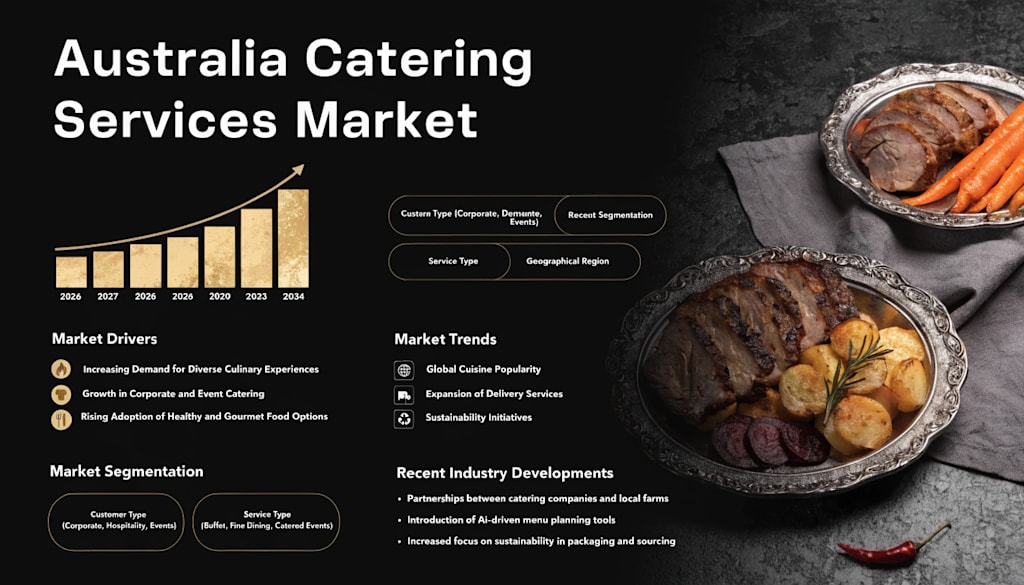
The Australia catering services market is expanding as Australian businesses, healthcare institutions, educational campuses and event-driven organisations increasingly outsource food service operations to professional providers. Catering services — spanning contract and non contractual models across industrial canteens, conference functions, school lunch programmes, hospital meal delivery and airline kitchens — are core elements of Australia's growing A$137 billion (2025) food service economy. According to IMARC Group, the market size reached USD 3.2 Billion in 2025 and is projected to reach USD 4.6 Billion by 2034, exhibiting a compound annual growth rate (CAGR) of 4.11% during 2026–2034.
The post pandemic recovery has reset catering demand. Corporate offices are reclaiming their workplace role, business events calendars are packed, and the healthcare aged care sector continues to expand. Combined with a rising appetite for personalised, nutrition aware and sustainable menus, contract and non contract caterers are reshaping how Australians eat when they are not at home.
What's Driving Market Growth?
Return to Office & Corporate Food Outsourcing. Australian corporations are moving beyond hybrid experimentation and into firmer workplace strategies. Average mandated office attendance rose to 3.64 days per week in 2025, anchoring predictable weekday demand for boardroom catering, canteens and internal events. The Corporate Catering Services industry grew at a 5.9% CAGR (2021–2026) to $7.1 billion, supported by sustained recovery in office footfall, rebounding business conferences and a wave of long term contract wins for major integrated operators serving mining, government and large corporate clients. This growth reflects a broader corporate shift: organisations now treat supplier managed workplace food as a talent retention, productivity and culture tool rather than a simple cafeteria expense.
Contractual & Non Contractual Model Expansion. The market is propelled by adoption of both contractual and non contractual catering models, driven by demand for assured, adaptable and innovative food options across different sectors. Contractual catering provides sustained quality, cost effectiveness and nutritional adherence, making it the preferred model for hospitals, universities and large employers. Non contractual services, meanwhile, are expanding consistently due to a surge in corporate events, private parties and conferences requiring short term, flexible food arrangements. The industry's capacity to pivot between long term agreements and event driven customisation makes it resilient and adaptive.
Tourism & Experiential Dining. Australia's food service market is projected to grow to US$130.4 billion by 2034 at a 4.07% CAGR, with rising tourism a major contributor. Tourists consistently seek local and international cuisines during travel, increasing footfall across restaurants, cafes and quick service outlets in major urban and coastal destinations. This trend is prompting caterers to enhance menu offerings, embrace multicultural cuisine and integrate dining with travel itineraries. Airports, hotels and event venues are upgrading in house catering experiences, with operators using food to differentiate their venues.
Health Conscious & Sustainable Menus. Plant based dishes, gluten free meals and lower sugar alternatives are no longer niche add ons. Healthcare and educational caterers are under pressure to deliver medically suitable and child friendly nutrition. ICC Sydney's 2025 menu collection introduced lower carbon options while maintaining exceptional quality, focusing on local and seasonal ingredients and Indigenous plants such as Kakadu plum, lemon myrtle and warrigal greens. Sustainable catering is not a trend — it is a baseline expectation.
Market Segmentation & Key Insights
By Service Type, the market is bifurcated into contractual catering service and non contractual catering service. Contractual models dominate due to their predictable revenue streams and long term client partnerships, but non contractual services are growing rapidly as events, functions and short notice occasions multiply.
By End User, major segments include industrial, hospitality, educational, healthcare, in flight and others. Each sector has distinct requirements: healthcare demands medically suitable meals, schools prioritise child friendly nutrition, the hospitality sector pursues high quality diverse menus, industrial clients focus on quick and cost effective workforce feeding, and the air segment requires innovative, compliant meal solutions. Contract caterers serving the resources and mining sector have grown especially strong via fly in fly out (FIFO) camps and remote site feeding.
By Region, key markets include Australia Capital Territory & New South Wales, Victoria & Tasmania, Queensland, Northern Territory & Southern Australia, and Western Australia.
What the Opportunities Are?
Smart Healthcare & Aged Care Catering. Australia's ageing population and the growing prevalence of chronic disease are generating demand for clinically tailored, texture modified and culturally sensitive meals. Opportunities exist for specialist health caterers who can blend medical requirements with food quality — particularly in rehabilitation, mental health and palliative settings.
AI Powered & Sustainable Kitchen Management. AI enabled food waste tracking systems such as Winnow Vision are being deployed to automatically track waste, identify patterns and reduce discard volumes. Caterers investing in smart kitchen analytics gain both cost savings and ESG credentials — a strong differentiator in competitive tenders for institutional contracts.
Indigenous & Native Ingredient Catering. First Nations foods are moving from curiosity to category. Indigenous commercial ventures are emerging, teaching young people to grow native plants and supply bush tucker to corporate catering clients and tourism operators. Caterers who build authentic native ingredient supply chains and train teams in Indigenous culinary knowledge will capture premium event, hotel and government contract opportunities.
Subscription & Workplace Meal Plans. As employers seek to support staff wellbeing, caterers can introduce employee subsidised meal plans, nutrition coaching and after hours dinner bundles for working parents — expanding beyond traditional 9 to 5 canteens.
Cloud Kitchens & Virtual Catering. On demand and cloud kitchen models are gaining traction as capital efficient, delivery focused operations. Virtual catering brands can test concepts and scale quickly without physical dine in footprints, serving office towers, events and private functions through partnership models.
Recent News and Developments in Australia Catering Services Market
January 2025: dnata Catering & Retail announced a A$50 million expansion of its Melbourne Airport facility to over 16,000m². Set to open in September 2026, it will become Victoria's largest airline catering centre, producing 25 million meals per annum and serving 20 airlines on more than 60,000 flights per year.
September 2024: The Catering Club launched in Sydney with modern, end to end catering for corporate functions, offering capacity for 1,500 guests, customisable menus and locally sourced fresh produce.
April 2024: Perth Inflight Catering was rebranded as Foodfolk Australia, increased staff and production, acquired key airline contracts, and announced a new facility to improve operational efficiency.
April 2024: National Media acquired Australian foodservice and hospitality events such as Foodservice Australia and Australian Chef of the Year, bolstering its Food and Beverage Group to serve Australia's $222 billion market.
April 2026: Melbourne Royal appointed Gema Group as the new catering partner for Melbourne Showgrounds and the Melbourne Royal Show, bringing extensive experience as one of Australia's leading catering and hospitality providers.
2025: The R&CA Industry Benchmarking Report provided a comprehensive snapshot of the sector, drawing insights from restaurants, cafés and catering businesses nationwide, highlighting profitability trends, cost pressures and operating margins.
Why Should You Know About Australia Catering Services Market?
You should know about this market because it illustrates how workplace transformation, healthcare expansion and consumer experience demand intersect to drive steady growth in a business critical segment of the hospitality ecosystem. Catering is no longer just about delivering food — it is about supporting workforce productivity, enabling patient recovery, creating memorable event moments, and improving nutritional outcomes across schools and aged care facilities.
For investors, the catering services market offers exposure to a stable growth industrial hospitality category anchored in corporate outsourcing, rising healthcare investments and a rebound in domestic and international travel. The projected CAGR of 4.11% reflects consistent confidence in away from home eating, contract renewals and the inelastic nature of institutional food provision.
For hospitality operators, food service directors, procurement leads and technology partners, understanding catering segmentation, end user requirements, Indigenous ingredient integration and sustainability analytics helps shape intelligent investment decisions, tender strategies and service offerings that deliver measurable quality, compliance and financial outcomes.
In essence, the Australia catering services market captures how institutional efficiency, nutritional science and experiential dining converge — making it a compelling area for innovators, investors and organisations seeking smarter approaches to feeding Australians beyond their own kitchens.
About the Creator
Thomas
Market Research Analyst | Industry Trends & Forecasting | Turning market data into clear, actionable business insights across global sectors.
Enjoyed the story? Support the Creator.
Subscribe for free to receive all their stories in your feed.
Comments
There are no comments for this story
Be the first to respond and start the conversation.