
Australia Catalyst Market 2026: Emission Reduction Technologies, Industrial Decarbonization & Clean Energy Applications Driving Growth
How environmental regulations, petroleum refining demand, and sustainable fuel development are transforming the Australia catalyst industry

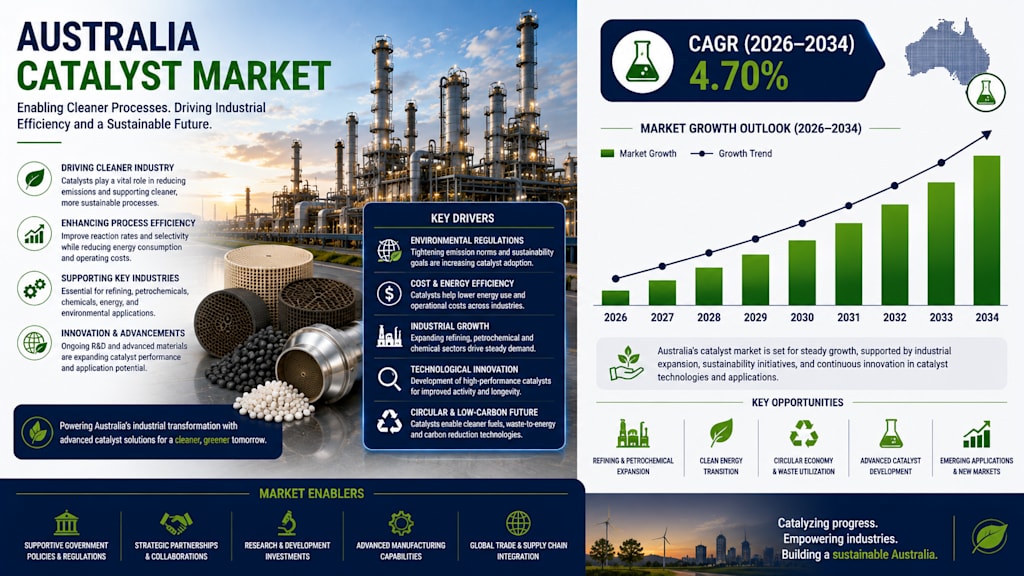
Australia Catalyst Market Overview
The Australia catalyst market is an important segment of the country’s chemical manufacturing, energy, environmental, and industrial processing sectors, encompassing heterogeneous catalysts, homogeneous catalysts, catalyst regeneration services, emission control catalysts, refining catalysts, and advanced materials used across various industrial applications.
According to IMARC Group, the Australia catalyst market size reached USD 1.22 Million in 2025 and is projected to reach USD 1.84 Million by 2034, exhibiting a compound annual growth rate (CAGR) of 4.70% during 2026–2034.
The market is witnessing steady growth driven by stringent environmental regulations, increasing demand for emission control technologies, expansion of petroleum refining activities, growing investments in clean energy projects, and rising adoption of advanced catalytic solutions across industrial manufacturing sectors.
Key Market Drivers
Stringent Environmental Regulations and Emission Standards
Australia’s commitment to reducing industrial emissions and improving environmental sustainability is accelerating demand for advanced catalyst technologies across manufacturing, transportation, and energy industries. New vehicle efficiency standards and tighter emission regulations are encouraging the adoption of sophisticated catalytic systems.
Expansion of Petroleum Refining Operations
Catalysts play a critical role in fluid catalytic cracking, hydrocracking, hydrotreating, and refining processes that convert crude oil into high-value fuels and petrochemical products. Ongoing refinery modernization efforts continue supporting catalyst demand.
Growth of Industrial Decarbonization Initiatives
Mining, chemical processing, and heavy industrial sectors are increasingly implementing catalyst-based technologies to reduce greenhouse gas emissions and improve operational sustainability.
Increasing Investments in Sustainable Fuel Production
Emerging projects focused on hydrogen production and sustainable aviation fuel development are creating new opportunities for advanced catalyst applications across Australia’s clean energy ecosystem.
Rising Adoption of Catalyst Regeneration Technologies
Industries are increasingly utilizing catalyst regeneration solutions to extend catalyst lifecycles, reduce operating costs, minimize waste generation, and improve overall process efficiency.
Request a Sample Report with the Latest 2026 Data & Forecasts
What the Opportunities Are
Growth of Hydrogen Economy Applications
Australia’s growing focus on hydrogen production, storage, and export infrastructure is creating significant opportunities for catalyst manufacturers supplying clean energy technologies.
Expansion of Sustainable Aviation Fuel Projects
The increasing development of sustainable aviation fuel (SAF) production facilities is generating demand for specialized catalytic solutions designed to improve fuel conversion efficiency and reduce environmental impact.
Increasing Demand for Emission Control Technologies
Industrial operators are investing in advanced catalytic systems capable of reducing nitrogen oxides, greenhouse gases, and other pollutants while meeting evolving environmental compliance requirements.
Development of Circular Economy Solutions
Catalyst recycling, regeneration, and recovery technologies are creating opportunities to improve resource utilization and reduce dependence on newly sourced raw materials.
Growth of Advanced Chemical Manufacturing
Expanding chemical production, specialty materials manufacturing, and petrochemical processing activities continue generating demand for innovative catalyst technologies across multiple industrial sectors.
Recent News and Developments
May 2026 : The Australia catalyst market continued expanding as industrial operators increasingly adopted advanced catalytic solutions to support emissions reduction objectives, operational efficiency improvements, and environmental compliance initiatives.
May 2026 : Catalyst manufacturers strengthened investments in research and development activities focused on improving catalyst performance, durability, selectivity, and sustainability across industrial applications.
April 2026 : Demand for catalyst technologies supporting clean energy projects continued increasing as Australia accelerated investments in hydrogen production, renewable fuels, and industrial decarbonization programs.
March 2026 : Petroleum refining remained a major catalyst application segment as refineries increasingly utilized advanced catalyst systems to improve product yields, enhance fuel quality, and comply with environmental regulations.
February 2026 : Catalyst regeneration services gained further momentum as industrial facilities focused on extending catalyst lifecycles, reducing operational expenses, and improving sustainability performance.
January 2026 : Emission reduction initiatives across mining, manufacturing, and chemical processing industries continued supporting the deployment of advanced catalytic technologies for pollution control and process optimization.
December 2025 : Industrial sustainability projects increasingly incorporated catalyst-based technologies to improve energy efficiency, lower carbon emissions, and support long-term environmental targets.
November 2025 : Research institutions, industrial companies, and technology providers expanded collaborations focused on developing next-generation catalysts for hydrogen production, carbon capture, and renewable fuel applications.
2025–2026 (Market Trend) : The Australia catalyst market is being shaped by environmental regulations, industrial decarbonization strategies, petroleum refining modernization, hydrogen economy development, and sustainable fuel innovation. Companies are increasingly investing in catalyst regeneration technologies, advanced materials research, emission control systems, and clean energy applications to strengthen competitiveness and improve environmental performance. At the same time, raw material costs, supply chain constraints, regulatory compliance requirements, and technological complexity continue influencing market dynamics across the industry.
Why You Should Know About the Australia Catalyst Market?
The Australia catalyst market is becoming an increasingly important pillar of the country’s industrial manufacturing, environmental protection, energy transition, and clean technology ecosystem.
With projected growth from USD 1.22 Million in 2025 to USD 1.84 Million by 2034, the market demonstrates stable long-term potential supported by industrial sustainability initiatives, tightening environmental regulations, growing clean energy investments, and increasing demand for advanced process technologies.
As catalyst manufacturers continue investing in hydrogen technologies, emission control solutions, catalyst regeneration systems, and sustainable fuel applications, the sector is expected to play a critical role in supporting Australia’s industrial competitiveness, energy transition, and long-term environmental objectives.
About the Creator
Amyra Singh
Market research analyst who loves spotting patterns, digging into data, and turning insights into strategies that help brands grow and stay ahead of the curve.
Enjoyed the story? Support the Creator.
Subscribe for free to receive all their stories in your feed.
Comments
There are no comments for this story
Be the first to respond and start the conversation.