
Australia Care Management Solution Market 2026: Digital Integration, Patient-Centric Models & AI-Driven Analytics
How government health interoperability funding, aged care digital mandates and cloud-based platforms are transforming Australia’s healthcare coordination landscape

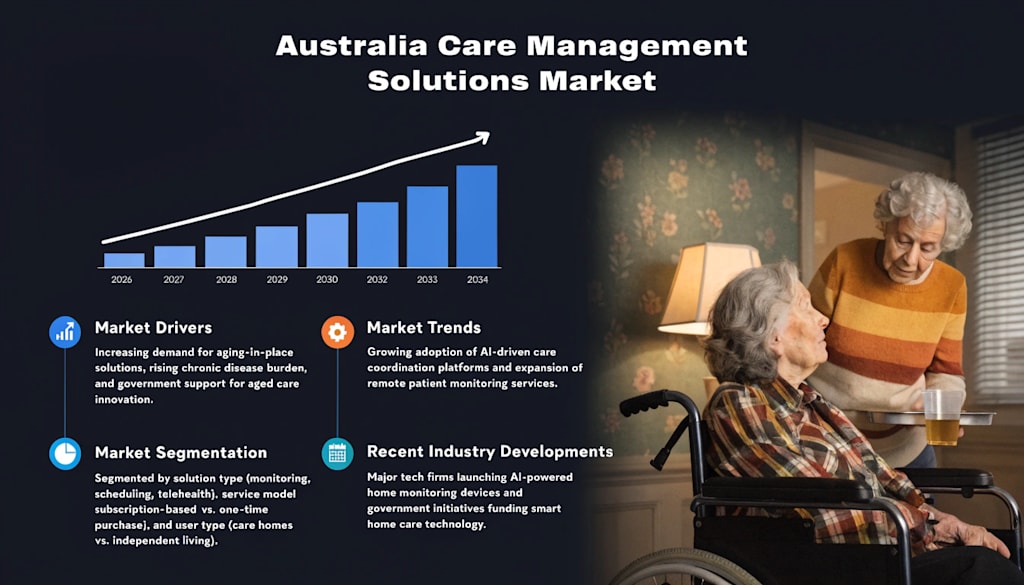
The Australia care management solution market is expanding at a strong pace as healthcare providers, payers and government bodies increasingly prioritise coordinated, digitally integrated and outcomes-focused patient care. Care management solutions – including cloud-based software platforms, AI powered analytics tools, remote patient monitoring systems and interoperability engines – are deployed across hospitals, primary care networks, aged care facilities and community health settings to streamline clinical workflows, reduce avoidable admissions and enable value based care delivery. According to IMARC Group, the market size reached USD 523.04 Million in 2025 and is projected to reach USD 1,168.49 Million by 2034, exhibiting a robust compound annual growth rate (CAGR) of 8.37% during 2026–2034. As Australia’s healthcare system confronts an ageing population, rising chronic disease burden and escalating consumer expectations for digital access, intelligent care coordination platforms are becoming central to the future of health delivery.
What’s Driving Market Growth?
Government Investment in Healthcare Interoperability and Digital Infrastructure. Substantial government funding for telehealth, electronic health record (EHR) integration and data-sharing platforms is accelerating adoption of integrated care management software. In aged care, the Department of Health, Disability and Ageing released the second year action plan for its Aged Care Data and Digital Strategy 2024–2029, outlining AI pilots, virtual nursing trials and secure data sharing frameworks to support the new Aged Care Act 2024. Across NSW Health, more than 450 artificial intelligence initiatives are currently being explored to respond to rising demand and an ageing population, with a strategic focus on redefining care models through digitally enabled workflows.
Rapid Adoption of Cloud Based and AI Powered Platforms. Healthcare organisations across Australia are shifting from on premise legacy systems to cloud based care management solutions that enable real time data sharing, coordinated care plans and remote patient monitoring. A recent flash survey found that 72% of Australian hospitals moved at least one core application to a sovereign or hybrid cloud in 2025, up from 61% in 2024. Meanwhile, 57% reported piloting AI enabled tools in decision support, documentation or revenue cycle processes. AI integration is transforming care management: predictive analytics tools now help identify at risk patients, forecast hospital readmission risks and automate administrative workflows, freeing healthcare professionals for direct patient contact.
Surge in Chronic Disease Prevalence and Ageing Population. The growing burden of chronic diseases – including diabetes, cardiovascular conditions and respiratory illness – together with Australia’s rapidly ageing population, are driving sustained demand for coordinated, long term care management. Healthcare providers increasingly rely on integrated software to manage complex patient needs, reduce hospital readmissions and enhance patient engagement through personalised care plans and remote monitoring tools.
Major Aged Care and NDIS Reforms Fueling Digital Adoption. The implementation of the new Aged Care Act 2024 (effective November 1, 2025) and the launch of the Support at Home programme have created urgent demand for digital systems capable of real time data capture, transparent reporting and interoperability. Peak body Ageing Australia has called for up to $600 million in ICT investment to lift providers into compliance, underscoring the scale of digital transformation underway. Similarly, the National Disability Insurance Scheme (NDIS) continues to drive adoption of specialised care management platforms, with providers increasingly switching to all in one solutions for rostering, billing and compliance. Notably, cloud ERP provider Wiise introduced Wiise for NDIS in November 2025, featuring direct claims submission to the National Disability Insurance Agency, automated invoice processing and enterprise grade audit trails.
Market Segmentation & Key Insights
By Type, the market is bifurcated into software and services. Software constitutes the largest revenue generating segment, driven by growing demand for cloud based care coordination platforms and AI enhanced analytics modules.
By Delivery Mode, platforms are segmented into cloud based and web based systems and on premises solutions. Cloud based deployment dominates, favoured for its scalability, lower upfront capital requirements and ability to support remote access and real time updates. The shift is being accelerated by government interoperability mandates and the need for secure multi site data sharing.
By Application, the market covers chronic care management, disease management and utilisation management. Chronic care management holds the largest share, reflecting the need for ongoing coordination of patients with long term conditions across primary, acute and community settings.
By End User, the market includes healthcare providers (hospitals, aged care facilities, primary care networks), healthcare payers (insurers, government schemes) and others. Healthcare providers represent the dominant segment, driven by hospital digital transformation initiatives and community based care expansion.
By Region, major markets include New South Wales & ACT, Victoria & Tasmania, Queensland, Northern Territory & South Australia and Western Australia. NSW and ACT lead, reflecting the concentration of major public hospital networks, digital health investment and aged care infrastructure in Sydney and Canberra.
What the Opportunities Are?
AI Powered Clinical Decision Support and Predictive Analytics. With the number of Australians aged 80+ projected to rise significantly by 2032, AI enabled care management platforms that flag patient deterioration, predict sepsis risk and prioritise medical imaging scans represent a major growth frontier. eHealth NSW reports that early clinical studies suggest AI based prioritisation could significantly improve turnaround times for urgent cases, creating strong demand for intelligent analytics tools.
Cloud Based and Hybrid Care Coordination Platforms. The ongoing migration from on premise systems to cloud based platforms creates substantial opportunity for vendors offering sovereign cloud solutions that comply with Australian data residency requirements. A 2025 Black Book survey found Oracle Health, InterSystems and Microsoft Azure are the top ranked vendors for public hospital scalability, while private hospitals favour Personify Care, CareMonitor and Episoft for measurable ROI and patient experience improvement.
Integrated NDIS and Aged Care Management Solutions. The NDIS and aged care sectors continue to undergo significant digital maturation. AlayaCare’s acquisition of Nightingale Software in late 2025 (expanding its ANZ aged care footprint to approximately 30% of the Australian home care market) and the launch of all in one platforms such as LAMA Care, HuGo and DayspringCare signal strong demand for purpose built, regulation ready software. Providers that embed direct NDIA claims processing, real time billing validation and automated compliance reporting will capture significant market share.
Remote Patient Monitoring and Hospital in the Home Solutions. The Southern NSW Local Health District’s December 2025 rollout of a digitally enabled Hospital in the Home programme – using wearable cardio respiratory devices and AI powered clinical dashboards from Philips Australia – demonstrates the viability of virtual care models. Such programmes free hospital beds, improve patient recovery and reduce administrative burden. Three in four Australian healthcare professionals lose patient facing time due to incomplete or inaccessible data, representing a clear pain point that integrated RPM solutions can address.
Interoperability and My Health Record Integration. With 68% of hospitals citing My Health Record integration as their top interoperability priority, vendors offering seamless API connectivity to Australia’s national EHR infrastructure are well positioned for growth. The government’s push for business to government API expansion for provider reporting further reinforces this demand.
Recent News and Developments in Australia Care Management Solution Market
August 2025: Black Book Research named Australia’s top healthcare IT vendors at HIC 2025. Oracle Health, InterSystems and Microsoft Azure led for public hospital scalability, while Personify Care, CareMonitor and Episoft were favoured by private hospitals for patient experience and ROI. Australian innovators Heidi Health, DC2Vue and CareMonitor were noted for agility in responding to evolving government digital health priorities.
October 2025: AlayaCare entered an agreement to acquire home care and NDIS software provider Nightingale. The combined organisation will offer expanded offerings across NDIS and aged care, with AlayaCare now serving approximately 30% of the Australian home care market.
November 2025: Cloud ERP provider Wiise introduced Wiise for NDIS, featuring direct claims submission to the National Disability Insurance Agency, split invoicing across funding sources, enterprise grade audit trails and real time billing validation against the NDIA product catalogue.
November 2025: Australia’s new rights based, person centred Aged Care Act 2024 came into force, replacing the 1997 legislation and aligning with the launch of the Support at Home programme. Key digital systems – including the Government Provider Management System Registered Provider Portal – went live on day one, supporting over 1.5 million older Australians.
December 2025: Seven Australian firms – including care management vendor Lumary, aged care platform Mable, oncology information system developer Magentus and AI powered diagnostic platform Harrison.ai – were named on Time magazine’s list of the world’s best healthtechs for 2025. Lumary, which provides care management solutions for the disability and aged care sectors, was classified as “very high” in the health information and management category.
December 2025: Southern NSW Local Health District began rolling out its Hospital in the Home programme, using a remote patient monitoring system from Philips Australia and Singapore based Respiree. The service equips patients with a wearable cardio respiratory device enabling continuous vital sign monitoring, with AI algorithms flagging deterioration and a clinical command centre dashboard supporting multidisciplinary care teams.
May 2026: Australia’s Department of Health, Disability and Ageing published the second year action plan for the Aged Care Data and Digital Strategy 2024–2029. The plan includes virtual nursing trials in residential aged care, ePrescribing enablement, expansion of the KeepAble wellness tool, AI consultation pilots for care and rehabilitation plans, and continued work on a national aged care data governance framework.
Why Should You Know About Australia Care Management Solution Market?
You should know about this market because it illustrates how government interoperability mandates, ageing population pressures and technological innovation intersect to create strong growth opportunities in a mission critical segment of Australia’s healthcare landscape. Care management solutions are no longer just administrative tools – they are intelligent platforms that help clinicians deliver personalised, preventative and cost effective care across hospitals, aged care homes, disability services and community settings.
For investors, the care management solution market offers exposure to a high growth health technology category anchored in sustained public and private investment in digital health infrastructure, the accelerating shift to value based care and the rapid adoption of AI enabled analytics. The projected CAGR of 8.37% reflects strong confidence in adoption trends, technological differentiation and recurring revenue opportunities tied to software subscriptions, cloud hosting and professional services.
For healthcare executives, aged care providers, NDIS organisations, technology partners and policy planners, understanding care management solution segmentation, interoperability priorities, AI integration strategies and regulatory drivers helps shape intelligent investment decisions, procurement roadmaps and system designs that deliver measurable patient outcomes and operational efficiency.
In essence, the Australia care management solution market captures how digital coordination, clinical intelligence and patient centred reform converge – making it a compelling area for innovators, investors and organisations seeking smarter approaches to healthcare delivery, population health management and sustainable care systems.
About the Creator
Thomas
Market Research Analyst | Industry Trends & Forecasting | Turning market data into clear, actionable business insights across global sectors.
Enjoyed the story? Support the Creator.
Subscribe for free to receive all their stories in your feed.
Comments
There are no comments for this story
Be the first to respond and start the conversation.