
Australia Carbon Credit Market 2026: Net-Zero Commitments, Emissions Trading & Sustainability Investments Driving Growth
How climate policies, corporate decarbonization strategies, and renewable energy projects are transforming the Australia carbon credit industry

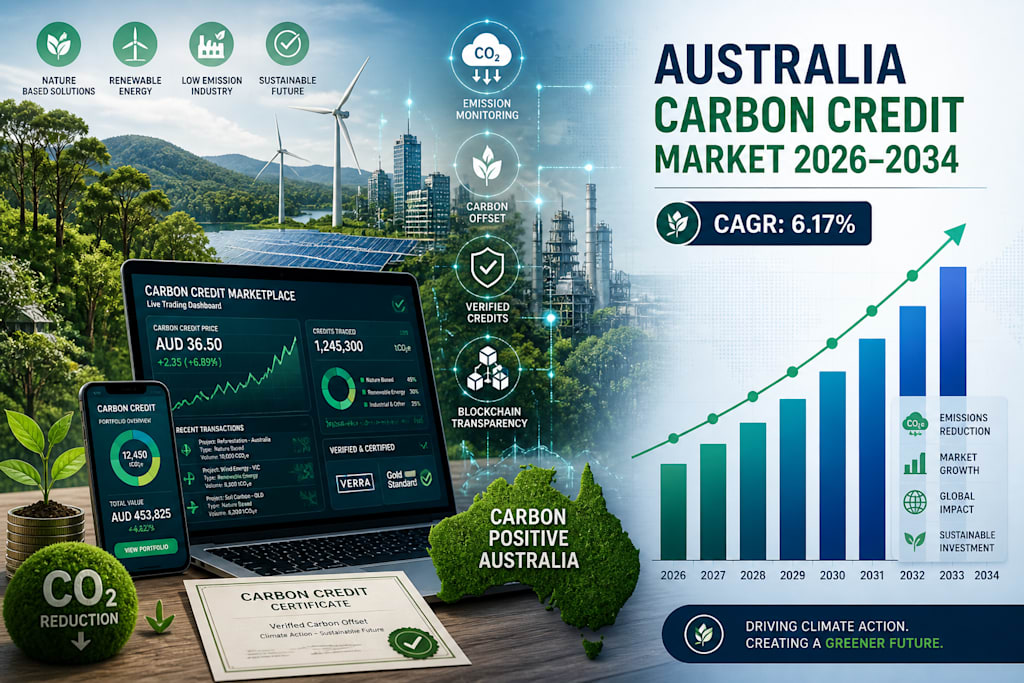
Australia Carbon Credit Market Overview
The Australia carbon credit market is an expanding segment of the country’s environmental and sustainability economy, involving tradable certificates that represent verified reductions or removals of greenhouse gas emissions. Carbon credits are widely used by businesses, governments, and organizations to offset emissions and support climate action initiatives.
According to IMARC Group, the Australia carbon credit market size reached USD 19.5 Million in 2025 and is projected to reach USD 33.3 Million by 2034, growing at a compound annual growth rate (CAGR) of 6.17% during 2026–2034.
The market is witnessing steady growth driven by increasing corporate net-zero commitments, rising adoption of emissions reduction programs, expansion of renewable energy projects, and growing government support for carbon trading and sustainability initiatives.
Key Market Drivers
Rising Corporate Net-Zero Commitments
Businesses across Australia are increasingly investing in carbon credits to offset operational emissions and achieve sustainability and ESG targets.
Expansion of Renewable Energy Projects
The growing deployment of solar, wind, and clean energy infrastructure is contributing to increased carbon offset generation and trading activities.
Government Policies Supporting Emissions Reduction
Australian climate regulations and emissions reduction initiatives are encouraging participation in carbon markets and environmental credit programs.
Increasing Focus on Environmental Sustainability
Organizations and consumers are prioritizing low-carbon operations and environmentally responsible business practices, supporting demand for verified carbon credits.
Growth of Voluntary Carbon Markets
The voluntary carbon offset market is expanding as companies seek flexible solutions for managing carbon footprints and enhancing sustainability credentials.
Request a Sample Report with the Latest 2026 Data & Forecasts
What the Opportunities Are
Expansion of Nature-Based Carbon Projects
Reforestation, soil carbon management, and biodiversity conservation initiatives are creating opportunities for carbon credit generation.
Growth of Carbon Capture and Storage Technologies
Advanced carbon capture, utilization, and storage (CCUS) technologies are supporting the development of new carbon offset solutions.
Increasing Investment in Sustainable Agriculture
Agricultural carbon farming projects are emerging as important contributors to carbon credit supply and rural sustainability initiatives.
Development of Digital Carbon Trading Platforms
Blockchain, AI-powered verification systems, and digital marketplaces are improving transparency and efficiency in carbon credit trading.
Rising Demand for International Carbon Offsets
Global organizations are increasingly seeking high-quality Australian carbon credits to support international decarbonization strategies.
Recent News and Developments
May 2026: The Australia carbon credit market continues expanding as demand for Australian Carbon Credit Units (ACCUs) rises across industrial, energy, and agricultural sectors. Australia’s biofuel and low-carbon fuel industries are increasingly advocating for stronger government mandates to support emissions reduction initiatives and carbon offset adoption. Industry groups stated that domestic biofuel facilities are currently operating at only 38% capacity but could increase output to nearly 600 million litres annually if stronger low-carbon fuel policies are implemented.
May 2026: Institutional investment in carbon farming and soil carbon projects is accelerating across Australia. Loam Bio’s CarbonBuilder technology became the first broadacre cropping system in Australia to generate soil carbon ACCUs on active farmland. A New South Wales grain farm using the technology across 880 hectares reportedly generated around AUD 200,000 worth of ACCUs, with the farmer planning to expand the project to the entire 1,600-hectare property after recording higher crop yields and improved soil quality.
April 2026: Australia’s carbon credit market is increasingly influenced by debates surrounding land use and food security. Agricultural groups and policymakers raised concerns regarding the rapid expansion of carbon farming projects on productive agricultural land. Industry analysis estimated that carbon sequestration activities could generate up to AUD 9 billion annually by 2050, although critics warned that excessive conversion of farmland into carbon offset projects may affect long-term food production capacity.
March 2026: The Australia carbon credit market reached approximately USD 19.5 million in 2025, supported by the reformed Safeguard Mechanism, which imposes mandatory annual emissions baseline reductions on Australia’s largest industrial emitters. ACCU issuances reached a record 21.64 million units in 2025, representing a 15% year-on-year increase from 18.78 million units in 2024. Compliance-related purchases accounted for approximately 62.3% of total market demand, reflecting growing regulatory-driven offset requirements.
February 2026: Nature-based sequestration projects remained the dominant source of ACCU generation in Australia. Removal and sequestration projects accounted for approximately 48.6% of total market share in 2025, led by human-induced regeneration (HIR), soil carbon, environmental planting, and savanna fire management initiatives across New South Wales, Queensland, and Northern Territory rangelands.
January 2026: Corporate and institutional participation in Australia’s carbon credit ecosystem continued strengthening. The Clean Energy Finance Corporation and La Caisse jointly launched the AUD 250 million Meldora agricultural and carbon platform, while GreenCollar established a new AUD 100 million environmental plantings ACCU fund focused on nature-based sequestration projects. Major corporations including Qantas, Rio Tinto, and BHP also expanded long-term ACCU procurement strategies linked to ESG and net-zero commitments.
January 2026: Australia’s industrial sectors increasingly integrated carbon credits into decarbonisation strategies. Santos received approximately 614,133 ACCUs for verified emissions reductions achieved at its Moomba carbon capture and storage project between September 2024 and March 2025, highlighting the growing role of industrial carbon capture technologies within Australia’s compliance-grade carbon credit supply.
2025–2026 (market trend): The Australia carbon credit market is being shaped by tightening emissions regulations, institutional investment in carbon farming, rising ESG disclosure requirements, and increasing demand for high-integrity carbon offsets. Digital measurement and verification infrastructure upgrades are improving ACCU transparency and market traceability, while Indigenous-led savanna fire management and soil carbon projects continue expanding across regional Australia. At the same time, concerns surrounding carbon credit integrity, agricultural land diversion, and long-term offset quality remain central issues influencing policy and investment discussions across the sector.
Why You Should Know About the Australia Carbon Credit Market?
The Australia carbon credit market is becoming a vital component of the country’s transition toward a low-carbon and sustainable economy.
With projected growth from USD 19.5 Million in 2025 to USD 33.3 Million by 2034, the market demonstrates solid expansion potential driven by corporate climate commitments, renewable energy growth, and increasing environmental awareness.
As businesses and governments continue prioritizing emissions reduction, sustainability investments, and climate resilience, carbon credits are expected to play a crucial role in supporting Australia’s long-term decarbonization objectives.
About the Creator
Amyra Singh
Market research analyst who loves spotting patterns, digging into data, and turning insights into strategies that help brands grow and stay ahead of the curve.
Enjoyed the story? Support the Creator.
Subscribe for free to receive all their stories in your feed.
Comments
There are no comments for this story
Be the first to respond and start the conversation.