
Australia Bioreactors Market: Precision Fermentation, Sovereign Manufacturing & Single Use Revolution
How a $22.7bn government catalyst, a 40% cost advantage for single use systems, and AUD 134.5m viral vector infrastructure are driving a 9.96% CAGR toward a $413m market by 2034

The Australia bioreactors market is emerging from a prolonged period of underinvestment into a nationally strategic, high growth segment of the broader biopharmaceutical manufacturing ecosystem. Bioreactors — encompassing single use and multi use systems, stirred tank, rocking and perfusion varieties — are deployed across the production of monoclonal antibodies, recombinant proteins, viral vectors for cell and gene therapy, mRNA based therapeutics, and precision fermentation products that are set to transform Australia’s agricultural and industrial base.
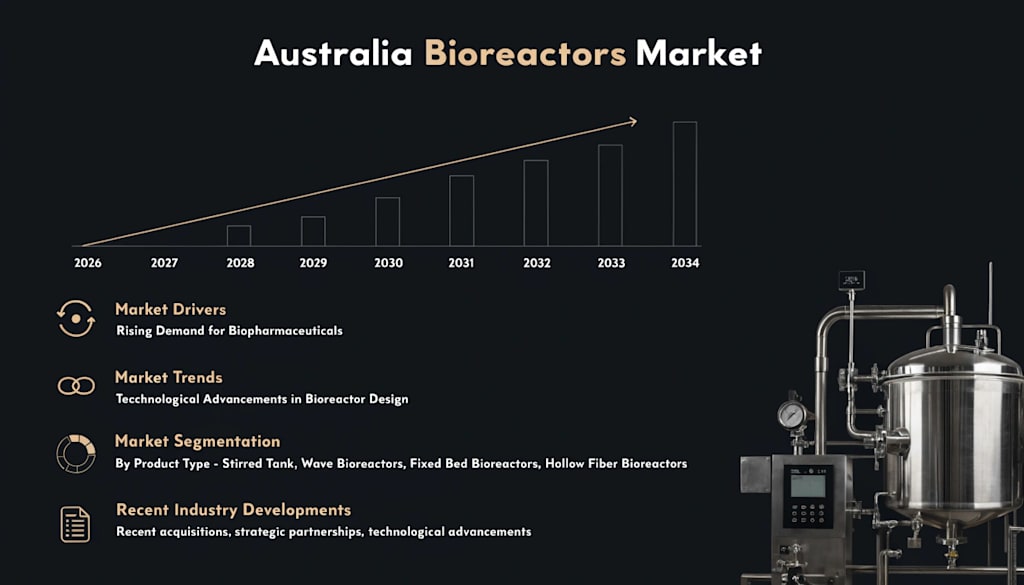
According to IMARC Group, the market size reached USD 175.93 Million in 2025 and is projected to reach USD 413.31 Million by 2034, exhibiting a robust compound annual growth rate (CAGR) of 9.96% during 2026–2034. The market is defined by a strategic bifurcation: large scale commercial biomanufacturing for established modalities leans toward stainless steel or hybrid systems for long term cost control, while the rapidly growing cell and gene therapy (CGT) and vaccine segments are almost exclusively served by single use bioreactors due to their flexibility and reduced cross contamination risk. As the nation works to close its first of a kind manufacturing gap and the federal government channels tens of billions into sovereign manufacturing, bioreactors have become the physical heart of Australia’s ambition to become a regional biomanufacturing hub.
What's Driving Market Growth?
Unprecedented Government Investment in Sovereign Biopharmaceutical Manufacturing. The most powerful growth driver is the Australian Government’s historic, multi year commitment to building domestic manufacturing capacity. Through policy initiatives such as the Medical Research Future Fund, the Biomedical Translation Fund, and the National Reconstruction Fund, substantial funding is being directed toward industrial infrastructure, clinical trial capabilities, and commercialisation pathways for novel medications. These initiatives directly address the supply chain vulnerabilities exposed during the COVID 19 pandemic and the dangers associated with over reliance on overseas manufacturing. In January 2025, the Medical Research Future Fund allocated AUD 35.7 million specifically to improve clinical trial and industrial infrastructure nationwide, targeting early stage development capacity and aiming to attract global pharmaceutical interest while supporting the growth of Australia's contract development and manufacturing organisation (CDMO) capabilities. State governments are complementing federal initiatives with targeted programs supporting regional biomanufacturing hubs, skills development and technology adoption, creating an enabling environment for bioreactor manufacturers and end users.
Explosive Adoption of Single Use Bioreactor Systems. Single use bioreactors are experiencing rapid and widespread adoption across Australia's biopharmaceutical manufacturing sector, driven by compelling operational and economic advantages. By eliminating the need for lengthy cleaning and sterilising processes between manufacturing batches, these disposable solutions dramatically shorten turnaround times and reduce the risk of cross contamination. The capital investment requirements for single use systems are approximately 40 percent lower compared to traditional stainless steel bioreactors, making them particularly attractive for contract manufacturing organisations and emerging biotechnology companies with limited infrastructure budgets. Energy and water consumption are reduced by 45 50 percent, aligning with sustainability objectives while delivering measurable cost savings. Single use bioreactors captured approximately 80 percent of the stirred tank bioreactor segment in 2024, driven by their advantages in reducing contamination risks, lowering capital investment and decreasing resource consumption. These systems are particularly favoured by contract development and manufacturing organisations due to operational flexibility and reduced turnaround times between batches. The ability to rapidly switch between different cell lines and production processes without extensive facility modifications provides unprecedented manufacturing agility, enabling Australian biomanufacturers to service diverse client requirements efficiently.
Cell and Gene Therapy Infrastructure Expansion. Australia is experiencing significant expansion in cell and gene therapy manufacturing infrastructure, creating specialised demand for bioreactor systems capable of supporting these advanced therapeutic modalities. Cell and gene therapies require highly controlled cultivation environments with precise monitoring and control of multiple parameters including dissolved oxygen, pH, temperature, nutrient concentrations and metabolite accumulation. These therapies often involve production in smaller batch sizes with more complex process requirements compared to traditional biologics, necessitating flexible bioreactor platforms that can accommodate process variability and product specific optimisation.
The New South Wales Government committed AUD 134.5 million to establish the Westmead Viral Vector Manufacturing Facility in Sydney, with Stage 2 construction completed by the end of 2024. This commercial scale facility provides Australia with the capability to manufacture viral vectors for cell and gene therapies, addressing a critical gap in the value chain for regenerative medicine product development both locally and throughout the Asia Pacific region. The facility is upscaling from a 25 litre pilot facility to a commercial scale 550 litre operation and will manufacture high quality clinical grade viral vectors for the Australian, broader Asia Pacific and global markets. In July 2025, the Viral Vector Manufacturing Facility and Cell Therapies entered a strategic collaboration to strengthen the onshore development and manufacture of Advanced Therapy Medicinal Products, reinforcing Australia's position as a premier destination for cell and gene therapy development. The Solutions for Manufacturing Advanced Regenerative Therapies (SMART) Cooperative Research Centre, a $238 million national initiative, has been established to accelerate the development, manufacturing and clinical adoption of regenerative therapies in Australia.
Precision Fermentation and Industrial Biotechnology Surge. Beyond human therapeutics, the bioreactors market is being fuelled by a wave of precision fermentation initiatives targeting alternative proteins, biochemicals and industrial ingredients. In September 2025, the Australian Government committed over $8.6 million** to establish a leading biomanufacturing hub in Mackay, with the Queensland Government contributing over **$2.3 million through its $180.6 million Sovereign Industry Development Fund**. The Queensland Government also unveiled ENTRI, Australia’s first cGMP biomedical manufacturing facility representing a more than **AU$100 million investment, designed to support the manufacture of biologics, RNA based products including mRNA LNP, cell therapies, and drug device combinations.
CSIRO projects that the biomanufacturing sector has the potential to generate 50,000 new jobs by 2040 and deliver annual revenue of AUD 27 billion, positioning precision fermentation as a complementary growth vector to pharmaceutical applications. Australian biomanufacturing specialist Cauldron Ferm has raised significant funding to expand its “hyper fermentation” platform, which keeps microbes continuously productive as they churn out high value ingredients round the clock. The company has also secured Queensland Government backing through the Industry Partnership Program to develop a facility projected to become Australia's largest precision fermentation facility and the first major contract manufacturer for bioproducts in the Asia Pacific region.
AI Integration Revolutionising Bioprocess Control. Artificial intelligence and machine learning are revolutionising bioprocess development, transforming how bioreactors are operated and optimised. Through predictive modelling, real time process optimisation and digital twin simulations that allow exact control of crucial factors like temperature, pH, oxygen levels and nutrient distribution, AI is enabling manufacturers to lower batch variability, reduce contamination concerns and expedite the transition from laboratory to commercial production. Leading biopharmaceutical companies are deploying AI platforms for continuous monitoring of mammalian cell culture bioreactors to boost yields and enhance operational efficiency across global manufacturing sites. The integration of automation platforms to enhance process control and reduce batch variability across commercial scale operations is identified as a key trend accelerating market growth.
Market Segmentation & Key Insights
By Type, the market is bifurcated into single use and multi use bioreactors. Single use bioreactors dominate, capturing approximately 80 percent of the stirred tank segment, driven by their lower capital costs, reduced contamination risk and operational flexibility. Multi use systems remain relevant for large scale commercial production of established biologics where long term cost control over many batches outweighs upfront capital expenditure.
By Usage, the market is segmented into lab scale production, pilot scale production, and full scale production. The pilot scale segment represents the critical bottleneck in Australia's biomanufacturing value chain, with a shortage of facilities in the 1,000 10,000 liter capacity range forcing companies to conduct scale up studies internationally. Lab scale production dominates in volume terms, driven by Australia's strong academic research base, while full scale commercial production is the fastest growing segment as government investments bring new facilities online.
By Scale, the market includes 5L 20L, 20L 200L, 200L 1500L, and above 1500L categories. The 200L 1500L segment is experiencing the most rapid growth, bridging the gap between pilot studies and commercial production. The above 1500L segment remains dominated by stainless steel systems for established monoclonal antibody manufacturing.
By Control Type, the market is divided into manual and automated systems. Automated bioreactors are gaining share rapidly as AI powered process control, real time monitoring and data analytics become standard expectations for GMP compliant manufacturing. Leading CDMOs are deploying AI platforms for continuous monitoring of mammalian cell culture bioreactors to boost yields and enhance operational efficiency.
By Region, Australia Capital Territory & New South Wales leads the market, driven by the concentration of the Westmead Viral Vector Manufacturing Facility in Sydney, major medical research institutes, and the headquarters of leading CDMOs and biotechnology companies. Victoria follows closely, anchored by CSL Seqirus's cell based vaccine facility, while Queensland is emerging as a precision fermentation hub anchored by the ENTRI facility and the Mackay biomanufacturing hub.
What the Opportunities Are?
First of a Kind Commercial Scale GMP Facilities. Australia suffers from a critical shortage of pilot scale (1,000 10,000 litre) bioreactor capacity that bridges the gap between laboratory research and commercial manufacturing. The FOAK manufacturing gap means Australian startups cannot easily access external manufacturing capacity, yet building dedicated facilities requires capital expenditures that exceed most early stage companies' financial resources. With government funding programs such as the National Reconstruction Fund requiring demonstrated ability to generate financial returns, there is an opportunity for specialised contract manufacturing organisations to develop shared use, multi purpose bioreactor infrastructure that serves multiple clients, lowering individual capital barriers while building national capacity.
Continuous Bioprocessing Platforms. Continuous bioprocessing — where fresh culture medium is continuously supplied and product is harvested without batch interruptions — offers orders of magnitude productivity improvements over traditional batch fermentation. The development of continuous processing platforms is gaining traction, and bioreactor manufacturers specialising in continuous flow systems can capture the growing demand for more efficient production methods. This creates opportunities for bioreactor manufacturers specialising in continuous flow systems, as well as for CDMOs willing to pivot away from legacy batch infrastructure.
AI Powered Digital Twin and Process Optimisation Services. With AI driven digital twin simulations identified as a key trend, there is substantial opportunity for software and analytics providers offering digital twin platforms for bioreactor process simulation, optimisation and scale up. These tools allow manufacturers to model critical parameters including mixing efficiency, oxygen transfer rates, heat dissipation and pressure gradients across different scales, reducing the need for expensive physical pilot trials. The shortage of skilled bioprocess engineers in Australia further accelerates demand for AI powered decision support tools that can augment the capabilities of existing technical staff.
Specialised Bioreactors for mRNA and Viral Vector Production. With the Westmead Viral Vector Manufacturing Facility now operational and commercial scale, and with CSL Seqirus and other players expanding mRNA manufacturing capabilities, there is growing demand for specialised bioreactor systems optimised for viral vector production and mRNA lipid nanoparticle encapsulation. Unlike traditional monoclonal antibody production, viral vectors require highly controlled cultivation environments with precise monitoring of dissolved oxygen, pH and nutrient concentrations, necessitating purpose built bioreactor platforms. The global pipeline of genetic therapies now exceeds 3,000 products, creating a multi year runway for specialised bioreactor procurement.
Precision Fermentation Ingredients for Food and Agriculture. Beyond pharmaceuticals, precision fermentation is poised to disrupt Australia's food and agriculture sectors. The Mackay biomanufacturing hub and Queensland's Sovereign Industry Development Fund signal strong government support for industrial biotechnology. Bioreactor manufacturers that develop systems specifically optimised for food grade fermentation, with lower capital costs, simplified validation and compatibility with diverse microbial strains, will capture emerging demand from food technology startups and agricultural ingredient companies entering the precision fermentation space.
Workforce Training and Bioprocessing Education. The Australia bioreactors market faces a significant constraint from the shortage of skilled professionals with specialised expertise in bioprocess engineering, cell culture operations, quality control and regulatory compliance. The educational pipeline is not producing sufficient graduates with bioprocessing specialisations to meet growing industry demand, particularly as Australia expands its biomanufacturing footprint and attracts international partnerships. This creates strong opportunities for training providers, educational institutions and industry accredited certificate programmes that can rapidly upskill workers in bioreactor operation, GMP compliance, automation and data analytics.
Recent News and Developments in Australia Bioreactors Market
December 2025: CSL Seqirus opened its new cell based influenza vaccine and antivenom manufacturing facility in Melbourne. The state of the art facility will replace the existing egg based manufacturing plant and is underpinned by a $1 billion contract with the Australian Government to supply seasonal flu vaccines through to 2036, with pandemic protection capabilities secured for the next decade. The facility will be fully operational in 2026.
October 2025: The Viral Vector Manufacturing Facility and Cell Therapies entered a strategic collaboration, strengthening the onshore development and manufacture of Advanced Therapy Medicinal Products and reinforcing Australia's position in the global cell and gene therapy market.
September 2025: The Australian Government committed over $8.6 million to establish a leading biomanufacturing hub in Mackay, with the Queensland Government contributing over $2.3 million through its $180.6 million Sovereign Industry Development Fund.
August 2025: The Queensland Government unveiled ENTRI, Australia's first cGMP biomedical manufacturing facility, representing a more than AU$100 million investment. The facility will support the manufacture of biologics, RNA based products including mRNA LNP, cell therapies, and drug device combinations.
July 2025: The SMART CRC, a $238 million national initiative, was established to accelerate the development, manufacturing and clinical adoption of regenerative therapies in Australia.
January 2025: The Medical Research Future Fund allocated AUD 35.7 million to improve clinical trial and industrial infrastructure nationwide.
2024: The NSW Government committed AUD 134.5 million to establish the Westmead Viral Vector Manufacturing Facility, with Stage 2 construction completed by the end of 2024.
Why Should You Know About Australia Bioreactors Market?
You should know about this market because it captures how government led sovereign capability building, technological bifurcation and precision fermentation expansion intersect to create one of Australia's fastest growing industrial biotechnology segments. Bioreactors are no longer laboratory scale research tools — they are the physical platforms through which Australia's AUD 22.7 billion Future Made in Australia initiative, the National Reconstruction Fund and state level viral vector facilities translate research excellence into commercial manufacturing, generating both therapeutic products and industrial ingredients that address national health security and food supply challenges.
For investors, the Australia bioreactors market offers exposure to a high growth industrial biotechnology category anchored in enforceable government funding commitments, the structural shift from multi use to single use systems (80 percent of the stirred tank segment), and the accelerating adoption of AI powered digital twins and continuous bioprocessing. The projected CAGR of 9.96% — transforming a USD 175.9 million market into a USD 413.3 million market by 2034 — reflects strong confidence in adoption trends, while higher growth sub segments including single use systems for cell and gene therapy, precision fermentation platforms and AI enabled process optimisation offer differentiated upside potential.
For biopharmaceutical manufacturers, CDMOs, industrial biotechnology investors and supply chain strategists, understanding segmentation across type (single use vs multi use), usage (lab scale to full scale production) and control type (manual vs automated), the unique constraints of Australia's FOAK manufacturing gap, and the emerging precision fermentation landscape helps shape intelligent investment decisions, facility planning and technology adoption roadmaps that deliver measurable manufacturing capacity, product quality and sovereign resilience outcomes.
In essence, the Australia bioreactors market captures how bioprocess engineering, strategic industrial policy and advanced therapeutic innovation converge — making it a compelling area for investors, manufacturers and biotechnology leaders seeking smarter approaches to domestic drug manufacturing, protein production and sustainable industrial growth across Australia's rapidly expanding biomanufacturing landscape.
About the Creator
Thomas
Market Research Analyst | Industry Trends & Forecasting | Turning market data into clear, actionable business insights across global sectors.
Enjoyed the story? Support the Creator.
Subscribe for free to receive all their stories in your feed.
Comments
There are no comments for this story
Be the first to respond and start the conversation.