
Australia Biopsy Devices Market 2026: Precision Diagnostics, Cancer Screening & Minimally Invasive Innovation
How early detection programs, AI-powered imaging and robotic assistance are transforming biopsy procedures across Australia

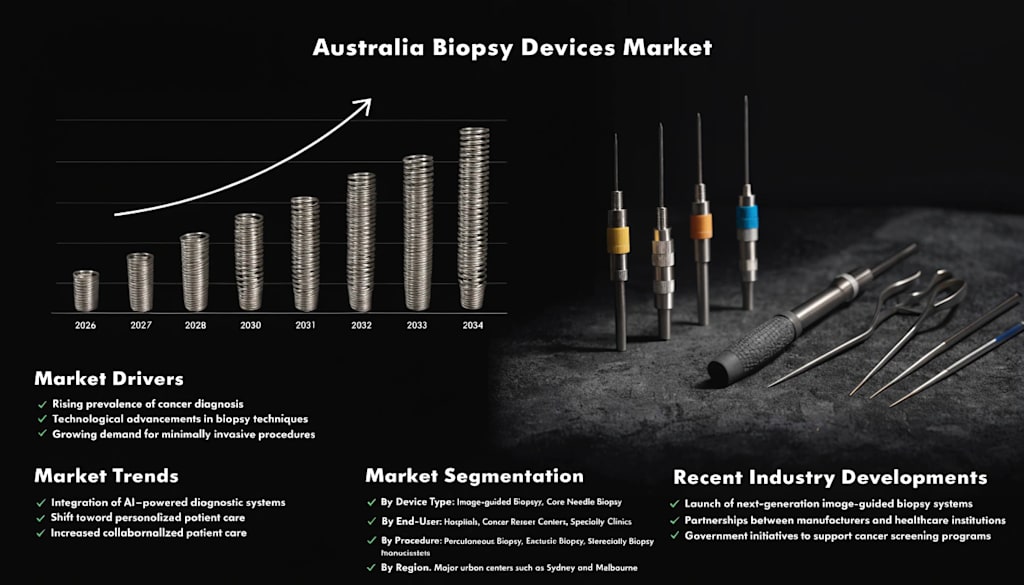
The Australia biopsy devices market is steadily expanding as healthcare providers, diagnostic centres and public health programmes increasingly prioritise early cancer detection, patient-friendly procedures and diagnostic precision. Biopsy devices — including core needle biopsies, vacuum-assisted systems, biopsy guns, aspiration needles and image-guided platforms — are essential tools for confirming malignancy, guiding treatment decisions and monitoring disease progression across oncology, radiology and interventional medicine. According to IMARC Group, the market size reached USD 59.1 Million in 2025 and is projected to reach USD 94.3 Million by 2034, exhibiting a compound annual growth rate (CAGR) of 5.32% during 2026–2034. As Australia's healthcare system integrates AI-driven imaging, robotic bronchoscopy and real-time navigation technologies, biopsy devices have become increasingly central to patient-centric, minimally invasive diagnostic workflows.
What's Driving Market Growth?
Rising Cancer Incidence and Early Detection Programmes. Australia's cancer burden continues to grow, with the crude cancer incidence rate estimated to reach 614 cases per 100,000 people in 2025, up from 463 cases in 2000. Approximately 170,000 new cancer cases are projected nationally in 2025. Healthcare policies in Australia intensely focus on early detection and timely diagnosis, driving demand for precise and effective biopsy instruments. This is particularly critical for breast, prostate and lung cancers, where early detection substantially improves treatment outcomes. The National Lung Cancer Screening Programme (NLCSP), launched in July 2025, uses low-dose CT scans to screen high-risk individuals aged 50–70 with significant smoking histories.
Rapid Adoption of Minimally Invasive Biopsy Procedures. Australian healthcare providers are increasingly shifting toward needle biopsies and other minimally invasive techniques that offer less patient discomfort, faster recovery and fewer complications compared to traditional surgical approaches. Image-guided biopsy technologies — including ultrasound-guided, MRI-guided and stereotactic-guided procedures — provide real-time imaging that helps clinicians target suspicious tissue with greater precision, reducing sampling errors and improving diagnostic accuracy for difficult-to-reach lesions.
Integration of AI and Robotic Technologies. Advanced imaging systems and robotic platforms are revolutionising biopsy precision in Australia. The Ion robotic bronchoscope, adopted by Epworth Eastern as the first private hospital in Australia to deploy the technology, uses built-in navigation to access pulmonary nodules previously unreachable with conventional approaches, achieving diagnostic yields in the 80–90 per cent range even for lesions under 20 mm. LungVision®, an AI-driven imaging system from Body Vision Medical that transforms any C-arm into a 3D imaging platform, received TGA regulatory approval in March 2025, enabling real-time navigation and enhanced visualisation for bronchoscopic biopsies.
Government Healthcare Investment and Screening Infrastructure. Public and private healthcare facilities across Australia are investing in state-of-the-art diagnostic equipment to meet accelerating demand. BreastScreen Australia reported that over 1.9 million women in the target 50–74 age group, representing 52 per cent of the eligible population, participated in breast screening in 2023–2024. In NSW, by the end of 2025, AI-driven machine reading technology is predicted to reduce the number of women recalled for additional diagnostic tests — including needle biopsies — by approximately 20 per cent.
Market Segmentation & Key Insights
By Product Type, the market includes biopsy needles, aspiration needles, biopsy guns, vacuum-assisted devices and others. Aspiration and biopsy needles constitute a substantial share, serving applications across breast, lung, colorectal and prostate cancer diagnosis.
By Procedure Type, procedures are segmented into image-guided procedures, ultrasound-guided procedures, stereotactic procedures, CT-guided procedures and MRI-guided procedures. Image-guided and ultrasound-guided biopsies dominate due to their accessibility, real-time feedback and favourable safety profiles.
By Application, major applications include breast cancer, lung cancer, colorectal cancer, prostate cancer and wound applications. Breast, lung and prostate biopsies represent the largest clinical segments, supported by dedicated national screening programmes.
By End User, the market serves hospitals and surgical centres, diagnostic clinics and pathology laboratories, and ambulatory care centres. Hospitals hold the largest share due to their capacity to perform complex image-guided and robotic-assisted procedures.
By Guidance Technique, platforms are categorised into MRI guidance, CT guidance, ultrasound guidance, stereotactic guidance and others. Ultrasound guidance leads in accessibility and cost-effectiveness, while MRI guidance is preferred for high-risk breast lesions requiring superior soft-tissue visualisation.
By Region, market coverage aligns with Australia's state and territory distribution patterns.
What the Opportunities Are?
AI & Robotic Biopsy Platforms. With the NLCSP driving increased lung nodule detection and AI-powered systems like LungVision® and Ion robotic bronchoscopy improving diagnostic yield for peripheral lung lesions, significant opportunity exists for providers of intelligent, robot-assisted biopsy solutions that enhance precision, reduce procedure time and lower complication rates.
Fusion Biopsy & Multi-modal Guidance. Integration of MRI and ultrasound fusion imaging for prostate biopsy is experiencing significant growth due to increasing prostate cancer prevalence and demand for more accurate diagnostic procedures. Providers offering hybrid guidance platforms that combine superior soft-tissue localisation with real-time needle visualisation capture substantial market opportunity.
Liquid Biopsy & Minimally Invasive Sampling. Novel technologies such as nasal liquid biopsy devices (ABEL Microsampler®) are gaining regulatory approval, opening pathways for early cancer detection through less invasive specimen collection. Investment in molecular diagnostics and circulating tumour DNA analysis aligns with precision medicine trends.
Telepathology & Digital Integration. Platforms that enable real-time pathology consultation and remote diagnostic support address Australia's geographic distribution challenges, particularly in regional and remote communities where specialist pathology access is limited.
Training & Technical Support Services. As advanced biopsy platforms become more sophisticated, demand is growing for professional training programmes, maintenance contracts, software updates and analytics optimisation services that help healthcare providers maximise diagnostic ROI and ensure dependable performance.
Recent News and Developments in Australia Biopsy Devices Market
March 2025: Body Vision Medical's LungVision® AI-driven advanced imaging system received regulatory approval from the Therapeutic Goods Administration, expanding access to real-time navigation for lung cancer diagnosis across Australia.
March 2025: Diag Nose.io announced that its ABEL Microsampler®, a novel nasal liquid biopsy device for precision respiratory diagnostics, was officially registered on the Australian Register of Therapeutic Goods, enabling broader research and diagnostic applications.
July 2025: The Australian Government launched the National Lung Cancer Screening Programme, offering biennial low dose CT scans to high risk Australians aged 50–70 with significant smoking histories, driving increased demand for confirmatory biopsy procedures.
July 2025: JEB Technologies and Medovate signed a distribution agreement with Murray Medical Solutions for the CamPROBE transperineal prostate biopsy device in Australia and New Zealand, enhancing prostate cancer diagnostic capabilities.
September 2025: Epworth Eastern in Melbourne became the first private hospital in Australia to deploy the next generation Ion robotic bronchoscope, achieving diagnostic yields up to 90 per cent for challenging pulmonary nodules and transforming lung cancer diagnosis pathways.
2025: The BreastScreen Australia monitoring report revealed that AI driven machine reading technology deployed in NSW is predicted to reduce patient recalls for additional diagnostic tests — including needle biopsies — by approximately 20 per cent by the end of 2025.
Why Should You Know About Australia Biopsy Devices Market?
You should know about this market because it illustrates how public health priorities, technological innovation and patient centred care intersect to create steady growth opportunities in a mission critical segment of Australia's diagnostic landscape. Biopsy devices are no longer just sampling tools — they are intelligent precision platforms that help clinicians detect cancer earlier, navigate complex anatomical targets and reduce procedural risk across diverse patient populations.
For investors, the biopsy devices market offers exposure to a stable growth MedTech category anchored in rising cancer incidence, expanding national screening programmes and accelerating adoption of AI guided and robotic assisted technologies. The projected CAGR of 5.32% reflects consistent confidence in adoption trends, technological differentiation and recurring demand tied to consumables and disposable components.
For healthcare providers, diagnostic facility managers, MedTech distributors and procurement planners, understanding biopsy device segmentation, image guidance trends, robotic integration strategies and emerging liquid biopsy platforms helps shape intelligent investment decisions, equipment roadmaps and service offerings that deliver measurable diagnostic accuracy and patient outcome improvements.
In essence, the Australia biopsy devices market captures how diagnostic precision, cancer screening infrastructure and medical robotics converge — making it a compelling area for innovators, investors and healthcare leaders seeking smarter approaches to early detection, patient safety and clinical excellence.
About the Creator
Thomas
Market Research Analyst | Industry Trends & Forecasting | Turning market data into clear, actionable business insights across global sectors.
Enjoyed the story? Support the Creator.
Subscribe for free to receive all their stories in your feed.
Comments
There are no comments for this story
Be the first to respond and start the conversation.