
Australia Biomethane Market: Waste-to-Energy Evolution, Grid Injection Milestones & Hard-to-Abate Decarbonisation
How a $22.7bn Future Made in Australia initiative, groundbreaking policy reforms and a wave of commercial biomethane projects are driving a 12.94% CAGR toward a $540 million market by 2034

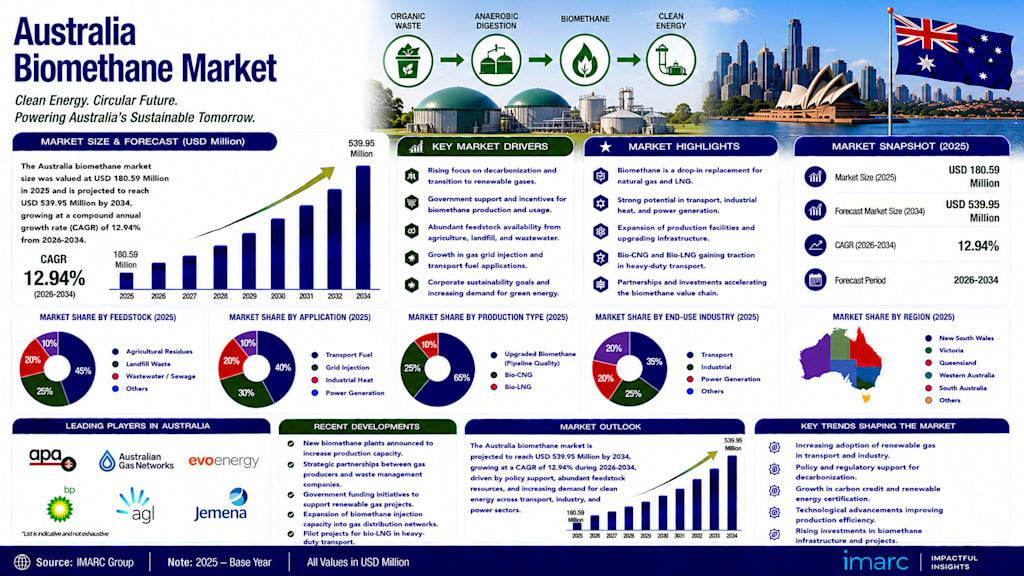
The Australia biomethane market is undergoing a transformative leap forward as government, industry and energy infrastructure operators embrace renewable gas as a practical, scalable pathway to decarbonise sectors that cannot be easily electrified. Biomethane — an upgraded form of biogas produced from organic waste sources including agricultural residues, food waste, sewage sludge and municipal solid waste — is deployed across industrial manufacturing, power generation, transport and residential gas networks as a direct, carbon neutral substitute for fossil natural gas that requires no modifications to existing appliances or infrastructure. According to IMARC Group, the Australia biomethane market size reached USD 180.59 Million in 2025 and is projected to reach USD 539.95 Million by 2034, exhibiting a robust compound annual growth rate (CAGR) of 12.94% during 2026–2034. As Australia accelerates toward its net zero 2050 target, biomethane has moved from a niche pilot technology to a strategic priority, backed by record public investment, landmark regulatory reforms and a wave of commercial projects that are finally demonstrating the viability of renewable gas at scale.
What's Driving Market Growth?
Abundant Feedstock Resources and Waste Diversion Mandates. The single most powerful driver is Australia's vast and untapped organic waste feedstock. A study commissioned for Energy Networks Australia estimates that approximately 400 PJ per year of biomethane could be recoverable today from existing feedstocks. By 2050, this could meet up to 96 per cent of current east coast gas demand. Organic residue and wastes dominate the feedstock segment with a 72.4% share in 2025, owing to the widespread availability of municipal solid waste, sewage sludge and agricultural residues, combined with established collection mechanisms and proximity to major population centres. Agriculture remains the dominant feedstock source, responsible for over 50 per cent of the potential in key catchment areas.
Landmark Policy Framework and Government Investment. The Australian government has committed unprecedented financial resources to biomethane development. The 2024 Future Made in Australia initiative allocated $22.7 billion over the next decade** to the Australian Renewable Energy Agency to support the commercialisation of low-carbon fuels including biomethane. In parallel, regulatory changes in 2025 allow renewable gas certificates to count toward companies' emissions reporting obligations under the National Greenhouse and Energy Reporting Scheme (NGERS), creating a clear commercial pathway for project developers. The NSW government has allocated **$40 million to the Renewable Gas Production Program, co funding up to 50 per cent of eligible projects that inject at least 0.1 petajoules (PJ) of biomethane into the gas network by June 2030, supported by the expansion of the Renewable Fuel Scheme to include biomethane, with a legislated target of 8 PJ by 2038.
GreenPower Certification and Guarantee of Origin Scheme. The establishment of voluntary certification schemes has created market confidence and enabled value stacking. Biomethane can now be certified under GreenPower's Renewable Gas Certification, enabling certificates to be traded between producers and buyers and allowing purchasers to directly reduce their Scope 1 emissions. The government is also consulting on extending its Guarantee of Origin (GO) scheme to include biogas and biomethane produced via anaerobic digestion, which will issue digital Product GO (PGO) certificates that record the origin and lifecycle emissions of a product, enabling producers to make verifiable environmental claims and access domestic and international low emissions markets.
Industrial Demand and Hard to Abate Sector Decarbonisation. The growing recognition of biomethane as a direct, drop in replacement for fossil natural gas is driving adoption across hard to abate manufacturing sectors. Industry estimates suggest the sector could abate an additional 13 to 14 million tonnes of carbon dioxide equivalent per year. Power generation leads the application segment with a 54.6% share in 2025, driven by growing integration of biogas-derived electricity into the national grid and increasing demand for dispatchable renewable energy to complement intermittent solar and wind generation. Manufacturers including Opal, a paper and packaging manufacturer operating across Australia, are already planning to adopt renewable gas as soon as practicably possible. ARENA's Bioenergy Roadmap found that Australia's biomethane sector could contribute around $14 billion in extra GDP per annum, reduce carbon emissions by about 12 per cent, and create over 35,300 new jobs by 2050.
Market Segmentation & Key Insights
By Feedstock, organic residue and wastes dominate the market with a share of 72.4% in 2025, owing to widespread availability of municipal solid waste, sewage sludge and agricultural residues, combined with established collection mechanisms and proximity to major population centres. Agriculture remains the dominant feedstock source, responsible for over 50 per cent of the potential in key catchment areas.
By Application, power generation leads the market with a share of 54.6% in 2025, driven by growing integration of biogas-derived electricity into the national grid and increasing demand for dispatchable renewable energy sources to complement intermittent solar and wind generation. Grid injection is the fastest growing segment, accounting for approximately 39% of total revenue share, driven by increasing investments in renewable gas infrastructure and growing integration of biomethane into existing natural gas distribution networks.
By Production Method, anaerobic digestion exhibits clear dominance with 81.9% share in 2025, reflecting its proven reliability, technological maturity and suitability for processing diverse organic waste feedstocks including municipal waste, sewage sludge and agricultural residues.
By Region, Australia Capital Territory & New South Wales represents the largest region with 34.7% share in 2025, driven by historic biomethane infrastructure projects, high urban waste volumes and strong government support for renewable gas projects throughout the Sydney metropolitan area. Western Australia and Victoria are emerging as significant players, supported by expanding waste to energy infrastructure and growing industrial demand.
What the Opportunities Are?
Grid Injection Infrastructure and Network Integration. The successful demonstration of biomethane injection into existing gas networks creates significant opportunities for infrastructure investment. The grid injection segment accounts for approximately 39% of total revenue share, driven by increasing investments in renewable gas infrastructure. Jemena's Malabar Biomethane Injection Plant was the first facility in Australia to produce and inject biomethane directly into the natural gas network, producing enough renewable gas annually to power the equivalent of 6,300 homes. The company has also secured an MoU with Sojitz to expand biomethane production across NSW, with potential to produce up to 20 PJ of biomethane each year – enough to meet the equivalent energy needs of over 250,000 homes. The NSW government's Renewable Gas Production Program requires eligible projects to inject at least 0.1 PJ of biomethane into the gas network by June 2030, creating a clear pipeline of demand for grid connection services, injection skids and network monitoring systems.
Carbon Credit Methodologies and ACCU Generation. The development of a new carbon crediting methodology for alternative waste treatment, which would include biomethane generation as a qualifying activity for the first time, represents a frontier opportunity. The previous alternative waste treatment method lapsed in March 2025 after generating roughly 5.57 million carbon credits across its lifetime. Proponents have called for an extended crediting period of 20 to 25 years (compared to the previous seven year window) to better reflect the long operational lifespan and higher capital costs of waste treatment facilities. If established, industry estimates suggest the sector could abate an additional 13 to 14 million tonnes of CO₂ equivalent per year. Project developers capable of generating ACCUs from biomethane production will benefit from multiple revenue streams beyond gas sales, including carbon credits and renewable gas certificates. Delorean's SA1 facility, for example, generates six revenue streams: renewable gas offtake, gate fees, biogenic liquid CO₂ sales, carbon credits (ACCUs), Renewable Gas Guarantee of Origin certificates (RGGOs), and biofertiliser by products.
Commercial Scale Project Pipeline Across Multiple Jurisdictions. A wave of commercial biomethane projects is advancing across Australia, creating opportunities for project developers, technology providers and investors. Delorean Corporation's SA1 Salisbury bioenergy facility in South Australia is 75 per cent complete, with first biomethane injection into the Adelaide gas network scheduled for November 2026. The facility will process 70,000 tonnes per annum of commercial and industrial food waste, producing 210 TJ of renewable gas annually. The company has also reached positive final investment decision (FID) for its NSW1 Horsley Park facility, supported by $30.5 million in grant funding, which will process 120,000 tonnes of organic waste to produce about 253,000 GJ of renewable biomethane annually, reducing natural gas usage at Brickworks' co located brick plant by approximately 50 per cent and delivering a 38 per cent reduction to its overall Scope 1 emissions at the site. The Griffith Biohub in the Riverina region of NSW, supported by state government funding, will process over 250,000 tonnes of organic waste and agricultural residues, with construction commencing in late 2026 and commercial operations in 2028.
Advanced Anaerobic Digestion and Upgrading Technologies. With anaerobic digestion commanding an 81.9% market share and representing the dominant production method, there is significant opportunity for technology providers offering advanced digestion systems, biogas upgrading equipment and CO₂ capture technologies. The SA1 facility utilises anaerobic digestion technology to process C&I food waste into biogas, which is subsequently upgraded to renewable biomethane, commercial grade biogenic CO₂, digestate for liquid fertiliser, and electricity and heat via a combined heat and power system. Delorean's project also demonstrates value stacking, where multiple revenue streams from a single facility (gas offtake, gate fees, CO₂ sales, carbon credits, renewable certificates and fertiliser) support the economics of anaerobic digestion and biomethane upgrading.
Industrial Offtake Agreements and Corporate Power Purchase Agreements (PPAs). The growing demand from industrial users for verifiable Scope 1 emissions reductions is creating a robust market for long term biomethane offtake agreements. Origin Energy has signed a long term biomethane offtake agreement for Delorean's SA1 facility, purchasing up to 200 TJ per annum through to March 2036. The NSW1 facility has secured a direct offtake agreement with Brickworks, with biomethane piped onsite to reduce fossil natural gas usage and emissions. Major manufacturers including Opal are actively planning to adopt renewable gas, and Bioenergy Australia estimates that up to 400 PJ of biomethane could be recovered annually – enough to meet 96 per cent of current east coast gas demand. Corporate purchasers seeking to meet science based targets and renewable energy commitments represent a substantial and growing addressable market for biomethane certificates and physical supply agreements.
International Investment and Technology Transfer Partnerships. Australia is actively seeking foreign investment and expertise to accelerate biomethane rollout. Austrade has identified biomethane as a priority sector, with the organisation looking for companies that have deep expertise in biomethane project development, site selection, feedstock contracts and grid integration. Austrade has highlighted opportunities for deeper German Australian collaboration on renewable gases, noting that Germany has decades of experience with biomethane regulation, grid integration and certification. Japanese utility companies also recognise biomethane as an important fuel for realising decarbonisation targets and are actively exploring renewable gas investment opportunities across Australia.
Recent News and Developments in Australia Biomethane Market
May 2026: Delorean Corporation announced that construction of its SA1 Salisbury bioenergy facility is now 75 per cent complete, with first biomethane injection into the Adelaide gas network scheduled for November 2026 and waste acceptance pencilled in for August. The facility will process 70,000 tonnes of C&I food waste annually and generate six revenue streams including gas offtake, gate fees, CO₂ sales, ACCUs, RGGOs and biofertiliser.
April 2026: Delorean Corporation reached a positive final investment decision (FID) for its NSW1 Horsley Park Bioenergy Facility, supported by combined $30.5 million grant funding from ARENA and the NSW Government. The facility will process 120,000 tonnes of organic waste annually, producing renewable biomethane to cut natural gas usage at Brickworks' co located brick plant by approximately 50 per cent and deliver a 38 per cent reduction in its overall Scope 1 emissions at the site.
March 2026: The NSW Government launched an **$80 million Industrial Decarbonisation Initiative**, including a $40 million Renewable Gas Production Program to support commercial biomethane production facilities that inject at least 0.1 PJ of biomethane into the gas network by June 2030, co funding eligible projects up to 50 per cent of costs with a maximum of $20 million per project.
March 2026: The Australian government opened consultation on proposed legislative amendments to extend its Guarantee of Origin (GO) scheme to include biogas and biomethane produced via anaerobic digestion, with the consultation period open until 27 April 2026, enabling producers to make verifiable environmental claims.
February 2026: Optimal Renewable Gas (ORG) was awarded a NSW government grant to accelerate development of the Griffith Biohub, a circular economy project using anaerobic digestion to convert agricultural residues into biomethane for injection into the existing gas network, with construction due to commence in late 2026 and commercial operations in 2028.
December 2025: The NSW Government's Renewable Fuels Strategy committed to expanding the Renewable Fuel Scheme to include biomethane, offering up to $130 million in financial support for NSW renewable fuel production facilities under the Net Zero Manufacturing Initiative, and setting a target of 15 per cent renewable industrial gas use by 2035.
September 2025: Origin Energy signed a long term biomethane offtake agreement with Delorean Corporation, purchasing up to 200 TJ per annum from the SA1 facility, with the agreement satisfying a key condition precedent for progressive payments up to $6.1 million and extending through to March 2036.
August 2025: The Australian government's Net Zero Plan was released, formally identifying biomethane as a key part of Australia's energy transition. The Energy and Climate Change Ministerial Council committed to work on developing a national renewable gas policy.
Why Should You Know About Australia Biomethane Market?
You should know about this market because it captures how waste to energy innovation, policy driven decarbonisation and infrastructure modernisation intersect to create a high growth renewable energy category that directly addresses two of Australia's most pressing challenges: organic waste management and industrial emissions reduction. Biomethane is no longer a theoretical alternative — it is a proven, commercially viable, drop in renewable gas that flows through existing pipelines, powers existing industrial equipment and generates multiple verifiable revenue streams (gas sales, carbon credits, renewable certificates, CO₂ offtake and fertiliser by products) while diverting waste from landfill and reducing methane emissions at source.
For investors, the biomethane market offers exposure to a high growth renewable energy category anchored in enforceable government funding, expanding emissions reporting obligations and the structural shift away from fossil natural gas across manufacturing, power generation and transport. The projected CAGR of 12.94% reflects strong confidence in adoption trends, while higher growth sub segments — including grid injection infrastructure, advanced anaerobic digestion technologies, ACCU generation and industrial offtake agreements — offer differentiated upside potential.
For project developers, energy infrastructure operators, waste management companies and sustainability investors, understanding the segmentation between feedstock sources, production methods and end use applications, the emerging policy framework (GreenPower certification, GO scheme expansion, NGERS reporting), and the commercial scale project pipeline (Delorean's SA1 and NSW1 facilities, Griffith Biohub, Jemena's Malabar plant) helps shape intelligent investment decisions, technology selection and strategic partnerships that deliver measurable environmental, economic and energy security outcomes.
In essence, the Australia biomethane market captures how circular economy principles, renewable energy policy and industrial decarbonisation converge — making it a compelling area for investors, technology partners and infrastructure developers seeking smarter approaches to waste valorisation, gas network decarbonisation and sustainable manufacturing across Australia's rapidly evolving energy landscape.
About the Creator
Thomas
Market Research Analyst | Industry Trends & Forecasting | Turning market data into clear, actionable business insights across global sectors.
Enjoyed the story? Support the Creator.
Subscribe for free to receive all their stories in your feed.
Comments
There are no comments for this story
Be the first to respond and start the conversation.