
Australia Battery Recycling Market 2026: EV Surge, Sovereign Capability & Black Mass Boom
How a $532m National Battery Strategy, record EV adoption and 95% critical mineral recovery are transforming Australia's circular economy

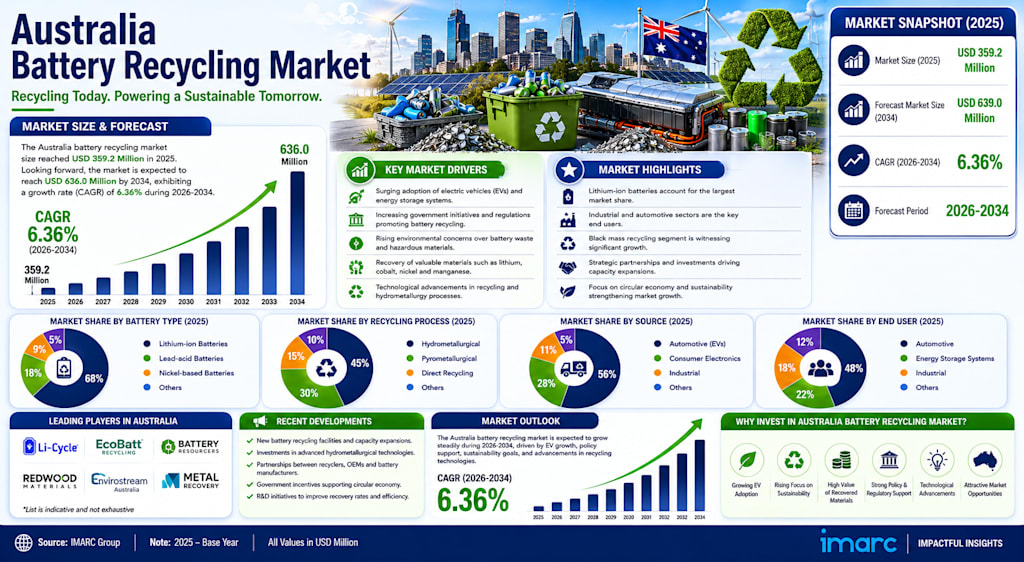
The Australia battery recycling market is undergoing a rapid and strategic transformation as electric vehicle adoption accelerates, grid-scale energy storage expands, and federal and state governments pour unprecedented investment into domestic circular economy infrastructure. Battery recycling — encompassing lithium ion, lead acid, nickel metal hydride and other chemistries — is deployed across automotive, consumer electronics, energy storage and industrial sectors to recover valuable materials including lithium, cobalt, nickel, manganese and graphite, reducing Australia's reliance on foreign processing and landfill disposal. According to IMARC Group, the market size reached USD 359.2 Million in 2025 and is projected to reach USD 636.0 Million by 2034, exhibiting a compound annual growth rate (CAGR) of 6.36% during 2026–2034. The surging electric vehicle adoption, rollout of residential and commercial energy storage generating end-of-life lithium ion streams, supportive federal and state regulations and incentives for a circular economy, technological advances in hydrometallurgical recovery boosting metal yields, and robust private public investments in domestic recycling infrastructure are boosting market expansion.
What's Driving Market Growth?
Explosive Growth in End-of-Life Streams from EV and Grid-Scale Storage. Australia's rapid electrification of transport and growth in utility-scale energy storage is driving an unprecedented rise in end-of-life lithium ion batteries, highlighting the need for advanced recycling capabilities. New EV sales reached 114,000 units in 2024, up from 98,000 units in 2023, forecasting larger waste streams in coming years. In parallel, Australia commissioned 4 GW (10 GWh) of grid-scale battery energy storage in 2023 and was set to exceed 5 GW by end of 2024, making it the fourth-largest utility-storage market globally. These deployments generate over 3,300 tons of lithium ion battery waste annually, with projections to grow significantly as passenger EV fleets and stationary storage systems mature. This surge in spent batteries is driving investment in hydrometallurgical and mechanical shredding lines, enabling higher recovery rates of critical metals like cobalt, nickel and lithium. A Battery Materials Recovery report released in March 2026 found the recycling sector contributed $2.1 billion to Australia's economy in 2025, supporting 19,450 jobs across more than 45 facilities nationwide.
Robust Policy Support and Mega-Scale Public-Private Investments. Australia's federal and state governments are driving battery recycling growth with strategic funding and regulatory support. In May 2024, the Commonwealth launched an AUD 532 million National Battery Strategy, aimed at bolstering domestic recycling infrastructure, R&D and circular economy efforts, capitalising on the country's vast reserves of critical minerals like cobalt, nickel and lithium. A federal proposal would provide 5 billion over 5 years** to support the National Battery Strategy, including manufacturing incentives and recycling support[reference:9], alongside **50 million over 2 years to establish a national battery collection network. At the state level, Western Australia awarded Envirostream AUD 850,000 in late 2024 to develop a dedicated battery sorting and dismantling facility. The Victorian government announced 1.7 million in funding** for local councils and charities to make it easier for households to recycle batteries, with grants of up to **22,000 available for battery drop-off units.
Advanced Hydrometallurgical and Black Mass Technologies. Recycling technologies are advancing rapidly, with companies achieving recovery rates exceeding 95 per cent for critical materials. Perth based Renewable Metals uses a patented process to recover 95 per cent of cobalt, lithium, nickel, copper and manganese from end-of-life lithium ion batteries, using a single processing line to extract material and save costs. The process generates black mass — a valuable material containing lithium, cobalt, nickel, manganese and graphite — supplied to downstream refiners where minerals and elements are recovered and returned to manufacturing supply chains to produce new high voltage batteries. BMW Australia launched a nationwide EV battery recycling program with a facility capable of processing up to 5,000 tonnes of batteries annually, engineered to recover more than 90 per cent of valuable materials for reuse.
Dominance of the B Cycle Scheme and Battery Stewardship. The B cycle scheme, Australia's official government backed product stewardship scheme for battery recycling, has demonstrated the scale of challenge and opportunity. Since its launch in 2022, the scheme has supported the recovery of 11,458 tonnes of batteries, including an estimated 477.4 million individual batteries and more than 92.6 million lithium ion batteries. The Association for the Battery Recycling Industry forecasts the sector to triple to $6.9 billion in value by 2050 . Upcoming amendments to the National Waste Policy will introduce Extended Producer Responsibility (EPR) for lithium ion batteries and set recycled content mandates by 2027.
Market Segmentation & Key Insights
By Type, the market is segmented into lithium ion, lead acid, nickel metal hydride, alkaline and other battery chemistries. Lithium ion is the fastest growing segment, driven by EV and grid storage adoption. Lead acid batteries have one of the world's most successful recycling systems, with recovery rates exceeding 90 per cent. By Source, key segments include automotive, consumer electronics, industrial and grid scale storage. By Material, recovered materials encompass lithium, cobalt, nickel, manganese, copper and graphite. By End User, the market serves battery manufacturers, automotive OEMs, energy storage providers and recyclers.
By Region, major markets include New South Wales & ACT, Victoria & Tasmania, Queensland, Western Australia, South Australia and Northern Territory. Western Australia is emerging as a key hub, with Renewable Metals' prototype plant in Kewdale due to operate from mid 2026, scaling up to recycle up to 2,000 tonnes of batteries per year, equivalent to 4,000 electric car batteries. A commercial plant in NSW's Hunter Region is planned to follow. Livium (formerly Envirostream) is consolidating operations at a larger Melbourne recycling hub to significantly expand lithium ion battery processing capacity.
What the Opportunities Are?
Critical Mineral Sovereignty and Domestic Processing. China currently dominates global battery recycling, but Australian players are building platforms that can compete at scale. Renewable Metals chairman Peter Bevan stated the company is "building a platform that can compete with leading Chinese recyclers at scale, while enabling recovery of critical minerals. That's critical to building resilient supply chains and reducing dependence on offshore processing as demand accelerates". Australia's battery materials recovery sector has the potential to be worth around A7 billion (5 billion) to the national economy by 2050. Extracting critical minerals from batteries becomes more important as countries introduce recycling mandates and restrictions on exporting waste. Australian households are also using more large scale batteries, with more than 250,000 installed under government schemes.
Black Mass Processing and Second Life Battery Applications. The increasing volume of spent batteries is driving investment in black mass processing and second life applications. The recycling process generates black mass, a valuable material containing lithium, cobalt, nickel, manganese and graphite, which is supplied to downstream refiners where minerals are recovered and returned to manufacturing supply chains to produce new high voltage batteries. Australia is seeing a growing trend towards repurposing used EV batteries for secondary applications such as energy storage systems for residential and commercial use. A CEBIC funded project is developing a circular economy business model to create Australia's first scalable reuse and recycling program for retired lithium ion batteries from EVs, repurposing them into battery energy storage systems (BESS).
Smart Collection Infrastructure and Reverse Logistics. Establishing efficient collection networks remains a critical enabler. The 50 million national battery collection network proposal aims to fill gaps in accessible disposal points and keep batteries out of waste streams[reference:33]. Grants of up to 22,000 are available for the purchase, installation and promotion of battery drop off units accepting a range of battery types including loose household batteries, batteries from e cigarettes and embedded batteries. The NSW EPA commenced a trial to accept products with embedded batteries (including Bluetooth speakers, headphones, electric toothbrushes and vapes) at selected recycling locations. Mandatory extended producer responsibility (EPR) is gaining momentum for batteries with low recovery rates, including lithium and products with embedded batteries.
Recycled Content Mandates and Circular Manufacturing. Upcoming amendments to the National Waste Policy will introduce EPR for lithium ion batteries and set recycled content mandates by 2027. These regulatory drivers create strong demand for high purity recovered materials that can be returned to manufacturing supply chains. OEMs are committing to circular supply chains: Envirostream's March 2024 agreements with LG Energy Solution and Hyundai Glovis will inject 6,000 large format battery packs into Australia's recycling stream, a 140 per cent increase over its 2023 volumes, highlighting OEMs' commitment to circular supply chains.
Grid Scale Battery Recycling and Decommissioning Contracts. As Australia becomes the fourth largest utility storage market globally, the decommissioning of grid scale batteries presents a significant and recurring revenue opportunity. Livium has secured an agreement to exclusively recycle the lithium ion batteries Hithium is set to supply for the 222MW/640MWh solar co located Woolooga project in Queensland. The $45 million Queensland government commitment supports 'high recovery' recycling projects targeting industrial waste and renewable energy components, particularly solar panels and batteries, including EV and stationary storage systems.
Recent News and Developments in Australia Battery Recycling Market
March 12, 2026: The Battery Materials Recovery Industry Profile report, prepared by Positive Economics for ABRI, revealed the sector contributed 2.1 billion to Australia's economy in 2025**, supporting 19,450 jobs across more than 45 facilities. The report projected the sector could generate **6.9 billion and support 34,650 jobs by 2050.
March 2026: Calls grew for Australia's rapidly growing battery recycling industry to have "nationally aligned" regulation. The Association for the Battery Recycling Industry and Battery Stewardship Council convened at Parliament House to advocate for mandatory product stewardship for battery materials including lithium, graphite, cobalt and nickel. Failure to achieve national consistency "threatens the viability and success of battery stewardship outcomes".
February 2026: Livium (formerly Envirostream) announced a larger Melbourne recycling hub to consolidate operations and significantly expand lithium ion battery processing capacity, positioning itself to benefit from rising EV and storage battery waste and regulatory shifts favouring domestic recycling growth.
December 2025: Iondrive continued optimising its new lithium ion battery processing plant in Australia, with wet commissioning expected in the last quarter of calendar 2026.
May 2026: Renewable Metals, a Perth based start up, secured a $12 million Series A funding round led by the Clean Energy Finance Corporation, with participation from Climate Tech Partners and European Metal Recycling, to establish a battery recycling prototype plant in Kewdale, Western Australia, due to operate from mid 2026 and scale up to recycle up to 2,000 tonnes of batteries per year, equivalent to 4,000 electric car batteries.
October 2025: BMW Australia launched a nationwide EV battery recycling program with a facility capable of processing up to 5,000 tonnes of embedded batteries annually, recovering more than 90 per cent of materials including metals and plastics.
September 2025: Iondrive received a $3.9 million government grant to advance urban mining technology, supporting construction of a large scale continuous integrated pilot plant with the grant covering up to 50% of eligible pilot plant construction and operating expenditure.
August 18, 2025: ABRI launched its 2025 30 Corporate Strategy, setting out how the peak body will deliver its mission to power a circular value chain for batteries to accelerate Australia's journey toward sustainable decarbonisation, with a focus on mandatory extended producer responsibility (EPR) for low recovery batteries.
Why Should You Know About Australia Battery Recycling Market?
You should know about this market because it captures how electrification of transport, national security imperatives and circular economy policy intersect to create one of Australia's fastest growing industrial sectors. Battery recycling is no longer just an environmental issue — it is a strategic sovereign capability that reduces dependence on Chinese processing, recovers critical minerals essential for the energy transition, and creates a multi billion dollar domestic manufacturing industry from what was previously considered waste.
For investors, the battery recycling market offers exposure to a high growth industrial category anchored in Australia's AUD 532 million National Battery Strategy, upcoming recycled content mandates (2027), and the structural shift from linear to circular supply chains. The projected CAGR of 6.36% reflects consistent baseline demand, while higher growth sub segments — including lithium ion processing (driven by EV adoption up 16% year on year), black mass refining, grid scale decommissioning contracts and second life battery systems — offer differentiated upside potential. The broader sector could expand from 2.1 billion in 2025 to 6.9 billion by 2050, representing a three fold increase in economic contribution.
For recycling facility operators, critical minerals processors, automotive OEMs, energy storage developers and policymakers, understanding battery recycling segmentation, black mass economics, EPR regulatory pathways and OEM off take agreements helps shape intelligent investment decisions, technology roadmaps and strategic partnerships that deliver measurable resource recovery, supply chain resilience and sovereign capability outcomes.
In essence, the Australia battery recycling market captures how electrification, urban mining and regulatory reform converge — making it a compelling area for investors, technology developers and industrial strategists seeking smarter approaches to critical mineral circularity, waste to value transformation and sustainable growth in Australia's rapidly decarbonising economy.
About the Creator
Thomas
Market Research Analyst | Industry Trends & Forecasting | Turning market data into clear, actionable business insights across global sectors.
Enjoyed the story? Support the Creator.
Subscribe for free to receive all their stories in your feed.
Comments
There are no comments for this story
Be the first to respond and start the conversation.