
Australia Automotive Lighting Market 2026: ADAS Integration, EV Growth & Smart Lighting Innovation
How advanced driver systems, electric vehicles, and design trends are shaping the Australia automotive lighting industry

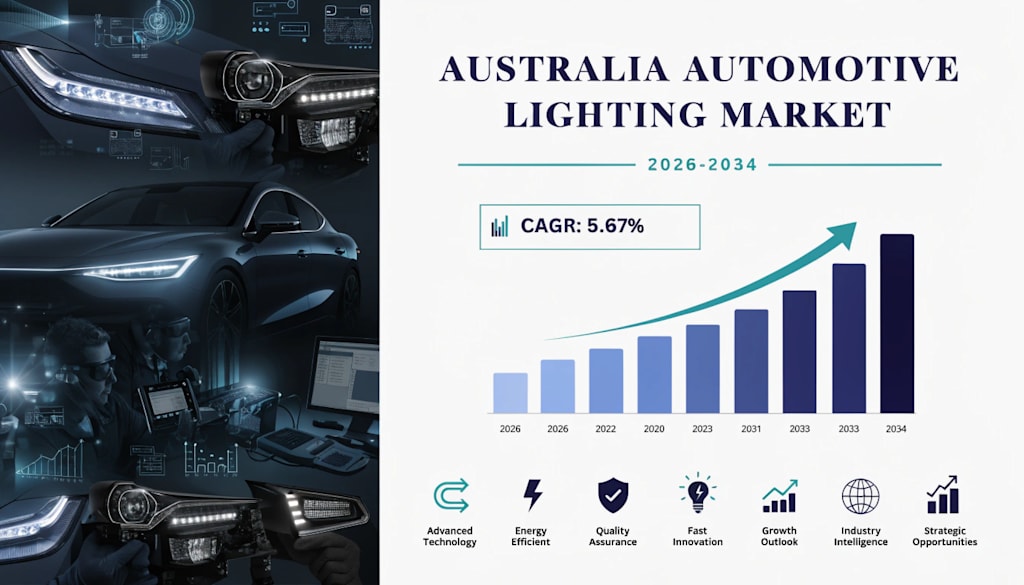
Australia Automotive Lighting Market Overview
The Australia automotive lighting market is a key component of the country’s automotive industry, covering lighting systems such as headlights, tail lights, signal indicators, and interior lighting used across passenger and commercial vehicles. These systems play a critical role in vehicle safety, visibility, and overall design aesthetics.
According to IMARC Group, The Australia automotive lighting market size reached USD 726.5 Million in 2025. Looking forward, IMARC Group expects the market to reach USD 1,210.9 Million by 2034, exhibiting a growth rate (CAGR) of 5.67% during 2026-2034.
The market is driven by the growing adoption of advanced driver assistance systems (ADAS), increasing demand for aesthetically enhanced vehicles, rising electric vehicle (EV) adoption, and regulatory initiatives promoting energy-efficient lighting solutions.
Key Market Drivers
Growing Integration of ADAS Technologies
The increasing adoption of advanced driver assistance systems (ADAS) is boosting demand for intelligent lighting solutions such as adaptive headlights, automatic high beams, and night-vision-enabled lighting systems.
Rising Demand for Aesthetic and Customizable Lighting
Consumers are placing greater emphasis on vehicle design and personalization, driving demand for LED lighting, ambient interior lighting, and programmable lighting features that enhance vehicle appeal.
Expansion of Electric Vehicle Market
The growing adoption of electric vehicles is accelerating the use of energy-efficient lighting systems such as LEDs and OLEDs, which help reduce power consumption and improve vehicle performance.
Regulatory Focus on Energy Efficiency and Emissions
Government regulations aimed at reducing emissions and improving fuel efficiency are encouraging automakers to adopt low-energy lighting technologies, replacing traditional halogen systems.
Increasing Vehicle Production and Sales
The overall growth in vehicle production and sales in Australia is contributing to higher demand for automotive lighting systems across both OEM and aftermarket segments.
Request a Sample Report with the Latest 2026 Data & Forecasts
What the Opportunities Are
Adoption of Advanced Lighting Technologies
Technologies such as LED, OLED, and laser lighting are creating opportunities for improved energy efficiency, durability, and design flexibility.
Growth of Smart and Adaptive Lighting Systems
Adaptive lighting systems that adjust brightness and direction based on driving conditions are gaining traction, enhancing safety and driving experience.
Expansion of Automotive Aftermarket
The aftermarket segment offers opportunities for upgrades and replacements, particularly for high-performance and customized lighting solutions.
Rising Demand for Connected Vehicle Features
Integration of lighting systems with vehicle sensors and software is enabling smarter, more responsive lighting solutions.
Increasing Focus on Vehicle Safety Innovations
Lighting systems are becoming integral to safety features such as pedestrian detection and lane guidance, creating further growth potential.
Recent Trends and Developments
May 2026: Rapid growth in electric vehicle (EV) adoption in Australia is significantly influencing automotive lighting demand. EVs accounted for 14.6% of new vehicle sales in March 2026 (up from 7.5% a year earlier), while EV-related insurance demand surged 121% year-on-year. Since EVs rely heavily on energy-efficient lighting systems (such as LED and adaptive lighting), this shift is accelerating demand for advanced lighting technologies designed to improve energy efficiency and vehicle range.
April 2026: Innovation in automotive lighting is accelerating globally, with technologies such as pixel-based headlights and projection lighting entering the market. For example, new systems can project images or information onto surfaces and roads, highlighting the evolution of lighting from a safety feature to an interactive and aesthetic component. These innovations are expected to influence premium and EV segments in Australia, where demand for high-end vehicle features is increasing.
April 2026: The broader automotive sector is experiencing mixed conditions, impacting component markets such as lighting. Global automotive production declined by 3.4% in early 2026, affecting suppliers, while companies are still investing in lighting divisions due to strong long-term demand and innovation pipelines. This indicates that despite short-term volatility, automotive lighting remains a strategic growth area within the supply chain.
February 2026: Regulatory pressure is shaping vehicle design, including lighting systems. Australia’s new emissions standards have already resulted in 17.2 million emissions credits issued and aim to reduce 1.3 million tonnes of excess emissions, pushing automakers toward more energy-efficient technologies such as LED lighting systems. These regulations indirectly support the adoption of advanced lighting solutions that reduce energy consumption.
February 2026: The Australian automotive market remains stable, with 87,092 new vehicles sold in January 2026, reflecting steady demand across segments. This stable vehicle base supports consistent demand for automotive lighting across OEM and aftermarket segments.
Why You Should Know About the Australia Automotive Lighting Market
The Australia automotive lighting market is a growing and technologically evolving segment of the automotive industry.
With projected growth from USD 726.5 Million to USD 1,210.9 Million by 2034, the market demonstrates strong potential driven by innovation, safety requirements, and energy efficiency trends.
As vehicles become more advanced and connected, automotive lighting is evolving beyond basic functionality to play a crucial role in safety, efficiency, and vehicle design, making it a key component of the future mobility ecosystem.
About the Creator
Amyra Singh
Market research analyst who loves spotting patterns, digging into data, and turning insights into strategies that help brands grow and stay ahead of the curve.
Enjoyed the story? Support the Creator.
Subscribe for free to receive all their stories in your feed.
Comments
There are no comments for this story
Be the first to respond and start the conversation.