
Australia Automotive Cooling Systems Market 2026: EV Transition, Thermal Efficiency & Smart Innovation
How electrified powertrains, extreme climate conditions and lightweight engineering are driving cooling system demand across Australia

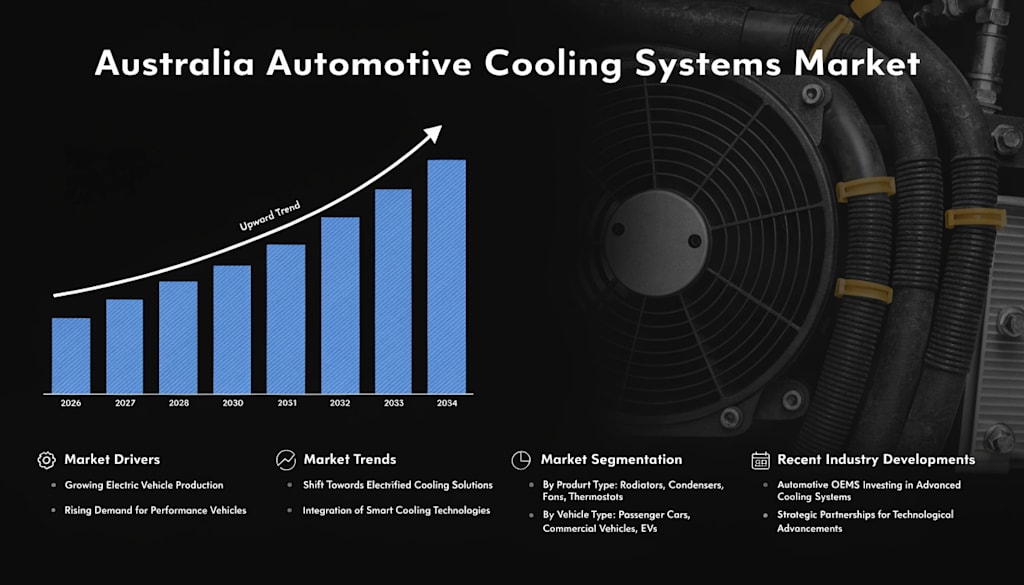
The Australia automotive cooling systems market is experiencing steady expansion as vehicle manufacturers, fleet operators and aftermarket suppliers increasingly prioritise thermal management, energy efficiency and component durability. Automotive cooling systems — encompassing radiators, cooling fans, water pumps, thermal management modules, electric coolant valves and heat exchangers — are deployed across passenger vehicles, commercial fleets and two-wheelers to maintain optimal operating temperatures, prevent overheating and extend powertrain lifespan. According to IMARC Group, the market size reached USD 951.4 Million in 2025 and is projected to reach USD 1,403.8 Million by 2034, exhibiting a compound annual growth rate (CAGR) of 4.42% during 2026–2034. As Australia accelerates toward electrified mobility and confronts extreme climatic conditions ranging from tropical humidity to desert heat, intelligent and lightweight cooling technologies have become mission-critical components of modern vehicle architectures.
What’s Driving Market Growth?
Accelerating Transition to Electrified Powertrains. Australia is experiencing a significant shift toward electrified powertrains, including hybrid and battery electric vehicles (BEVs), which is profoundly reshaping innovation in advanced cooling systems. Unlike conventional internal combustion engines, electric powertrains require thermal management not only for motors but also for battery packs, power electronics and inverters. Contemporary cooling systems are being developed with more accurate and energy-efficient technologies, including liquid-cooled modules and intelligent thermal routing that ensure ideal operating temperatures and prolong EV component lifespan. With government incentives promoting cleaner mobility solutions and EVs hitting a record 14.25 percent monthly market share in March 2025 alone, demand is rising for resilient, scalable thermal management technologies that address the distinct needs of electrified vehicle platforms. The Australia EV battery cooling systems market, a specialised subset, was valued at USD 78.06 Million in 2025 and is projected to grow at a robust CAGR of 14.86% through 2034.
Integration of Smart and Adaptive Cooling Technologies. One emerging trend is the incorporation of smart and adaptive cooling technologies aimed at enhancing engine performance and fuel efficiency. These systems use sensors, electronic control modules and real-time data processing to vary cooling flow according to vehicle load, driving conditions and ambient temperature. The shift from mechanically actuated to electrically controlled systems is increasing responsiveness while reducing parasitic energy losses. Such systems are particularly valuable in urban driving environments with frequent start-stop demands, ensuring stable engine temperatures and aligning with Australia’s heightened focus on energy preservation and sustainability.
Focus on Lightweight and Compact Cooling Components. Australian manufacturers are increasingly prioritising lightweight and compact cooling parts to align with the automotive sector's broader drive toward fuel efficiency and emission reduction. By reducing the weight and size of radiators, hoses, pumps and ancillary components, vehicles achieve improved weight distribution and lower energy usage. New materials such as aluminium alloys and high-performance plastics are replacing conventional materials, enhancing both engine cooling and structural integrity while creating additional space for modular vehicle architectures.
Extreme Climate Conditions and Aftermarket Demand. Australia’s harsh climatic conditions — including extreme summer heat waves, high humidity in tropical regions and demanding off-road environments — place exceptional stress on vehicle cooling systems. This drives sustained demand for high-performance aftermarket cooling components, particularly in commercial vehicle fleets operating in remote mining, agricultural and transport sectors where reliable thermal management is essential for operational continuity.
Market Segmentation & Key Insights
By Vehicle Type. The market is categorised into two wheelers, passenger vehicles, and commercial vehicles. Passenger vehicles represent the largest segment, driven by rapid consumer uptake and expanding EV model availability. For EV battery cooling specifically, passenger vehicles accounted for a market share of 71.3% in 2025.
By Engine Type. The market is segmented into liquid-cooled engines and air-cooled engines. Liquid-cooled systems dominate across passenger cars and commercial vehicles due to their superior thermal regulation efficiency.
By Region. Major regional markets include Australia Capital Territory & New South Wales, Victoria & Tasmania, Queensland, Northern Territory & Southern Australia, and Western Australia. In the EV battery cooling segment, NSW and ACT lead with 35.4% share in 2025, driven by high EV adoption rates, strong government incentive frameworks and concentration of major automotive distribution networks.
What the Opportunities Are?
EV Battery Thermal Management Solutions. With the Australia EV battery cooling systems market projected to grow from USD 78.06 Million in 2025 to USD 283.58 Million by 2034 at a CAGR of 14.86%, significant opportunity exists for providers of advanced liquid cooling, phase-change materials and integrated thermal management platforms. Manufacturers focusing on next-generation cooling technologies for lithium-ion batteries — which hold 89.2% market share in battery type — will capture substantial growth as EV penetration accelerates.
Smart Electric Coolant Valves and Components. The transition toward electrically controlled cooling architectures creates opportunity for electric coolant valves that offer improved efficiency, durability and integration with smart monitoring systems. These components enable real-time data processing and optimisation of thermal flow, supporting both conventional and electrified vehicle platforms.
Additive Manufacturing for High-Performance Cooling. Metal 3D printing is enabling development of game-changing heat transfer technology previously reserved for Formula One applications. As structural cost declines occur in metal additive manufacturing, F1-grade cooling technology is becoming accessible to general automotive, particularly as OEM hybridisation increases under-bonnet heat loads. Companies investing in additive manufacturing for complex radiator geometries and heat exchanger designs are positioned to capture premium market segments.
Integrated Aftermarket and Service Networks. As advanced cooling systems become more sophisticated, demand is growing for professional installation services, diagnostic tools, maintenance contracts and thermal performance optimisation. Establishing comprehensive aftermarket support networks that bundle hardware with technical training and remote monitoring capabilities offers recurring revenue opportunities.
Sustainable and Eco-Friendly Cooling Solutions. Growing emphasis on reducing carbon footprints and complying with tightening emissions regulations is driving development of sustainable cooling technologies, including systems using eco-friendly refrigerants and energy-efficient electric compressors. In January 2025, DENSO launched new electric air-conditioners specifically designed for Australian double-deck and articulated buses, reinforcing local market presence with cutting-edge, energy-saving HVAC products.
Recent News and Developments in Australia Automotive Cooling Systems Market
January 2025: DENSO launched new electric air-conditioners specifically designed for double-deck and articulated buses for the Australian market, building on the success of its Generation 2 LD9E model released in late 2024 and reinforcing its local market foothold with energy-saving HVAC products.
December 2025: PWR Advanced Cooling Technology was named winner of the 2025 Australian Export Awards – Manufacturing and Advanced Materials category. The Queensland-based company, which supplies cooling systems to every Formula One team on the grid, is also developing systems for hydrogen-powered craft to support a cleaner energy future.
December 2025: PWR Holdings announced the appointment of Sharyn Williams as its new chief executive and managing director. Williams had served as the company's chief financial officer since January 2025.
October 2025: Toyota confirmed the updated 2026 GR Corolla would arrive in Australian showrooms early 2026, featuring increased cooling capability and an engine cool air duct to lower intake temperatures, drawn from Gazoo Racing's motorsport expertise.
January 2026: A report highlighted how 3D printing is being used to develop game-changing heat transfer technology for supercars, with F1-grade cooling technology expected to become accessible to general automotive as OEM hybridisation intensifies under-bonnet heat loads.
Why Should You Know About Australia Automotive Cooling Systems Market?
You should know about this market because it illustrates how electrification priorities, extreme environmental conditions and thermal engineering innovation intersect to create steady growth opportunities in a mission-critical segment of Australia's automotive landscape. Cooling systems are no longer just auxiliary components — they are intelligent thermal management platforms that determine vehicle performance, battery longevity and operational reliability across Australia's demanding driving conditions.
For investors, the automotive cooling systems market offers exposure to a stable-growth industrial category anchored in the accelerating EV transition, expanding vehicle parc and rising demand for high-performance aftermarket components. The projected CAGR of 4.42% for the broader market, alongside the 14.86% CAGR for the specialised EV battery cooling segment, reflects strong confidence in adoption trends, technological differentiation and recurring demand tied to vehicle maintenance and thermal system upgrades.
For automotive manufacturers, fleet operators, aftermarket distributors and technology partners, understanding cooling system segmentation, smart thermal management trends, lightweight material adoption and EV-specific requirements helps shape intelligent investment decisions, procurement strategies and service offerings that deliver measurable performance, efficiency and reliability outcomes.
In essence, the Australia automotive cooling systems market captures how thermal intelligence, vehicle electrification and extreme-environment engineering converge — making it a compelling area for innovators, investors and organisations seeking smarter approaches to mobility, energy efficiency and operational visibility.
About the Creator
Thomas
Market Research Analyst | Industry Trends & Forecasting | Turning market data into clear, actionable business insights across global sectors.
Enjoyed the story? Support the Creator.
Subscribe for free to receive all their stories in your feed.
Comments
There are no comments for this story
Be the first to respond and start the conversation.