
Australia Applicant Tracking System Market: AI Recruitment Surge, Cloud Dominance & Talent Tech Evolution
How AI-powered hiring, workforce digitisation and the 230,000-worker tech talent gap are driving a 7.74% CAGR toward a $122 million market by 2034

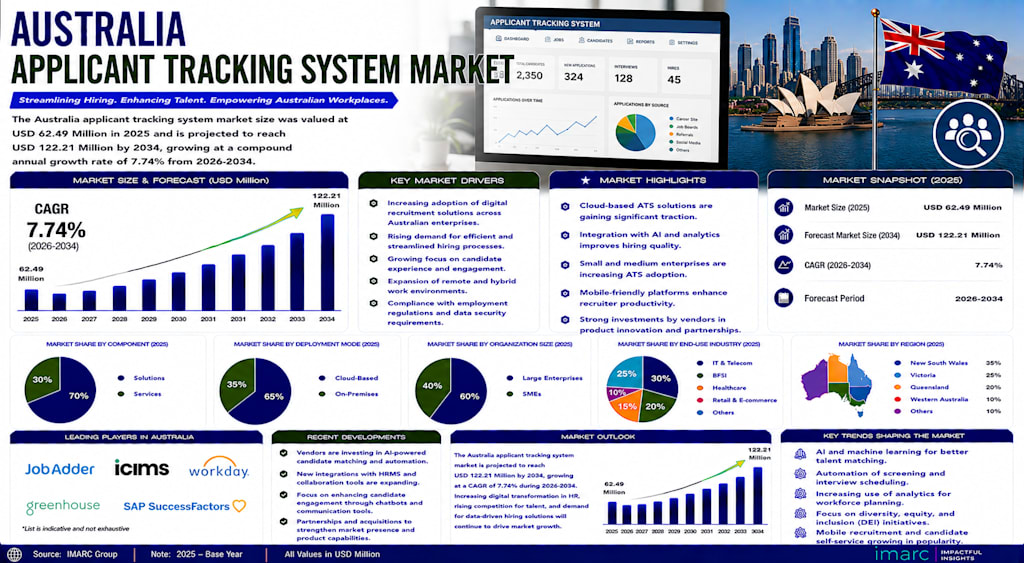
The Australia applicant tracking system market is undergoing a fundamental transformation as organisations across every sector abandon manual recruitment processes in favour of AI-powered, cloud-native platforms that promise faster hiring, better candidate matches and data-driven workforce decisions. Applicant tracking systems — encompassing recruitment software, candidate screening platforms, interview scheduling tools, and compliance management solutions — are deployed across IT, healthcare, finance, retail and government to streamline hiring workflows, manage applicant pipelines and improve talent acquisition outcomes in a persistently competitive labour market. According to IMARC Group, the market size reached USD 62.49 Million in 2025 and is projected to reach USD 122.21 Million by 2034, exhibiting a strong compound annual growth rate (CAGR) of 7.74% during 2026–2034.
The market is driven by rising recruitment digitisation, increasing adoption of cloud-based HR solutions, growing demand for efficient talent acquisition processes, and organisational focus on improving hiring compliance and candidate management, while businesses across industries continue investing in advanced analytics and automation to enhance workforce planning outcomes. As Australia faces a tech sector talent gap of 230,000 workers by 2030 and a projected shortage of more than 70,000 nurses by 2035, applicant tracking systems have become the strategic backbone of the nation's recruitment infrastructure.
What's Driving Market Growth?
AI-Powered Recruitment and Candidate Assessment. The integration of artificial intelligence into applicant tracking systems is revolutionising how Australian organisations identify, screen and select talent. Major platforms have launched AI Hiring Assistants in Australia, automating sourcing and screening to cut recruiter admin time, with early trials showing significantly fewer profile reviews, hours saved per role, and higher candidate engagement. Platforms are integrating automated skill testing, natural-language resume evaluation and predictive candidate ranking to enable faster hiring decisions. AI-driven talent acquisition software is now processing thousands of CVs and conducting thousands of AI interviews annually, reducing hiring cycles from weeks to days. These AI-enabled tools are becoming essential for organisations seeking more objective, data-supported recruitment outcomes.
Cloud Dominance and Scalable Recruitment Infrastructure. Cloud-based applicant tracking systems now dominate the Australian market with a substantial share, driven by scalability benefits, remote accessibility, reduced IT costs and faster platform deployment. Cloud platforms enable organisations to manage recruitment workflows efficiently across multiple locations, making them highly suitable for companies adapting to hybrid and distributed work models. The segment continues to expand as employers seek scalable solutions with lower infrastructure costs and faster implementation, with cloud platforms also providing frequent software updates, improved data storage capabilities and easier integration with HR ecosystems.
Technology Talent Gap Driving Enterprise Adoption. Australia's technology sector is facing a critical talent shortage that is accelerating ATS adoption. Recent reports indicate Australia's tech sector will require an additional 230,000 workers by 2030. The industry already contributes nearly USD 134 billion to the economy, employs over one million people, and continues to expand. The IT and telecommunications sector represents the largest end-user segment, supported by persistent demand for skilled professionals, rapid workforce expansion and high recruitment activity. Companies in this sector rely heavily on applicant tracking systems to efficiently manage large applicant pipelines and maintain competitive hiring turnaround times.
Compliance, Data Privacy and Regulatory Pressure. Applicant tracking systems in Australia are increasingly incorporating enhanced compliance and privacy management tools. Providers are developing features to support secure storage of candidate data, audit tracking, and compliance with employment and privacy regulations. Advanced AI tools are automating candidate data storage, profile updates and career tracking, with early trials showing faster hiring and reduced administrative work. Businesses are prioritising systems with strong governance frameworks to reduce legal risk and improve transparency in hiring processes, reflecting growing regulatory scrutiny around digital recruitment and workforce data handling.
Market Segmentation & Key Insights
By Deployment, cloud dominates the market, driven by scalability benefits, remote accessibility, reduced IT costs and faster platform deployment.
By Organization Size, large enterprises accounted for the highest market share, supported by high-volume hiring needs, structured recruitment workflows and greater investment in HR technology systems. Large organisations across finance, technology and public services invest heavily in advanced applicant tracking systems to strengthen workforce planning, with demand for sophisticated features such as analytics dashboards, candidate scoring and multi-location hiring management.
By Component, software leads the market due to demand for integrated recruitment platforms, automation features and advanced candidate tracking capabilities. Advanced software offerings increasingly include AI-driven candidate matching, workflow automation and reporting features, with rising adoption across industries reinforcing software as the primary driver of ATS spending.
By End-User, IT and telecommunications represented the biggest market share, owing to rapid workforce expansion, competitive talent demand and digital hiring process adoption. Other key end-users include BFSI, government and public sector, retail, manufacturing, and healthcare and life sciences.
By Region, Australia Capital Territory & New South Wales reigns the market, fueled by a well-established HR infrastructure, high recruitment activity and a concentrated corporate presence. NSW recorded the largest net increase in businesses during 2024–25, more than any other Australian state or territory.
What the Opportunities Are?
AI-Powered Recruitment Automation for High-Volume Hiring. With advanced AI tools demonstrating hiring cycle reductions from weeks to days and AI Hiring Assistants cutting recruiter admin time significantly, there is strong opportunity for ATS providers offering advanced AI-powered candidate screening, automated interview scheduling and predictive hiring analytics. The market is increasingly demanding platforms that can process thousands of applications while maintaining quality and fairness.
Mobile-First Recruitment Platforms for Candidate Engagement. ATS providers in Australia are enhancing mobile-first functionalities to accommodate job seekers who rely heavily on smartphones for applications. Employers are adopting platforms that enable mobile resume submission, real-time interview scheduling and instant communication, improving candidate engagement, reducing application drop-off rates and supporting faster recruitment cycles. Mobile optimisation is becoming a critical feature for organisations competing for talent in dynamic labour markets.
Video Interview Integration for Distributed Workforces. Australia's ATS market is experiencing rising integration of video interviewing tools within recruitment platforms. Companies are adopting built-in virtual interview capabilities to shorten hiring timelines and expand access to candidates in remote regions. Video-based assessments also support standardised evaluation processes and reduce travel-related costs. This trend is particularly relevant for organisations managing distributed workforces and high-volume recruitment requirements.
SME Adoption and Affordable ATS Solutions. While large enterprises currently dominate, future growth is expected to be supported by increased adoption among small and mid-sized businesses. However, high implementation and customisation costs remain a barrier, with organisations often requiring tailored workflows, integration with existing HR software and specialised training. Providers offering affordable, user-friendly ATS solutions tailored for SMEs can capture a significant underserved segment.
Sector-Specific Recruitment Customisation. The market is seeing demand for multilingual hiring platforms, workforce planning integration and sector-specific recruitment customisation. Advanced platforms are centralising workforce data, accelerating planning and aligning HR, finance and business leaders with AI-driven insights for permanent, contingent and gig workforce management. Providers offering customised solutions for healthcare, retail, manufacturing and government sectors will capture specialised demand.
Recent News and Developments in Australia Applicant Tracking System Market
Late 2025: Major global platforms launched AI Hiring Assistants in Australia, automating sourcing and screening to significantly cut recruiter admin time, with early trials showing fewer profile reviews, hours saved per role, and higher candidate engagement.
Late 2025: A leading ATS provider strengthened its Australian presence with new integrations and advanced tools, enhancing candidate experience, reducing spam and improving applicant relevance, serving hundreds of Asia-Pacific clients.
Late 2025: An Australian ATS provider launched an AI tool automating candidate data storage, profile updates and career tracking, with early trials showing faster hiring, reduced administrative work and improved fairness.
2025: AI-driven talent acquisition software processed tens of thousands of CVs and conducted thousands of AI interviews, reducing hiring cycles from weeks to days.
Why Should You Know About Australia Applicant Tracking System Market?
You should know about this market because it captures how artificial intelligence, workforce digitisation and competitive labour markets intersect to transform one of the most fundamental business functions — hiring. Applicant tracking systems are no longer simple resume databases — they are AI-powered recruitment engines that process thousands of applications, conduct video interviews, predict candidate success and automate compliance tracking. In a country facing a 230,000-worker tech talent gap and a shortage of more than 70,000 nurses by 2035, these systems are not just efficiency tools — they are strategic assets for national workforce development.
For investors, the applicant tracking system market offers exposure to a high-growth HR technology category anchored in Australia's persistent skills shortages, accelerating AI adoption across recruitment, and the structural shift from on-premise to cloud-based HR infrastructure. The projected CAGR of 7.74% reflects strong confidence in adoption trends, while higher-growth sub-segments — including AI-powered candidate screening, mobile-first recruitment platforms, video interview integration and SME-focused solutions — offer differentiated upside potential.
For HR leaders, recruitment technology vendors and workforce strategists, understanding segmentation across deployment models, organisation sizes and end-user industries, the emerging role of AI in hiring efficiency, and the growing importance of candidate relationship management helps shape intelligent investment decisions, product roadmaps and talent acquisition strategies that deliver measurable hiring speed, quality and compliance outcomes.
In essence, the Australia applicant tracking system market captures how recruitment technology, AI innovation and workforce demand converge — making it a compelling area for investors, technology vendors and HR leaders seeking smarter approaches to talent acquisition, candidate experience and sustainable workforce growth across Australia's dynamic and competitive labour market.
About the Creator
Thomas
Market Research Analyst | Industry Trends & Forecasting | Turning market data into clear, actionable business insights across global sectors.
Enjoyed the story? Support the Creator.
Subscribe for free to receive all their stories in your feed.
Comments
There are no comments for this story
Be the first to respond and start the conversation.