
Australia Anti-Money Laundering Market: Tranche 2 Expansion, AI Compliance Surge & Regulatory Enforcement
How 80,000+ new reporting entities, AUSTRAC's intensified enforcement and AI powered transaction monitoring are driving a 15.72% CAGR in Australia's AML market

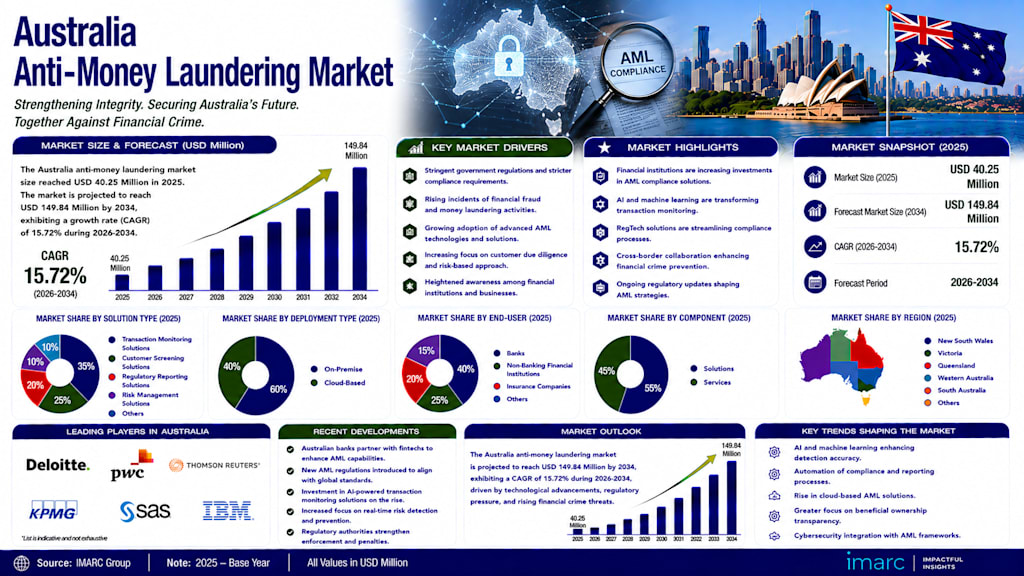
The Australia anti money laundering (AML) market is experiencing explosive growth as the most significant regulatory expansion since 2006 converges with surging digital transaction volumes and the rapid adoption of AI powered compliance technologies. AML solutions — encompassing transaction monitoring platforms, customer identity management systems, compliance management software and currency transaction reporting tools — are deployed across financial institutions, fintech platforms, government agencies and newly regulated professional services to detect, prevent and report suspicious financial activity in an increasingly complex threat environment. According to IMARC Group, the Australia anti money laundering (AML) market size reached USD 40.25 Million in 2025 and is projected to reach USD 149.84 Million by 2034, exhibiting a robust compound annual growth rate (CAGR) of 15.72% during 2026–2034. As the country's AML/CTF regime expands to cover an estimated 80,000 to 90,000 new entities and Australians lose over AUD 3 billion to scams annually, the market for advanced compliance solutions is poised for a near fourfold expansion within a decade.
What's Driving Market Growth?
Regulatory Expansion Through Tranche 2 Reforms. The passage of the Anti Money Laundering and Counter Terrorism Financing Amendment Bill 2024, which received parliamentary approval in November 2024, represents a paradigm shift in Australia's financial crime prevention landscape. The legislation extends AML/CTF obligations to previously exempt sectors, including real estate professionals, lawyers, accountants, trust and company service providers, and dealers in precious metals and stones. This legislative reform will dramatically expand the reporting population from approximately 17,000 to between 80,000 and 100,000 entities when compliance requirements take effect on 1 July 2026. For existing reporting entities, critical changes — including new AML/CTF program requirements, value transfer obligations and the replacement of 'designated business groups' with a new 'reporting group' framework — came into force on 31 March 2026. AUSTRAC has released comprehensive guidance frameworks and educational materials to support both current and newly captured entities in implementing effective AML/CTF measures, and the regulatory expansion necessitates significant investment in compliance infrastructure, including software solutions, training programs and operational processes.
AI Powered Compliance and Real Time Transaction Monitoring. Australian financial institutions are rapidly embracing artificial intelligence and advanced analytics technologies to enhance their AML capabilities. The integration of machine learning algorithms, natural language processing and predictive analytics is revolutionising how organisations detect suspicious activities, assess risk profiles and manage compliance obligations. Cloud based AML platforms are gaining prominence as they offer scalability, real time monitoring capabilities and seamless integration with digital payment infrastructures such as the New Payments Platform and PayTo instant payment systems. The adoption of AI powered solutions addresses critical challenges including reducing false positive rates that overwhelm compliance teams, improving detection accuracy for emerging financial crime typologies, and enabling institutions to process vast transaction volumes in real time. The regtech sector was the only fintech subsector experiencing growth in 2024, as organisations recognise that proactive investment in advanced compliance technologies provides competitive advantages through enhanced risk management, operational efficiency and regulatory confidence.
Heightened AUSTRAC Enforcement and Escalating Penalties. AUSTRAC's intensified enforcement activities and substantial financial penalties imposed on non compliant institutions are fundamentally reshaping organisational approaches to AML compliance. The regulatory landscape has witnessed unprecedented enforcement actions, with civil penalty proceedings resulting in hundreds of millions of dollars in fines against major financial institutions and gaming operators for serious and systemic AML/CTF breaches. Landmark penalties include a $450 million penalty** against Crown Melbourne and Crown Perth (July 2023), a **$67 million penalty against SkyCity Adelaide (June 2024), and ongoing proceedings against Entain Group (December 2024) and Mount Pritchard and District Community Club (July 2025). Recent enforcement cases have targeted inadequate transaction monitoring programs, insufficient customer due diligence processes, failures in beneficial ownership identification, and deficient governance oversight by boards and senior management. AUSTRAC's expanded investigatory powers, including the authority to compel individuals to attend compulsory examinations, signal an increasingly rigorous regulatory environment where personal accountability for compliance failures extends to directors and officers.
Crypto Asset and Virtual Asset Service Provider Oversight. The virtual asset sector remains a priority focus for AUSTRAC as a high money laundering risk. Australia implemented major AML reforms on 31 March 2026, expanding oversight beyond traditional exchanges to encompass Virtual Asset Service Providers (VASPs) — covering custody, brokerage and other crypto services. Under the new laws, all businesses providing virtual asset services must be registered with AUSTRAC and comply with Australia's AML/CTF obligations. AUSTRAC has launched targeted supervisory campaigns evaluating the AML and risk management frameworks of virtual asset service providers, and has proposed new powers to target 'high risk' crypto ATMs.
Market Segmentation & Key Insights
By Component, the market is divided into software and services. Software dominates, including transaction monitoring, customer identity management and compliance reporting tools. Services such as consulting, integration and support are growing steadily. By Product, key segments include compliance management, currency transaction reporting, customer identity management and transaction monitoring. By Deployment Mode, cloud based solutions are gaining traction due to scalability and real time monitoring capabilities, while on premise systems are used by organisations requiring high data control. By Enterprise Size, large enterprises lead adoption due to strict compliance requirements, while SMEs are increasingly adopting AML solutions as regulatory awareness grows. By End Use, the BFSI sector dominates due to high exposure to financial crimes, followed by government and regulatory bodies, with fintech and digital payment platforms representing rapidly growing segments. By Region, major markets include Australia Capital Territory & New South Wales, Victoria & Tasmania, Queensland, Northern Territory & Southern Australia and Western Australia. NSW and ACT represent the largest regional market, driven by the concentration of major financial institutions, government agencies and corporate headquarters in Sydney and Canberra.
What the Opportunities Are?
AI Powered Transaction Monitoring and Real Time Risk Assessment. The shift from compliance based to outcomes oriented AML frameworks, effective from 31 March 2026, creates strong demand for advanced AI powered transaction monitoring systems. Organisations must move beyond legacy rules based detection to intelligent platforms that can identify sophisticated money laundering patterns in real time. The integration of graph based analytics to uncover patterns of illicit behaviour, machine learning models that surface overlooked anomalies, and automated investigation workflows represents a significant growth frontier. In June 2026, Concentrix Corporation announced a collaboration with RegTech firm Napier AI to deliver AI powered AML solutions across Australia and New Zealand, targeting banks, financial services organisations, and entities affected by Tranche 2 AML obligations.
Compliance Automation for Tranche 2 Entity Onboarding. With up to 100,000 new entities required to enrol with AUSTRAC by 1 July 2026, there is an unprecedented demand for scalable compliance onboarding solutions, automated risk assessment tools and entity specific AML program frameworks. Lawyers, accountants, real estate agents and precious metals dealers — many with no prior AML compliance experience — require simplified, sector tailored solutions that can be deployed quickly. Under AUSTRAC's regulatory expectations, Tranche 2 entities must be enrolled, have an AML/CTF program in place, appoint a compliance officer and train all staff by 1 July 2026. Providers offering pre configured AML compliance packages, automated customer due diligence workflows and ongoing monitoring services for professional services firms are positioned to capture substantial market share.
RegTech as a Service for Small and Medium Enterprises. The SME segment, newly captured under Tranche 2, lacks the dedicated compliance teams that large financial institutions employ. There is strong opportunity for RegTech as a service providers offering subscription based AML platforms that combine automated transaction monitoring, customer screening, suspicious matter reporting and compliance audit trails. With an estimated 80,000 to 100,000 new entities seeking solutions before the July 2026 deadline, scalable, cost effective offerings that minimise manual intervention will capture significant first mover advantage.
Blockchain Based Transaction Traceability and Cryptocurrency Compliance. As cryptocurrency and virtual asset service providers come under full AML/CTF oversight, there is growing demand for blockchain analytics solutions that can trace fund flows across decentralised networks, identify wallet risk profiles and provide admissible evidence for suspicious matter reporting. The expansion of the AML/CTF regime to cover VASPs creates a new addressable market of crypto businesses requiring transaction monitoring, KYC compliance and suspicious activity detection tailored to digital asset environments.
Sanctions Screening and Proliferation Financing Detection. With Australia aligning its framework with FATF international standards ahead of its 2026 27 assessment — where a poor result risks the country being 'grey listed' — entities must implement robust sanctions screening systems capable of detecting potential proliferation financing activity. This creates opportunities for vendors offering integrated sanctions list management, real time transaction screening against global watchlists and automated sanctions escalation workflows.
Fraud and Scam Prevention Integration. Australians lost over AUD 3 billion to scams in 2024, with losses rising substantially year on year. Organisations are increasingly seeking integrated solutions that unify fraud detection and AML compliance, enabling faster identification of scam related transaction patterns and cross channel intelligence sharing. Vendors offering unified fraud and AML platforms that leverage shared data sets and analytics engines can capture the growing convergence of financial crime prevention.
Recent News and Developments in Australia Anti Money Laundering Market
June 2026: Concentrix Corporation announced a strategic partnership with Napier AI to deliver AI powered AML solutions across Australia and New Zealand, targeting banks, financial services firms and Tranche 2 entities, marking a significant expansion of RegTech capabilities in the region.
April 2026: AUSTRAC opened enrolment for new professions under the expanded AML/CTF regime, with Tranche 2 entities required to enrol by 29 July 2026.
March 2026: Major AML/CTF changes came into effect on 31 March 2026 for existing reporting entities, including new AML/CTF program obligations, value transfer requirements and the replacement of 'designated business groups' with new 'reporting groups'.
February 2026: Herbert Smith Freehills reported that the introduction of the Amended AML/CTF Act and New Rules marked a significant shift, requiring entities to overhaul compliance frameworks, strengthen governance, and embed sanctions and proliferation financing controls.
December 2025: AUSTRAC applied for civil penalty orders against Castra Licensee Pty Ltd and Princeton Securities (NSW) Pty Ltd for alleged failure to lodge compliance reports for the 2023 calendar year.
October 2025: AUSTRAC released core guidance materials for both current and future reporting entities to comply with changes to AML/CTF legislation.
September 2025: AUSTRAC fined a remittance service provider $187,800 for late submission of AML/CTF reports, highlighting the importance of timely reporting ahead of the expanded regime.
July 2025: AUSTRAC applied for civil penalty orders against Mount Pritchard and District Community Club Ltd for alleged serious and systemic non compliance with Australia's AML/CTF laws. AUSTRAC released its regulatory priorities for 2025 26, focusing on improving risk management within the digital currency exchange sector and by virtual asset service providers.
Why Should You Know About Australia Anti Money Laundering Market?
You should know about this market because it captures how regulatory expansion, AI powered compliance and stringent enforcement intersect to create one of the fastest growing financial technology segments in Australia's economy. AML solutions are no longer optional back office functions — they are strategic imperatives that protect financial institutions from billion dollar penalties, enable fintech platforms to operate securely, and empower professional services firms to meet their legal obligations as newly regulated gatekeepers.
For investors, the AML market offers exposure to a high growth RegTech category anchored in the most significant AML/CTF regulatory expansion since 2006, the tripling of AUSTRAC's regulated population, and the irreversible shift from rules based legacy systems to AI powered, real time compliance platforms. The projected CAGR of 15.72% — more than triple the growth rate of the broader Australian economy — reflects strong confidence in regulatory tailwinds, technological innovation and the recurring revenue models inherent to subscription based compliance software.
For financial compliance officers, technology vendors, legal practitioners and business leaders, understanding AML segmentation across transaction monitoring, identity management and compliance reporting, the architecture of the reformed AML/CTF Rules taking effect in March and July 2026, and the emerging threat landscape of crypto based money laundering and AI generated financial fraud helps shape intelligent investment decisions, product development roadmaps and compliance strategies that deliver measurable risk reduction, regulatory confidence and operational efficiency.
In essence, the Australia anti money laundering market captures how financial integrity, digital innovation and regulatory sovereignty converge — making it a compelling area for investors, technology developers and compliance professionals seeking smarter approaches to financial crime prevention, automated regulatory compliance and sustainable growth in one of the world's most closely watched AML jurisdictions.
About the Creator
Thomas
Market Research Analyst | Industry Trends & Forecasting | Turning market data into clear, actionable business insights across global sectors.
Enjoyed the story? Support the Creator.
Subscribe for free to receive all their stories in your feed.
Comments
There are no comments for this story
Be the first to respond and start the conversation.