
Australia Anti-Caking Market to Grow Steadily Driven by Processed Food Demand and Food Safety Standards
Rising consumption of packaged foods, stricter quality regulations, and innovation in food additives are accelerating the use of anti-caking agents across Australia’s food and feed industries.

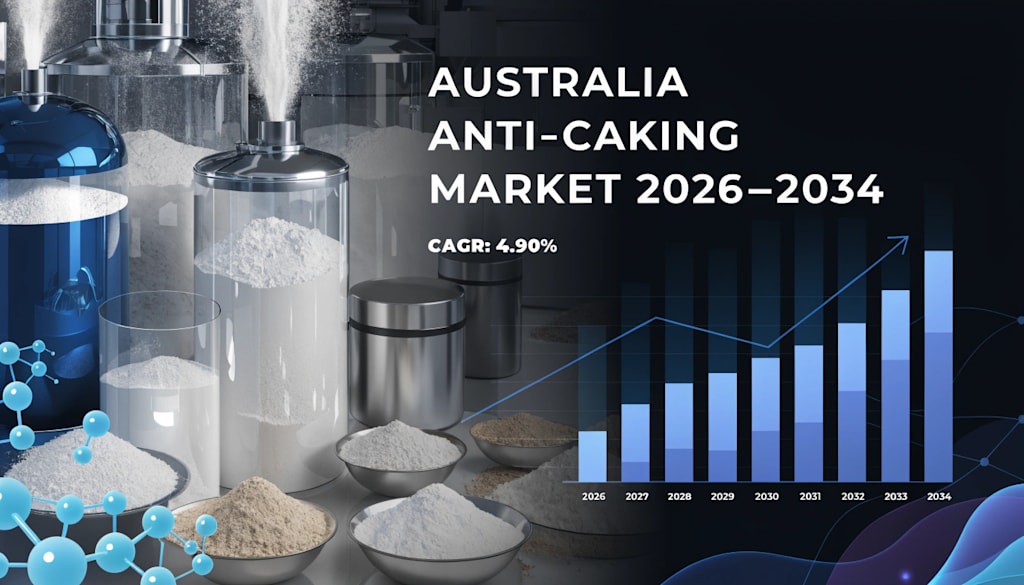
The Australia anti-caking market is witnessing consistent and structurally driven growth as food manufacturers increasingly prioritize product stability, shelf life, and quality consistency. According to IMARC Group, the market reached a value of USD 16.54 million in 2024 and is projected to expand to USD 26.28 million by 2033, registering a CAGR of 5.28% during 2025–2033.
Anti-caking agents are functional food additives used to prevent the formation of lumps in powdered or granulated products. They ensure free-flowing characteristics in products such as salt, spices, milk powders, baking mixes, and seasoning blends. In Australia, their usage is expanding beyond traditional food applications into animal feed and processed industrial formulations, reflecting the broader evolution of the food additives ecosystem.
Request a Business Sample Report for Procurement & Investment Evaluation:
Why the Market Is Growing So Rapidly
One of the strongest growth drivers is the rising demand for processed and convenience foods. As consumer lifestyles become more urbanized and time-constrained, there is increasing reliance on ready-to-eat and packaged food products. Anti-caking agents play a critical role in maintaining the usability and texture of these products, ensuring ingredients remain free-flowing and easy to measure or mix.
Another key factor is the heightened focus on food safety and quality regulations. Australian food regulatory frameworks are becoming more stringent, encouraging manufacturers to adopt reliable additives that ensure consistency, hygiene, and compliance. Anti-caking agents help maintain uniformity in food powders and reduce contamination risks caused by moisture absorption and clumping.
The expansion of the food processing industry is also contributing significantly. As the sector grows, particularly in dairy, bakery, and seasoning applications, the need for stable powdered ingredients is increasing. This directly supports demand for anti-caking solutions that enhance product performance and extend shelf life.
Technological advancements in food additives are further accelerating market development. Manufacturers are investing in R&D to develop cleaner-label, more natural anti-caking agents that align with growing consumer preference for transparency and minimally processed ingredients. Innovations are also improving performance efficiency across different environmental conditions.
Lastly, the rise of dietary supplements and health-focused nutrition products is expanding application scope. Many powdered supplements require anti-caking agents to maintain flowability and dosage accuracy, making them essential in the evolving health and wellness segment.
What the Opportunities Are
The Australia anti-caking market offers several important growth opportunities across food, agriculture, and industrial applications.
First, clean-label and natural ingredient development is a major opportunity. Consumers are increasingly demanding transparency in food formulations, encouraging manufacturers to develop plant-based or naturally derived anti-caking agents.
Second, expansion in functional foods and dietary supplements is creating strong demand. Protein powders, vitamin blends, and nutritional supplements require high-performance flow agents to maintain consistency and usability.
Third, growth in the animal feed industry is opening new application areas. Anti-caking agents are widely used in feed formulations to ensure even nutrient distribution and prevent spoilage during storage and transport.
Fourth, innovation in dairy and bakery applications presents opportunities for specialized formulations. These segments require moisture-resistant additives that maintain texture and stability under varying storage conditions.
Fifth, technological improvements in production processes are enabling cost-effective and more sustainable additive solutions, allowing manufacturers to scale production while meeting environmental standards.
Sixth, expansion of packaged food exports from Australia is increasing demand for additives that ensure long-distance shelf stability, particularly in humid or variable climate conditions.
Finally, cross-industry applications beyond food, such as fertilizers and industrial powders, are gradually widening the addressable market for anti-caking technologies.
• February 2025: Australian food safety authorities reinforced regulatory frameworks governing food additives, emphasizing stricter compliance for moisture-control agents used in processed foods. The updated guidelines aim to ensure higher product safety standards and improve transparency in labeling practices across packaged food categories. This has encouraged manufacturers to invest in certified and traceable anti-caking solutions to align with evolving regulatory expectations.
• June 2025: Major food processing companies in Australia expanded production capacity for seasoning mixes and instant food products, leading to higher consumption of anti-caking agents. Manufacturers reported increased adoption of silicon dioxide and calcium-based compounds to improve product stability in humid storage environments. This expansion reflects strong domestic demand for convenient food formats driven by busy urban lifestyles.
• September 2025: The dietary supplements industry in Australia recorded significant growth in powdered nutrition products, including protein and vitamin blends. This trend boosted demand for anti-caking agents to ensure uniform mixing and dosage accuracy. Companies in the health and wellness sector increasingly integrated advanced flow-control additives to enhance product performance and consumer experience.
Why Should You Know About the Australia Anti-Caking Market?
The Australia anti-caking market may appear niche, but it sits at the core of the country’s food processing and ingredient technology ecosystem. Its importance is directly tied to how modern food systems ensure quality, consistency, and usability in everyday products.
For investors, the market offers stable, steady growth driven by essential demand rather than cyclical consumption patterns. It benefits from structural trends such as urbanization, processed food consumption, and regulatory tightening.
For food manufacturers, anti-caking agents are critical enablers of product performance, influencing everything from shelf life to consumer experience. Innovation in clean-label and natural additives is becoming a key competitive differentiator.
For policymakers and regulators, the market plays an important role in food safety and quality assurance frameworks. Ensuring proper additive use supports broader goals of public health and consumer protection.
Overall, the market represents a foundational but often overlooked segment of the food ingredients industry—quietly enabling the smooth functioning of modern food systems in Australia.
About the Creator
Rashi Sharma
I am a market researcher.
Enjoyed the story? Support the Creator.
Subscribe for free to receive all their stories in your feed.
Comments
There are no comments for this story
Be the first to respond and start the conversation.