
Australia Anti-Caking Market Grows Steadily as Food Processing and Packaged Products Expand
Rising demand for processed foods, longer shelf life, and improved product quality is driving growth across Australia’s anti-caking industry.

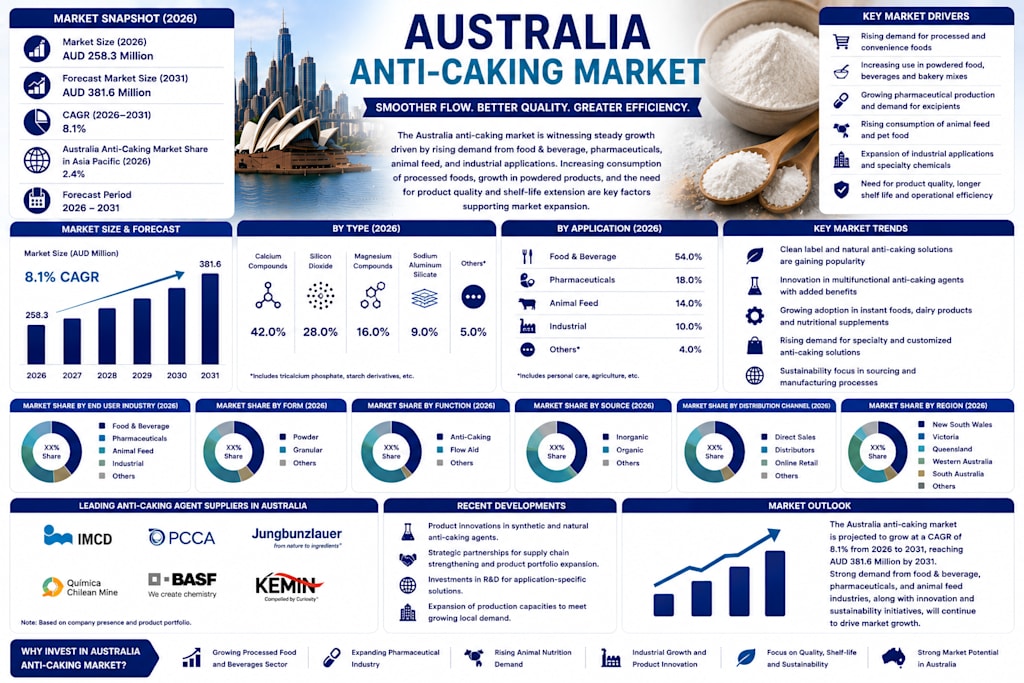
Australia’s anti-caking market is experiencing stable growth as the country’s food processing and packaged goods industries continue expanding. Anti-caking agents, which prevent powdered and granulated products from clumping together, have become increasingly important across food manufacturing, pharmaceuticals, agriculture, and industrial applications. According to IMARC Group, the Australia anti-caking market reached USD 17.4 Million in 2025 and is expected to reach USD 27.1 Million by 2034, growing at a CAGR of 4.87% during 2026–2034.
The market’s growth reflects changing consumer lifestyles and the increasing demand for convenience-oriented packaged products. As Australians consume more ready-to-eat meals, seasoning blends, powdered beverages, bakery mixes, and processed food products, manufacturers are relying more heavily on anti-caking solutions to maintain product texture, quality, and shelf stability.
Anti-caking agents play a critical role in preserving product flowability and preventing moisture-related clumping during storage and transportation. These additives are widely used in products such as salt, powdered milk, soup mixes, spices, coffee creamers, protein powders, and nutritional supplements. Their importance continues to grow as food companies prioritize consistency, packaging efficiency, and longer product shelf life.
Request a Business Sample Report for Procurement & Investment Evaluation:
According to IMARC, the market is segmented across several major categories:
• By Type: Calcium Compounds, Sodium Compounds, Magnesium Compounds, Microcrystalline Cellulose, Silicon Dioxide, Others
• By Application: Food and Beverage, Cosmetics and Personal Care, Feed, Fertilizers, Others
• By Source: Natural, Synthetic
• By Region: New South Wales, Victoria, Queensland, Western Australia, South Australia, Others
Australia’s expanding food manufacturing ecosystem and increasing focus on product quality standards are further strengthening demand across the anti-caking ingredients sector.
Why the Market Is Growing So Rapidly
One of the key growth drivers is the continued expansion of Australia’s processed food industry. Consumers increasingly prefer convenient and shelf-stable food products that offer ease of preparation and longer storage life. This trend has significantly increased demand for powdered and granulated ingredients that require anti-caking solutions to maintain quality and usability.
The rise in packaged food consumption is also supporting market growth. Products such as instant beverages, seasoning blends, dairy powders, nutritional supplements, and bakery premixes rely heavily on anti-caking agents to prevent clumping and maintain texture consistency. As demand for convenience foods continues increasing, manufacturers are investing more in ingredient technologies that improve product performance and consumer experience.
Australia’s growing sports nutrition and health supplement industries are creating additional opportunities. Protein powders, meal replacements, powdered vitamins, and dietary supplements require stable formulations and smooth flow characteristics during production and packaging. Anti-caking agents help maintain product integrity while improving shelf stability and handling efficiency.
Another major factor contributing to market expansion is increasing emphasis on food safety and product quality standards. Manufacturers are adopting advanced food processing practices and ingredient solutions that improve consistency, reduce waste, and support regulatory compliance. Anti-caking technologies help maintain uniformity across packaged products while minimizing moisture-related quality issues.
Industrial and agricultural applications are also supporting broader market demand. Anti-caking compounds are commonly used in fertilizers, animal feed, and industrial powders to improve storage, transport, and application efficiency. As Australia’s agricultural and industrial sectors continue modernizing, demand for functional additive solutions is expected to remain strong.
What the Opportunities Are
1. Growth in Convenience and Packaged Foods
The expanding market for ready-to-eat meals, powdered beverages, and processed ingredients continues creating strong opportunities for anti-caking solutions.
2. Rising Demand for Nutritional Supplements
Sports nutrition and wellness products require stable powdered formulations, supporting long-term demand for anti-caking ingredients.
3. Expansion of Natural Ingredient Solutions
Manufacturers developing plant-based and naturally derived anti-caking agents can benefit from growing clean-label consumer preferences.
4. Food Export and Shelf-Life Optimization
Australia’s export-focused food industry requires advanced preservation and flow-enhancement technologies to maintain product quality during transportation.
5. Industrial and Agricultural Applications
Fertilizers, feed products, and industrial powders present additional growth opportunities for anti-caking compound suppliers.
6. Innovation in Moisture-Control Technologies
Advanced ingredient formulations capable of improving humidity resistance and product stability can strengthen market competitiveness.
7. Increasing Demand for Sustainable Packaging Systems
Anti-caking technologies integrated with modern packaging innovations may improve product preservation and reduce material waste.
• February 2025: Australian food manufacturing discussions continued emphasizing improved ingredient functionality and product stability across packaged food categories. Several manufacturers expanded investments in advanced food processing technologies aimed at improving shelf life and maintaining product consistency. Industry participants highlighted increasing demand for powdered food formulations and convenience-oriented products.
• June 2025: Multiple ingredient suppliers introduced upgraded anti-caking formulations designed for enhanced moisture resistance and cleaner-label food applications. Companies also focused on developing naturally derived additive solutions aligned with evolving consumer preferences for transparency and sustainable food ingredients. Market analysts observed rising adoption of premium ingredient technologies within Australia’s processed food sector.
• September 2025: Australia’s packaged food and nutritional supplement industries reported continued growth in demand for powdered and granulated product formats. Manufacturers highlighted stronger demand for efficient flow-enhancement solutions supporting production scalability and packaging efficiency. Industry forecasts also indicated positive long-term momentum across food processing and functional ingredient markets.
Why Should You Know About Australia Anti-Caking Market?
The Australia anti-caking market may appear highly specialized, but it plays an essential role in modern food manufacturing, product quality management, and industrial processing. From packaged foods and nutritional supplements to fertilizers and feed products, anti-caking technologies help ensure product consistency, shelf stability, and operational efficiency across multiple industries.
For investors, the market offers reliable long-term growth supported by rising processed food consumption, expanding wellness industries, and increasing industrial applications. For manufacturers, anti-caking ingredients are critical for maintaining product quality and improving supply chain efficiency. For policymakers and industry leaders, the market highlights the importance of advanced food processing technologies and ingredient innovation within Australia’s evolving manufacturing economy.
As consumer demand for convenience, quality, and shelf-stable products continues rising, Australia’s anti-caking industry is positioned for sustained growth over the coming decade.
About the Creator
Rashi Sharma
I am a market researcher.
Enjoyed the story? Support the Creator.
Subscribe for free to receive all their stories in your feed.
Comments
There are no comments for this story
Be the first to respond and start the conversation.