
Australia Air Purifier Market Witnesses Strong Growth Amid Rising Focus on Indoor Air Quality
Health awareness, smart home adoption, and growing concerns over airborne pollutants are driving demand for advanced air purification solutions across Australia.

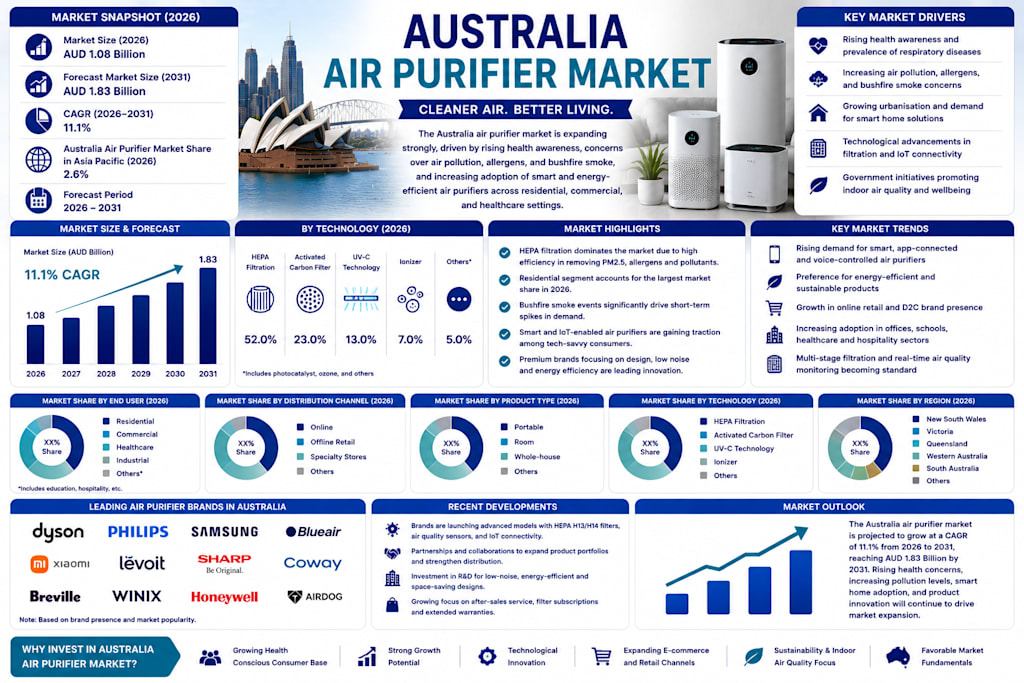
Australia’s air purifier industry is rapidly gaining momentum as consumers and businesses increasingly prioritize healthier indoor environments. Rising concerns surrounding air pollution, allergens, bushfire smoke, and respiratory wellness are transforming air purification systems into essential household and commercial products. According to IMARC Group, the Australia air purifier market was valued at USD 438.89 Million in 2025 and is projected to reach USD 861.09 Million by 2034, expanding at a CAGR of 7.78% during 2026–2034.
The growing emphasis on indoor wellness is reshaping purchasing behavior across Australia. Consumers are becoming more aware that indoor spaces can contain harmful pollutants such as dust particles, smoke residue, mold spores, pollen, bacteria, and volatile organic compounds. As Australians spend more time indoors for work, education, and recreation, maintaining clean indoor air has become an increasingly important part of modern living.
One of the major factors supporting market growth is Australia’s recurring bushfire activity. Severe wildfire seasons over recent years have heightened awareness regarding airborne particulate exposure and long-term respiratory health risks. During periods of heavy smoke conditions, air purifiers have become critical tools for maintaining safer indoor environments, especially for children, older adults, and individuals with respiratory sensitivities.
Request a Business Sample Report for Procurement & Investment Evaluation:
According to IMARC, the market is segmented into several major categories:
• By Filter Type: HEPA, Activated Carbon, Ionic Filters, Electrostatic Precipitators, Others
• By Technology: High-Efficiency Particulate Air (HEPA), Activated Carbon, Ionic, Others
• By Coverage Area: Below 250 Sq. Ft., 250–400 Sq. Ft., Above 400 Sq. Ft.
• By Distribution Channel: Supermarkets and Hypermarkets, Specialty Stores, Online Stores, Others
• By End Use: Residential, Commercial, Industrial
• By Region: New South Wales, Victoria, Queensland, Western Australia, South Australia, Others
The increasing availability of smart, energy-efficient, and portable purification systems is further accelerating consumer adoption across residential and commercial sectors.
Why the Market Is Growing So Rapidly
Health and wellness awareness remains one of the strongest growth drivers for Australia’s air purifier market. Consumers are increasingly seeking solutions that can reduce exposure to allergens, airborne bacteria, smoke particles, and pollutants linked to respiratory illnesses and poor indoor air quality. This growing health consciousness is encouraging stronger adoption of advanced filtration technologies in homes, offices, schools, and healthcare facilities.
Australia’s environmental conditions are also playing a significant role in market expansion. Bushfire smoke events and seasonal air-quality fluctuations have made indoor air management a priority for many households. Consumers now view air purifiers as long-term investments that can improve comfort, reduce health risks, and provide protection during periods of poor environmental conditions.
Technology innovation is transforming the industry as well. Manufacturers are introducing intelligent air purification systems equipped with real-time air quality monitoring, automated filtration adjustment, mobile application controls, and voice assistant compatibility. These smart features are making air purifiers more user-friendly while appealing to technology-focused consumers seeking connected home solutions.
Commercial demand is expanding rapidly across offices, retail environments, hotels, educational institutions, and healthcare facilities. Businesses are increasingly investing in cleaner indoor environments to improve employee wellbeing, customer confidence, and workplace productivity. Advanced filtration systems are becoming especially important in healthcare and hospitality settings where air quality standards play a critical role in operational safety and customer experience.
The rapid growth of e-commerce and online retail platforms is also contributing to stronger market penetration. Consumers now have easier access to premium air purification products, detailed product comparisons, and educational resources that support informed purchasing decisions. Online channels are helping manufacturers reach broader audiences across metropolitan and regional markets alike.
What the Opportunities Are
1. Expansion of Smart Air Purification Systems
Smart-enabled air purifiers featuring app connectivity and automated monitoring are becoming increasingly attractive within Australia’s growing smart home market.
2. Rising Healthcare and Institutional Adoption
Hospitals, clinics, aged-care centers, and schools present strong opportunities for commercial-grade air purification systems.
3. Growth in Portable and Compact Solutions
Urban households and apartment residents are driving demand for smaller, portable purification devices suitable for personal spaces and home offices.
4. Sustainable and Energy-Efficient Product Development
Manufacturers investing in eco-friendly filtration technologies and low-energy systems can strengthen long-term market competitiveness.
5. Increasing Commercial Workplace Demand
Businesses prioritizing employee wellness and healthier indoor work environments continue expanding opportunities for large-scale purification systems.
6. Bushfire Preparedness and Emergency Indoor Safety
Recurring wildfire seasons are likely to support sustained consumer demand for advanced residential air purification solutions.
7. Expansion Through Online Retail Channels
Digital commerce platforms provide opportunities for brands to improve accessibility, customer education, and nationwide product distribution.
• January 2025: Australian health and environmental discussions continued emphasizing the importance of indoor air quality management amid increasing awareness of respiratory wellness and airborne pollution risks. Several educational institutions and healthcare facilities expanded investments in advanced filtration infrastructure to improve indoor environmental standards. Industry participants reported growing consumer interest in HEPA-based purification technologies during seasonal air-quality fluctuations.
• May 2025: Multiple air purifier manufacturers launched upgraded smart filtration systems featuring AI-powered air monitoring, mobile controls, and enhanced energy efficiency. Companies also expanded product lines targeting residential users seeking compact and connected indoor air solutions. Market analysts observed rising consumer demand for intelligent purification systems integrated with smart home ecosystems.
• September 2025: Australia’s air purifier sector reported continued sales growth driven by increasing concerns over allergens, smoke exposure, and indoor wellness. Retailers highlighted stronger demand for portable air purification devices among urban households and remote-working professionals. Industry forecasts also indicated rising commercial investment in advanced air quality systems across offices, hospitality venues, and healthcare facilities.
Why Should You Know About Australia Air Purifier Market?
The Australia air purifier market reflects a broader transformation in how consumers and organizations approach health, environmental awareness, and indoor living standards. Air purification is increasingly viewed not only as a convenience product but also as an essential component of preventive wellness and modern home infrastructure.
For investors, the market offers long-term growth potential supported by rising health awareness, environmental challenges, and rapid smart technology adoption. For manufacturers and retailers, evolving consumer expectations are creating opportunities for innovation across connected devices, energy efficiency, and wellness-focused product design. For policymakers and public health leaders, improving indoor air quality can contribute to stronger respiratory health outcomes and more resilient communities.
As Australians continue prioritizing cleaner indoor environments and healthier lifestyles, the country’s air purifier industry is positioned for sustained growth throughout the coming decade.
About the Creator
Rashi Sharma
I am a market researcher.
Enjoyed the story? Support the Creator.
Subscribe for free to receive all their stories in your feed.
Comments
There are no comments for this story
Be the first to respond and start the conversation.