
Australia Agricultural Testing Market 2026: Precision Farming, Food Safety & Quality Assurance
How rising demand for crop quality, sustainable practices and regulatory compliance is driving growth in agricultural testing across Australia

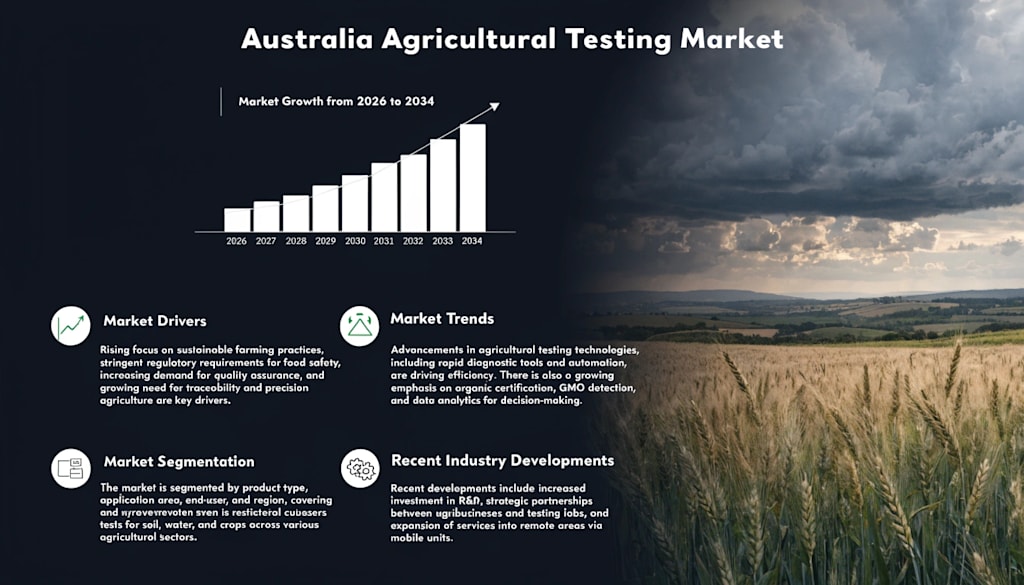
The Australia agricultural testing market is steadily expanding as farmers, food producers, agribusinesses and regulatory bodies increasingly prioritise quality assurance, sustainability and safety across agricultural value chains. Agricultural testing — including soil analysis, crop nutrient profiling, pesticide residue testing, food quality evaluation and environmental assessment — is crucial for improving farm productivity, meeting export standards and complying with food safety regulations. According to IMARC Group, the market size reached USD 122.20 Million in 2025 and is projected to reach USD 174.68 Million by 2034, exhibiting a compound annual growth rate (CAGR) of 4.05% during 2026–2034. As Australia embraces precision farming techniques, data-driven decision-making and stringent food quality requirements, agricultural testing systems are becoming integral to modern agronomic practice.
What's Driving Market Growth?
Focus on Food Safety and Export Regulations. Australia's farming industry is a significant worldwide supplier of goods like grains, livestock, wine and horticultural products. Producers must demonstrate product quality through extensive testing for contaminants, pathogens and chemical residues to enter international markets and meet safety standards. Thorough agricultural evaluations guarantee that products comply with export requirements, protect consumer well-being and uphold brand integrity internationally.
Agricultural Precision & Data-Driven Agriculture. Techniques in precision agriculture — such as soil sampling, nutrient mapping and crop health analysis — utilise agricultural testing to enhance input efficiency (fertiliser, irrigation, pesticides) and increase yields while minimising waste. Recognising deficiencies and stressors early allows farmers to customise interventions, optimise resource distribution and boost sustainability.
Stringent Regulatory Frameworks. Government regulations around food safety, environmental protection and residue limits for pesticides and veterinary drugs necessitate regular testing across production cycles. Compliance with national and international regulatory standards obliges agribusinesses to adopt robust testing protocols to verify that products meet legal criteria before commercialisation and export.
Environmental Sustainability & Traceability. Sustainability initiatives within agriculture — including soil health monitoring, water quality assessment and residue tracking — depend heavily on analytical testing services. These services help producers adopt sustainable practices that preserve soil fertility, protect ecosystems and meet environmental stewardship standards demanded by consumers and regulators alike.
Market Segmentation & Key Insights
By Sample Type, the market includes testing for water, soil, seed, biosolids, manure and other agricultural inputs. Soil and water testing remain dominant due to their critical role in precision farming and regulatory compliance.
By Technology Type, testing technologies are categorised into conventional, rapid and others. Rapid testing solutions are gaining traction as farmers and agribusinesses seek faster turnaround times for on-farm decision-making.
By Application, the market is segmented into safety testing, quality assurance and others. Safety testing for contaminants, pathogens and chemical residues holds the largest share, driven by export requirements and domestic food safety standards.
By Region, major regional markets include Australia Capital Territory & New South Wales, Victoria & Tasmania, Queensland, Northern Territory & Southern Australia and Western Australia.
What the Opportunities Are?
Precision & Rapid Diagnostic Solutions. There is strong opportunity for growth in point-of-care and on-farm testing technologies that deliver fast, real-time data. Portable soil sensors, handheld diagnostic tools and field testing kits enable quicker decision-making and reduce turnaround time compared to traditional laboratory services.
Digital Integration & Data Analytics. Combining agricultural testing results with data analytics platforms and farm management software creates actionable insights that improve crop performance, mitigate risk and support strategic planning. Cloud-based platforms and AI-driven recommendations can further enhance predictive capability and resource optimisation.
Sustainable Agriculture Credentials. Testing services that support sustainability certifications — such as organic verification, low-residue crop certification and environmentally responsible farming labels — provide value to producers targeting premium market segments and export markets with strict eco-standards.
Collaborative Research & Innovation Partnerships. Partnerships between laboratories, agritech companies and research institutions can drive innovation in analytical methods, improve testing accuracy and expand the scope of services offered. Collaborative initiatives can support the development of new tests addressing emerging challenges such as climate variability and pest resistance.
Training & Advisory Services. As testing technologies become more sophisticated, demand is growing for professional training, installation support, maintenance contracts and analytics optimisation services that help agricultural stakeholders maximise system ROI and ensure dependable performance.
Recent News and Developments in Australia Agricultural Testing Market
May 2025: FreshTest, Australia's largest horticultural residue-testing program, added 12 new detectable chemicals to its Mega Screens, now detecting more than 480 analytes. The expansion strengthens residue detection, compliance and spray drift monitoring across the fresh produce industry.
August 2025: Australia-based MALDIID announced expansion with a second laboratory on the eastern coast, driven by the emerging voluntary Code of Practice for biostimulants introduced by Fertilizer Australia. The code requires a number of tests to be conducted, presenting a significant growth area for biologicals testing services.
November 2025: The Grains Research and Development Corporation (GRDC) invested $4.5 million into the Australian Plant Phenomics Network (APPN) to equip researchers with cutting-edge crop measurement technology, including hyperspectral and multispectral sensors for disease detection and nutrient assessment.
March 2026: The QUOLL electronic nose from Australia moved toward commercialisation, offering a faster, cheaper and more affordable way to assess soil biology functioning directly in the field without relying on laboratory testing. The technology is positioned to inform on-farm management and potentially support carbon market participation.
Why Should You Know About Australia Agricultural Testing Market?
You should know about this market because it illustrates how food safety priorities, technological evolution and sustainability requirements intersect to create steady growth opportunities in a mission-critical segment of Australia's agricultural landscape. Agricultural testing is no longer just a compliance exercise — it is an intelligent tool that helps farmers, agribusinesses and regulators monitor soil health, verify product quality, prevent contamination and respond quickly to biosecurity threats.
For investors, the agricultural testing market offers exposure to a stable-growth technology category anchored in increasing food safety demand, precision farming adoption and expanding export compliance requirements. The projected CAGR of 4.05% reflects consistent confidence in adoption trends, technological differentiation and recurring service opportunities tied to quality assurance and regulatory compliance.
For agribusiness operators, technology partners, farm managers and supply chain planners, understanding agricultural testing segmentation, rapid diagnostics trends, deployment architectures and integration strategies helps shape intelligent investment decisions, procurement roadmaps and solution designs that deliver measurable safety and quality outcomes.
In essence, the Australia agricultural testing market captures how safety, technology and data-driven agriculture converge — making it a compelling area for innovators, investors and organisations seeking smarter approaches to food quality, environmental stewardship and operational visibility.
About the Creator
Thomas
Market Research Analyst | Industry Trends & Forecasting | Turning market data into clear, actionable business insights across global sectors.
Enjoyed the story? Support the Creator.
Subscribe for free to receive all their stories in your feed.
Comments
There are no comments for this story
Be the first to respond and start the conversation.