
Australia Agricultural Robots Market: Precision Automation, Labor Crisis & Smart Machinery
How severe workforce shortages, targeted government funding and AI-driven field robots are driving a $755 million agricultural automation market by 2034

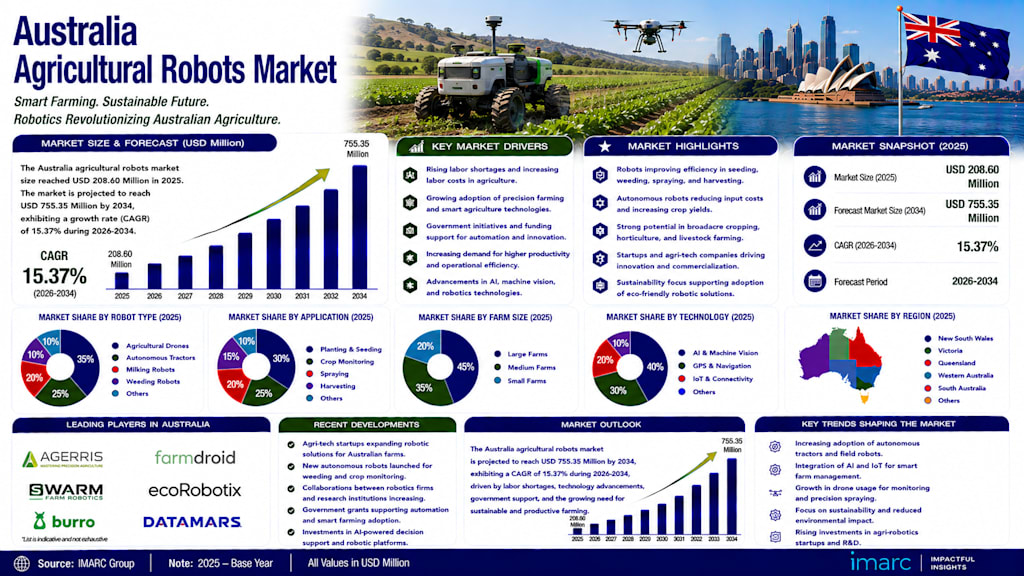
The Australia agricultural robots market is rapidly transitioning from experimental pilot projects to essential farm machinery, as labor shortages, rising operational costs and the push for sustainability converge to make automation a strategic necessity rather than a luxury. Agricultural robots — spanning driverless tractors, automated harvesting systems, milking robots, UAVs/drones, and robotic weeding and spraying equipment — are deployed across broadacre cropping, horticulture, dairy farming and viticulture to address the most persistent operational challenges facing the sector. According to IMARC Group, the Australia agricultural robots market size reached USD 208.60 Million in 2025 and is projected to reach USD 755.35 Million by 2034, exhibiting a strong compound annual growth rate (CAGR) of 15.37% during 2026–2034.
Australia's agricultural sector faces a uniquely acute labor crisis. Labor accounts for 38 percent of overall production costs — the largest single cost component — and with rising wages and a shrinking seasonal workforce, automation has become the most viable pathway to maintain productivity and global competitiveness. Autonomous tractors, AI‑guided sprayers and robotic harvesters are moving from trial phases to commercial deployment, fundamentally reshaping the economics of Australian farming while addressing environmental imperatives through precision application technologies.
What's Driving Market Growth?
Acute Agricultural Labour Shortages and Escalating Costs. The single most powerful driver is the intensifying workforce crisis across Australian farming. Labor availability has become critically constrained by seasonal fluctuations, competition from other industries, an aging farmer demographic and rising wage costs. Labor accounts for 38 percent of overall production costs — the largest single cost component — and as the minimum wage continues to rise and finding workers becomes harder, growers are increasingly turning to automation to sustain food production levels without proportionally increasing labour costs. Australian farmers face a dilemma: without robotics, maintaining production schedules becomes dependent on an increasingly unreliable workforce.
The economics are compelling. While the initial capital investment in robotic systems can be substantial, the long-term financial case incorporates reduced labour costs, improved operational efficiency, lower input waste and the ability to operate continuously without dependency on volatile workforce availability. Robotic systems can work 24/7 without fatigue, maintain consistent precision across variable conditions, and reduce physical strain on human workers, allowing them to focus on higher‑value judgment‑driven tasks.
National Robotics Strategy and Government Investment. The Australian government has responded with landmark policy and funding commitments designed to position the nation as a global leader in agricultural automation. The National Robotics Strategy establishes an extensive policy framework anticipating that robotics and automation technologies could contribute significantly to Australia's GDP while increasing productivity growth. The strategy is backed by substantial financial commitments, including the USD 15 billion National Reconstruction Fund, which allocates significant capital specifically for critical technologies including robotics and advanced manufacturing. These investments are explicitly designed to bridge the commercialisation gap that Australian robotics companies have historically faced, providing crucial capital for scaling innovative solutions from research and development to commercial deployment. Australian research in robotics already ranks in the top ten countries globally for research quality, and the strategy emphasizes the importance of Australian‑made solutions to build resilient supply chains and create high‑value employment opportunities in regional agricultural areas.
Sustainability Imperative and Precision Agriculture Transformation. Environmental stewardship requirements are revolutionizing Australian farming practices, and agricultural robots have emerged as essential tools for achieving sustainability objectives while maintaining productivity. Precision application technologies significantly reduce chemical inputs, minimize soil disturbance, optimize water usage and enable data‑driven decision‑making that enhances resource efficiency across farming operations. Precision agriculture capabilities are extending beyond chemical management to include intelligent irrigation systems that react to real‑time soil moisture data, autonomous monitoring platforms enabling early disease detection before widespread crop damage occurs, and variable rate application technologies that deliver nutrients precisely where needed rather than using uniform applications across diverse field conditions. The integration of advanced sensors, artificial intelligence and machine learning enables agricultural robots to collect and analyze vast quantities of data about crop health, soil conditions, weather patterns and growth trajectories, transforming reactive farming approaches into proactive management systems that anticipate challenges and optimize interventions.
Technological Advances in AI, ML and Sensor Technologies. Advancements in machine learning, artificial intelligence and sensor technologies are fundamentally enhancing the capabilities of agricultural robots to perform complex tasks with greater accuracy and efficiency. The technology stack combining GPS positioning for precision navigation, LiDAR sensing for obstacle detection and computer vision for crop identification enables autonomous machinery to make real‑time decisions in the field. These systems are moving beyond simple repetitive tasks to sophisticated operations: autonomous tractors can now plant wheat across vast arid regions, AI‑powered drones can detect early disease infections days before visible symptoms appear, and robotic sprayers can identify individual weeds and apply herbicides only where needed, dramatically reducing chemical usage while improving environmental outcomes.
Market Segmentation & Key Insights
By Product Type, the market includes unmanned aerial vehicles (UAVs)/drones, milking robots, automated harvesting systems, driverless tractors and others. Driverless tractors and automated harvesting systems currently constitute the largest segments, reflecting the scale of broadacre cropping and horticulture, while drones and UAVs are the fastest‑growing segment, driven by advances in AI‑powered weed detection and crop monitoring.
By Application, key segments include field farming, dairy farm management, animal management, soil management and crop management. Field farming dominates, reflecting the vast scale of Australia's grain and broadacre cropping sectors, which are early adopters of autonomous tractor technology.
By Offering, the market is segmented into hardware, software and services. Hardware represents the largest revenue segment, but software is the fastest‑growing, driven by the increasing importance of AI‑powered analytics, fleet management platforms and decision support systems.
By Region, Australia Capital Territory & New South Wales represent the largest regional market, driven by the concentration of broadacre cropping, government research institutions and early adopter farming communities. Queensland is an emerging hub for agricultural robotics innovation, anchored by autonomous fleet development and drone‑based weed management research.
What the Opportunities Are?
Autonomous Tractor Retrofit Kits for Existing Machinery. While new autonomous tractors remain expensive, retrofit systems that convert existing tractors into autonomous machines are rapidly gaining traction. These systems transform standard tractors into fully autonomous machines capable of 24/7 operation without constant human supervision, helping farmers reduce capital expenditures while overcoming labor shortages and maximizing operational uptime. The technology enables a single operator to remotely manage and optimize a fleet of tractors from any device, enabling around‑the‑clock operation with minimal human intervention.
AI‑Powered Weeding and Precision Spraying Solutions. The substantial annual cost of weed management represents one of the most significant agricultural expenses, and drone‑based AI detection systems are offering a targeted, sustainable alternative. World‑first prototypes integrate AI, GPS and lightweight drone technology to precisely identify and spray weeds, reducing chemical usage and boosting environmental sustainability. These systems are moving beyond existing green‑on‑brown (fallow) mapping capabilities to achieve green‑on‑green targeted weed management, where the system can distinguish weeds within growing crops.
Harvesting Robotics in High‑Value Horticulture. Labour‑intensive fruit and vegetable picking has emerged as a critical frontier for robotics. Harvesting robots have demonstrated the ability to remove a significant percentage of fruit in a given area, addressing the fundamental problem of rising costs and labor shortages. The aim is to expand harvesting technology beyond specific crops to other horticulture requiring selective fruit picking. In greenhouse production, intelligent picking carts featuring real‑time fruit ripeness detection and automated guidance address persistent labor challenges while introducing "yield shaping" — the ability to adjust harvest strategy in response to real‑time market price changes.
Software, Data Analytics and Fleet Management Platforms. Beyond hardware, the software and services segment represents a significant and rapidly growing opportunity. As farms deploy multiple autonomous units — tractors, drones, robotic sprayers and harvesters — demand is growing for integrated fleet management platforms, AI‑powered analytics dashboards and predictive maintenance systems. Companies developing integrated autonomy platforms that operate fleets of smaller, self‑operating machines rather than large conventional tractors are reducing soil compaction, fuel consumption and expenses compared to traditional large‑tractor systems.
Livestock Management and Animal Monitoring. Robotics applications are extending beyond crops into livestock management. Drone‑based livestock mustering, fixed‑camera monitoring of animal health and pasture condition, and autonomous feed delivery systems are advancing from trial phases to commercial use. Robotics platforms using machine‑learning‑powered autonomous drones and fixed‑camera systems deliver real‑time insights on animal location, pasture health, water trough status and fence integrity, helping livestock producers cut costs, improve animal welfare and build climate resilience.
Recent News and Developments in Australia Agricultural Robots Market
October 2025: Australian ag‑tech pioneer SwarmFarm Robotics secured significant funding to boost the growth of its fleet of autonomous farm robots and broaden commercial activities. The company's system uses smaller self‑operating machines to free productivity from machine size while reducing soil compaction, fuel consumption and expenses.
October 2025: Sabanto expanded into Australia through exclusive partnerships, providing farmers with retrofit autonomy systems that convert existing tractors into fully autonomous machines capable of 24/7 operation, helping farmers overcome labor shortages and maximize operational uptime.
July 2025: Researchers received a federal grant under the AEA Innovate program to commercialise a drone‑based, AI‑driven weed management system, building on a world‑first prototype that integrates AI, GPS and lightweight drone technology to precisely identify and spray weeds, reducing chemical usage.
July 2025: A project was announced to bring autonomous tractor technology to Australian horticulture, retrofitting existing tractors with AI‑driven systems enabling a single operator to remotely manage a fleet of machines, slashing labour input costs while boosting productivity across nut industries.
2025: An intelligent picking cart for greenhouse tomatoes was launched, featuring real‑time fruit ripeness detection and automated guidance, enabling faster picking with improved accuracy and introducing "yield shaping" to align harvest with market price changes in real time.
Why Should You Know About Australia Agricultural Robots Market?
You should know about this market because it captures how workforce crisis, sustainability mandates and advanced AI intersect to drive one of the fastest‑growing industrial automation segments in Australia. Agricultural robots are no longer prototypes — they are commercially deployable machines that plant wheat across vast arid regions, pick fruits in horticulture, detect disease days before visible symptoms, and give a single operator the ability to manage a fleet of autonomous tractors from a tablet.
For investors, the agricultural robots market offers exposure to a high‑growth AgTech category anchored in enforceable government funding through the National Reconstruction Fund, a zero‑unemployment environment for seasonal agricultural labour, and the accelerating shift toward precision agriculture that reduces chemical inputs while maintaining yields. The projected CAGR of 15.37% — transforming a USD 208.6 million market into a USD 755.4 million market by 2034 — reflects strong confidence in adoption trends, while higher‑growth sub‑segments including autonomous tractor retrofit systems, AI‑powered weed detection platforms, and harvesting robotics for high‑value horticulture offer differentiated upside potential.
For agricultural equipment manufacturers, technology investors, farm operators and supply chain strategists, understanding segmentation across autonomous tractors, harvesting systems and drones, the economics of retrofit versus new machinery, and the emerging software and services ecosystem helps shape intelligent investment decisions, product development roadmaps and adoption strategies that deliver measurable cost reduction, productivity improvement and environmental performance outcomes.
In essence, the Australia agricultural robots market captures how labour economics, sensor technology and policy support converge — making it a compelling area for investors, innovators and farm operators seeking smarter approaches to food production, resource conservation and operational resilience in one of the world's most innovative agricultural sectors.
About the Creator
Thomas
Market Research Analyst | Industry Trends & Forecasting | Turning market data into clear, actionable business insights across global sectors.
Enjoyed the story? Support the Creator.
Subscribe for free to receive all their stories in your feed.
Comments
There are no comments for this story
Be the first to respond and start the conversation.