
Australia Agricultural Packaging Market: Circular Economy Mandates, Bio material Revolution & Export Resilience
How strict packaging covenants, plant waste innovation and a 58% demand surge for eco friendly materials are driving a $200 million industry by 2034

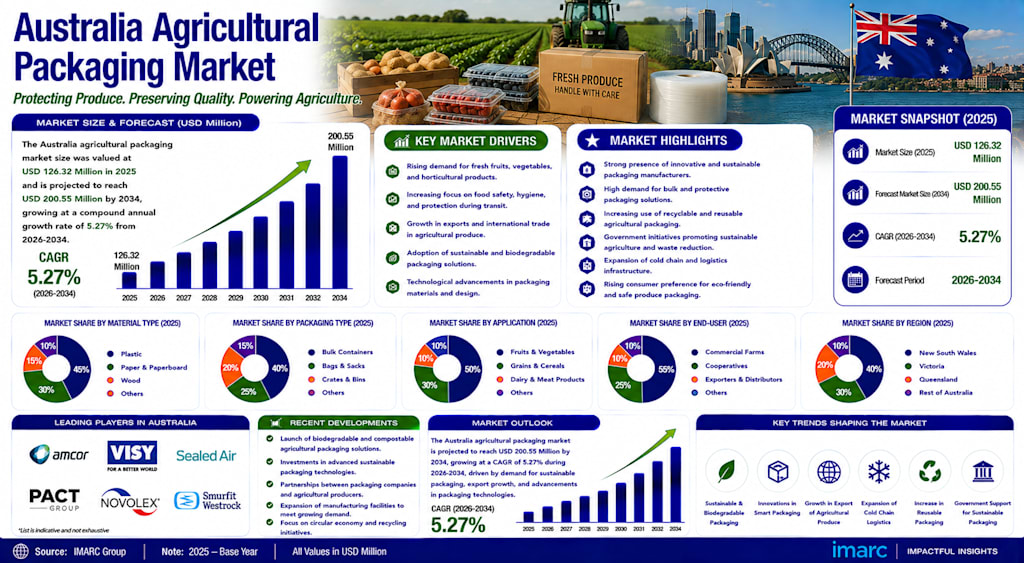
The Australia agricultural packaging market is stepping firmly into the spotlight as the nation’s vast farm sector confronts a defining challenge: how to protect premium produce through long, temperature sensitive supply chains while slashing plastic waste, hitting strict recycled content targets and satisfying an eco conscious consumer base. Agricultural packaging – including flexible pouches, rigid crates, paper based cartons, bulk intermediate bulk containers (IBCs), and innovative biodegradable films – is deployed across crop harvesting, livestock feeding, food processing, and export logistics to shield grains, fresh fruits, vegetables, meat and seafood from spoilage, contamination, and bruising. According to IMARC Group, the market size reached USD 126.32 Million in 2025 and is projected to reach USD 200.55 Million by 2034, exhibiting a steady compound annual growth rate (CAGR) of 5.27% during 2026 2034 0†L24-L25.
Crop producers dominate the sector, requiring efficient packaging to preserve product quality during transportation and storage; flexible packaging leads the market thanks to its versatility, light weight and cost effectiveness, particularly for pouches and bags 15†L33-L35 11†L5-L8. New South Wales, Victoria and Queensland are the key regions, thanks to their robust agricultural output and strong distribution networks 11†L13-L17. As the government pushes for 100% reusable, recyclable or compostable packaging by 2026 and the demand for eco friendly solutions is projected to jump 15% to AUD 1.4 billion, agricultural packaging is no longer just a logistical necessity – it is a strategic lever for brand trust, environmental compliance and export competitiveness 3†L4-L7 15†L53-L58.
What's Driving Market Growth?
Strict Packaging Covenants & Recycled Content Mandates. The sector’s most powerful driver is the Australian Packaging Covenant Ordinance 2016, which imposes legally binding targets on businesses handling more than 10 tonnes of consumer packaging annually: all packaging must be reusable, recyclable or compostable by 2026, with minimum recycled content thresholds and a phase out of problematic plastics 15†L17-L23. While Australia has reached 86% of its goal for overall packaging design, the specific plastic recovery target – originally set at 70% – remains stuck at just 20%, as Sandra Dal Maso, head of packaging transformation at APCO, recently acknowledged 12†L21-L28. “Further progress will depend on stronger policy settings, infrastructure investment and end market demand,” she said 12†L28-L30. Calls are growing for mandatory recycled content requirements to create a viable end market that makes it economically feasible for the recovery sector to treat these materials 12†L32-L34. Europe’s PPWR and the UK’s EPR schemes are already moving in that direction, and Australian agribusinesses know they must align or risk losing export competitiveness 12†L35-L45.
Surge in Demand for Eco friendly & Bio based Materials. Consumer attitudes have flipped. A full 75% of Australian consumers are willing to pay more for environmentally sustainable packaging, and the projected demand for eco friendly packaging is set to reach AUD 1.4 billion, a 15% increase from previous levels 15†L55-L58. This is not merely virtue signalling – it is translating directly into procurement decisions. Major food brands and retailers are pushing suppliers to switch to monomaterial recyclable pouches, biodegradable films and fibre based alternatives. Startups and incumbents are responding with a flood of innovation. Papyrus Australia has developed a proprietary technology that converts banana plantation waste – stalks, leaves and stems that would otherwise emit 900,000 tonnes of CO₂ annually – into refined pulp for food containers, trays and protective packaging 14†L3-L14. The company has already secured a $250,000 matched funding grant from the Australian Government’s Industry Growth Program and is establishing a production facility in Adelaide to scale its banana fibre technology 14†L19-L29.
In Western Australia, the Bioplastics Innovation Hub (a Murdoch University CSIRO joint venture) is turning wheat straw – a common by product of which WA alone generates 10 million tonnes a year, mostly burned – into fossil free biofoam boxes for the state’s $1 billion seafood sector 13†L9-L14. Unlike expanded polystyrene, which can take more than 500 years to break down and adds to microplastic pollution, biofoam decomposes within months and even improves soil health 13†L14-L18. The boxes are lightweight, hydrophobic, able to retain ice, and suitable for home composting. The Hub’s technology readiness level is currently 4, with laboratory prototypes validated and investment being sought to scale production 13†L26-L28.
Market Segmentation & Key Insights
By Material Type, the market is segmented into flexible packaging, rigid packaging, paper based, plastic, metal, glass and others. Flexible packaging leads thanks to its lightness, versatility and cost effectiveness, especially for pouches and bags. Rigid packaging remains strong for bulk storage and transport of heavy grains, chemicals and livestock feed 15†L24-L31.
By End User, key segments include crop producers, livestock producers, food processors, distributors and retailers. Crop producers dominate, as they require efficient solutions to preserve product freshness during long storage and transit 15†L32-L35.
By Region, NSW, Victoria and Queensland are the top markets, supported by their strong agricultural output and well developed logistics hubs 11†L13-L17.
By Packaging Type, the market includes pouches, crates, IBCs, boxes, films, and pallet wrap. The punnet packaging segment is also witnessing steady growth, driven by consumer demand for portion controlled convenience and longer shelf life for fresh berries, cherries and small fruits 1†L22-L28.
What the Opportunities Are?
Bio material Commercialisation from Agricultural Waste. The circular economy is turning farm waste into packaging feedstock – and early movers are capitalising. Papyrus Australia has already proven banana stalk pulp can be moulded into robust food containers and trays. Wandarra is partnering with German packaging technology firm PAPACKS® to bring hemp based moulded fibre packaging to the Australian and Asia Pacific markets, leveraging hemp’s fast growth, carbon capture potential and soil health benefits 8†L41-L47. Investors and packaging converters who back these waste to pulp technologies will not only secure preferential supply of low carbon materials but also help Australian farmers monetise what was once landfill.
Monomaterial Recyclable Pouches & Film Lamination. With APCO pushing for design for circularity, there is strong demand for monomaterial films and recyclable high barrier laminates that can replace multilayer, unrecyclable structures. At Hort Connections 2025, Filton showcased flexible packaging innovations with a strong focus on recyclability and performance, reflecting the industry’s need for alternatives that keep moisture and oxygen out while meeting 2026 covenants 8†L49-L52. Companies that master PE based and PP based high barrier films will capture long term contracts with food processors and supermarkets.
Cold chain Optimisation & Temperature controlled Packaging. As Australia’s seafood, meat and horticulture exports grow, so does demand for cold chain optimised packaging that prevents spoilage without increasing carbon footprint. iBOXiT, a UK agri tech firm, is actively seeking collaboration with Australian seafood exporters, fruit and vegetable producers, and packaging manufacturers to transform how cold chain packaging is produced, used and disposed of 9†L15-L19. Innovations such as phase change materials (PCMs) and reusable insulated shippers that maintain precise temperature windows for 72+ hours are gaining traction, particularly for high value perishables air freighted to Asian markets.
EPR & Plastic Waste Compliance Services. The recycling industry is under pressure: the 2025 National Packaging Targets’ plastic recovery goal is stuck at 20%, and waste exporters are pleading for the government to wind back exemptions on shipping recyclables overseas so that local processors can get enough material to run profitably 10†L6-L11. This creates a prime opportunity for service providers offering waste auditing, compliance certification and take back schemes tailored to agricultural pack houses and distributors. With the federal government also reviving talks of a packaging producer levy to wean Australia off imported packaging, early investment in circular logistics will pay off handsomely 10†L41-L46.
Premium Branded & Eco labelled Export Packaging. Global buyers are scrutinising not just food safety but packaging footprint. Australian exporters who adopt FSC certified cardboard, verified recycled content, or carbon neutral certified packaging can command a premium in discerning markets. The Papyrus Australia banana fibre story already resonates: a low impact conversion process from waste material to final product, suitable for food packaging and medical applications alike 14†L8-L15. Similarly, the Wandarra PAPACKS® hemp partnership is geared toward turning the tide on plastic waste across the Asia Pacific, signalling that ‘grown in Australia’ can now apply to the box as well as the fruit.
Recent News and Developments in Australia Agricultural Packaging Market
April 2026: Papyrus Australia was awarded a $250,000 matched funding grant from the Australian Government’s Industry Growth Program to accelerate commercialisation of its banana plantation waste pulp technology. The company is establishing a production facility in Adelaide to house the key transformation technology 14†L19-L29.
April 2026: The Bioplastics Innovation Hub (Murdoch University CSIRO) continued development of wheat straw based biofoam boxes as a replacement for polystyrene in WA’s $1 billion seafood sector. The boxes decompose within months and improve soil health, with the team seeking investment to scale production 13†L6-L18.
April 2026: Wandarra announced a revolutionary partnership with PAPACKS® to bring moulded fibre packaging made from Australian hemp to the domestic and Asia Pacific markets, aiming to reduce plastic waste and support environmental sustainability 8†L41-L47.
May 2026: APCO’s head of packaging transformation confirmed that while Australia had achieved 86% compliance in making packaging reusable, recyclable or compostable, the plastic recovery target was stuck at just 20%, prompting calls for government mandates on recycled content and stronger legislative settings 12†L21-L34.
March 2026: The federal government revived talks of a packaging producer levy to wean Australia off imported packaging, with an associated penalty for failing to recycle, citing exposure of supply chain weaknesses during global oil shocks 10†L41-L46.
2026: Opal’s ChillFresh™ recyclable cardboard packaging was increasingly adopted for fresh produce, dairy and seafood, designed to reduce heat ingress and condensation, extend shelf life and reduce spoilage across cold chain logistics 9†L25-L29.
Why Should You Know About Australia Agricultural Packaging Market?
You should know about this market because it captures how regulatory enforcement, agricultural waste valorisation and export supply chain resilience intersect to create steady, high margin growth in an essential industrial segment. Agricultural packaging is no longer just a protective layer – it is a tool for carbon footprint reduction, a marketing asset for eco conscious exporters, and a compliance instrument for Australia’s 2026 packaging covenants. From banana fibre food trays to wheat straw biofoam boxes and hemp based moulded fibre pallets, the sector is experiencing a wave of real world circular innovation.
For investors, the agricultural packaging market offers exposure to a stable growth industrial category anchored in enforceable recycling targets, a 75% consumer willingness to pay for eco packaging, and the urgent need to modernise Australia’s plastic waste infrastructure. The projected CAGR of 5.27% reflects consistent baseline demand, while higher growth sub segments – including bio based packaging, monomaterial recyclable films, cold chain optimised systems and EPR compliance services – offer differentiated upside potential.
For agribusiness managers, packaging converters, logistics planners and sustainability officers, understanding segmentation across flexible vs rigid formats, end user requirements from crop producers to food retailers, and the emerging roster of waste to packaging technologies helps shape intelligent procurement, product design and circular economy roadmaps that deliver measurable cost savings, environmental performance and export market competitiveness.
In essence, the Australia agricultural packaging market captures how farm to fork protection, material science and legislative momentum converge – making it a compelling area for investors, manufacturers and food exporters seeking smarter approaches to packaging optimisation, waste reduction and sustainable growth across Australia’s vast and climate exposed agricultural supply chains.
About the Creator
Thomas
Market Research Analyst | Industry Trends & Forecasting | Turning market data into clear, actionable business insights across global sectors.
Enjoyed the story? Support the Creator.
Subscribe for free to receive all their stories in your feed.
Comments
There are no comments for this story
Be the first to respond and start the conversation.