
Australia Agricultural Chelates Market: Precision Fertilisation, Soil Resilience & Organic Chemistry Shift
How rising micronutrient deficiency, precision agriculture adoption and the transition to biodegradable formulations are driving chelate demand across Australian broadacre and horticultural cropping systems

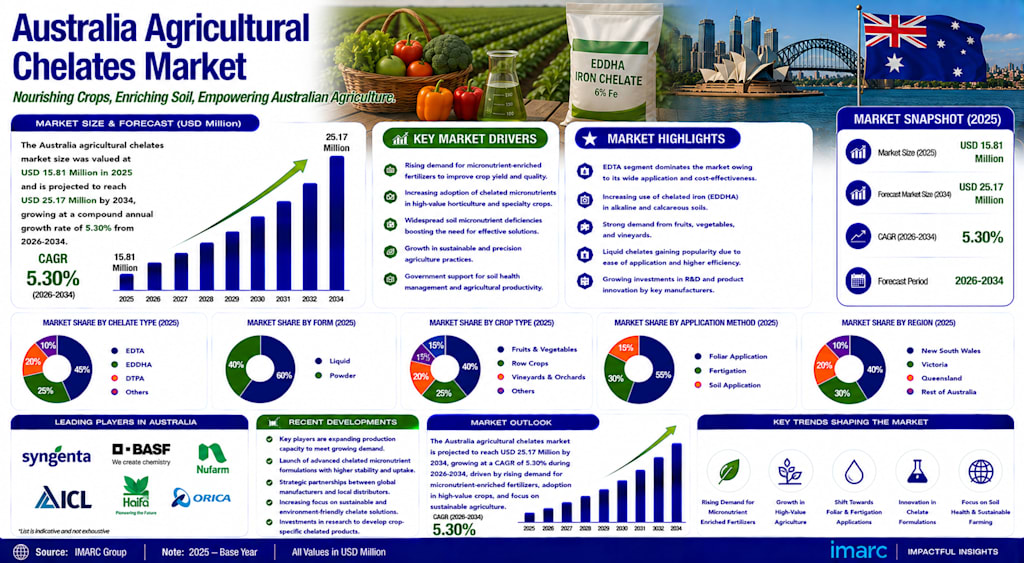
The Australia agricultural chelates market is steadily expanding as grain growers, horticultural producers, pasture managers and fertiliser formulators increasingly deploy specialised chelating agents to ensure that essential micronutrients reach crops despite challenging soil chemistry, high pH levels and nutrient fixation. Agricultural chelates — encompassing both synthetic formulations such as EDTA (ethylenediaminetetraacetic acid), DTPA (diethylenetriaminepentaacetic acid) and EDDHA, and organic alternatives including lignosulfonates and amino acid complexes — are deployed across wheat, barley, canola, pulses, vegetables, fruit orchards and viticulture to deliver iron, zinc, copper and manganese in forms that plants can actually absorb rather than losing to soil lock-up. According to IMARC Group, the global agricultural chelates market reached USD 792.6 Million in 2025 and is projected to reach USD 1,284.9 Million by 2034 at a 5.35% CAGR, with the Australian segment following a similar trajectory within the Asia Pacific region's leadership in chelate adoption.
As Australian agriculture confronts widespread zinc-deficient soils across Western Australia, New South Wales and Victoria — with calcareous soils occupying approximately 60% of cropping soils in south eastern Australia — and as precision agriculture tools enable targeted, variable rate micronutrient applications, agricultural chelates have moved from specialised inputs for high value horticulture to essential components of broadacre fertility management.
What's Driving Market Growth?
Widespread Soil Micronutrient Deficiencies Across Australian Cropping Zones. The most fundamental driver of chelate demand is the well documented prevalence of micronutrient deficiencies in Australian agricultural soils. Zinc deficiency is a persistent constraint on production across the grain growing areas of Western Australia, New South Wales and Victoria. Iron deficiency imposes particular challenges on pulse production in calcareous soils, which dominate south eastern Australia. Research has shown that iron chelates stable under high pH corrected deficiency and significantly increased broad bean yield. Chelated foliar nutrients from suppliers such as SJB have provided optimum performance in Australia's most deficient soils for decades. While nutrient lock up occurs across diverse soil types, the problem is most acute in alkaline and calcareous soils, which are widely distributed across Australia. On such soils, conventional inorganic micronutrients rapidly become unavailable due to chemical fixation. Chelates overcome this by forming stable complexes around metal ions, making them bioavailable even in high pH environments.
Precision Agriculture and Variable Rate Micronutrient Management. The accelerating adoption of precision agriculture technologies — including soil sensors, GPS, satellite imagery and drones — is enabling farmers to identify and treat nutrient deficiencies with unprecedented accuracy. Precision agriculture depends on data driven insights to ascertain soil nutrient status and specific crop needs, and chelates act in concert with these technologies to ensure effective nutrient absorption. The global precision agriculture market reached USD 8.5 Billion in 2023 and is expected to reach USD 20.2 Billion by 2032 at a 9.9% CAGR. As Australian grain growers adopt variable rate application technologies, the ability to apply chelated micronutrients precisely where deficiencies occur — rather than blanket spreading conventional fertilisers — improves both agronomic outcomes and input efficiency. This trend is particularly pronounced in the grains and cereals segment, which holds the largest crop type share of the agricultural chelates market globally due to the staple role of wheat, rice, corn and barley in global food security.
Sustainable Agriculture and the Shift Toward Biodegradable Chelates. Environmental sustainability is reshaping the agricultural chelates landscape in Australia, though the shift is balanced against the established efficacy of synthetic formulations. Globally, synthetic chelates dominate the market due to their outstanding stability, efficacy and cost effectiveness, with EDTA and DTPA providing highly stable complexes in challenging soil conditions. However, agricultural use of EDTA faces increasing regulatory restrictions in Europe, and product cost has historically limited micronutrient fertiliser use to high value crops. In response, manufacturers are developing organic alternatives including lignosulfonates, amino acid complexes, heptagluconates and humic/fulvic acid based chelating agents. Both humic acid and fulvic acid are chelating agents that can serve as significant carriers of plant nutrients and improvers of nutrient availability. Agmin's formulations employ organic chelation using lignosulfonate to assist rapid and efficient absorption of zinc, manganese and copper into plant leaves, preventing greatest financial losses in fertilisation by avoiding nutrient fixation from adverse soil reactions.
Rising Demand for High Efficiency Fertilisers and Yield Optimisation. The agricultural industry faces constant pressure to improve crop yields and quality in response to growing global population and sustainable food production demands. High efficiency fertilisers including chelates are essential for meeting this demand, as they improve the availability and absorption of vital nutrients. Conventional fertilisers often suffer nutrient loss through volatilisation, fixation in soil and leaching, whereas chelates reduce these losses by creating stable complexes that remain available even in adverse soil conditions. According to the Food and Agriculture Organization (FAO), 33% of land globally is moderately to highly degraded due to salinisation, erosion, compaction, acidification and chemical pollution. In this context, chelates have become a cost effective tool for maintaining soil fertility and crop productivity on degraded agricultural lands.
Market Segmentation & Key Insights
By Type, the market is segmented into synthetic (EDTA, EDDHA, DTPA, IDHA, others) and organic (lignosulfonates, amino acids, heptagluconates, others). Synthetic chelates represent the largest segment globally, driven by their outstanding stability, efficacy and economical production enabling large scale manufacturing to meet rising agricultural demand. The Australia zinc chelates market is a specialised segment defined by the application of chelated zinc, where zinc ions are bound to organic ligands for enhanced bioavailability.
By Nutrient Type, the market encompasses chelated iron (Fe), zinc (Zn), manganese (Mn), copper (Cu), magnesium (Mg) and calcium (Ca), along with micronutrient blends. Zinc chelates are particularly critical given documented zinc deficiency across Australia's grain growing belt, while iron chelates are essential for pulse production on calcareous soils. EDTA is the most commonly used chelating agent, with the most frequently supplemented micronutrient metals being iron, copper, manganese and zinc.
By Crop Type, grains and cereals hold the largest global share, reflecting the role of rice, corn, wheat and barley in global food security and the effectiveness of chelates in addressing micronutrient deficiencies in these staple crops.
By Application, foliar application holds the largest market share globally. Foliar application delivers nutrients directly to plant leaves, bypassing soil related problems such as leaching and nutrient fixation, and is particularly effective for rapid correction of micronutrient deficiencies in suboptimal soil conditions including high pH or saline soils.
By End Use, the market serves commercial agriculture (broadacre grains, oilseeds and pulses), horticulture (fruits, vegetables and vines), floriculture, turf and smallholder farming. Agricultural applications remain the dominant consumer, while human nutritional supplements are exhibiting more dynamic growth.
By Region, the Australian market is concentrated in Western Australia, New South Wales and Victoria, where soil zinc deficiency is a well documented constraint on production and calcareous soils pose persistent availability challenges for iron and other micronutrients.
What the Opportunities Are?
Organic and Biodegradable Chelates for Sustainable Certification. The growing regulatory pressure on persistent synthetic chelates and the increasing demand for certified sustainable agricultural products create significant opportunities for organic chelate development. Lignosulfonate based formulations, amino acid chelates and heptagluconate complexes offer biodegradability while providing effective nutrient delivery. For Australian grain growers seeking access to premium markets with strict environmental input standards, verified organic chelated fertilisers represent a compliance driven growth category. The role of humic and fulvic acids as natural chelating agents — improving nutrient uptake and remedying deficiencies — is being rediscovered as sustainable agriculture expands.
Foliar and Fertigation Formulations for Precision Application. As precision agriculture technologies enable more targeted input placement, there is strong opportunity for chelate manufacturers to develop specialised foliar and fertigation formulations optimised for variable rate application, tank mix compatibility and high concentration delivery. Foliar feeding is particularly advantageous where soil conditions are suboptimal, including in high pH or saline soils where nutrient availability is restricted. In broadacre applications, products such as Wilchem Sentinel ZMC (zinc, manganese, copper) are applied via fertigation, furrow injection or foliar applications. The development of advanced liquid formulations tailored to specific crop growth stages and deficiency profiles will capture increasing market share.
Zinc Chelates for Human Nutrition and Biofortification. Beyond agricultural applications, the human nutritional supplements segment is exhibiting more dynamic growth than agricultural inputs, and the market for chelated zinc is already bifurcated between these two demand streams. Australian zinc chelates suppliers serving both the agricultural inputs and nutraceutical industries can achieve revenue diversification and higher margins in the health supplement segment, which is more evenly distributed across urban population centres and retail distribution networks.
Research Partnerships for Novel Chelating Molecules. EDTA is not readily absorbed by plant roots due to membrane exclusion, and alternative chelating molecules that enhance absorption rates could dramatically improve input efficiency. For alkaline soils, chelates that increase the rate of micronutrient absorption into the root symplast have been shown to be significantly more effective than EDTA. Research collaborations between Australian universities, the CSIRO and chemical manufacturers to develop novel chelating agents tailored to Australia's unique soil chemistry represent a high potential investment area.
Regulatory Compliance and Certification Services. The agricultural chelates market is governed by frameworks from the Australian Pesticides and Veterinary Medicines Authority (APVMA) for agricultural uses and the Therapeutic Goods Administration (TGA) for human supplements. Compliance with these standards represents a significant barrier to entry and a core component of product positioning for established suppliers. There is growing opportunity for consulting and certification services that assist manufacturers and importers in navigating APVMA registrations, TGA listings and organic certification pathways, particularly as regulatory scrutiny on synthetic chelates intensifies.
Recent News and Developments in Australia Agricultural Chelates Market
March 2026: The Australian zinc chelates market was characterised as a specialised segment of the broader agricultural inputs industry, with demand bifurcated between agricultural applications and human nutritional supplements. Demand is heavily concentrated in the grain growing areas of Western Australia, New South Wales and Victoria, where soil zinc deficiency is a well documented constraint on production.
2025: Global agricultural chelates market research positioned synthetic chelates — particularly EDTA and DTPA — as the dominant segment due to their stability, efficacy and economical large scale production. Organic alternatives including lignosulfonates, amino acids and heptagluconates were identified as the fastest growing segment, driven by sustainability and regulatory pressures.
May 2025: Major agricultural input suppliers expanded their chelated micronutrient portfolios with liquid formulations designed for broadacre compatibility, including chelated trace element blends that mimic natural nutrient transport mechanisms for crop safety.
2025: BASF, Nufarm, Yara International and other major players in the chelated agricultural micronutrients market continued to invest in product development and distribution networks across Australian agricultural regions, competing with regional agricultural input suppliers and niche nutrition companies.
Why Should You Know About Australia Agricultural Chelates Market?
You should know about this market because it captures how precision agriculture, soil chemistry challenges and sustainable input innovation intersect to create steady growth in a specialised but strategically critical segment of Australia's fertiliser industry. Agricultural chelates are no longer viewed as optional additives for high value horticulture — they are essential tools that help grain growers correct widespread zinc deficiency across Western Australia, enable pulse producers to maintain yields on calcareous soils where iron availability is otherwise negligible, and support the shift toward variable rate, efficiency optimised nutrient management that reduces environmental losses while improving productivity.
For investors, the agricultural chelates market offers exposure to a stable growth agricultural input category anchored in Australia's persistent soil chemistry constraints, the accelerating adoption of precision agriculture technologies and the global transition toward more efficient, less environmentally damaging fertiliser formulations. The projected growth of the broader global agricultural chelates market from USD 792.6 Million in 2025 to USD 1,284.9 Million by 2034 at a 5.35% CAGR reflects consistent demand, while higher growth sub segments — including organic and biodegradable chelates, human nutrition applications and novel chelating molecules tailored to alkaline soils — offer differentiated upside potential.
For agronomists, fertiliser formulators, broadacre farmers and agricultural technology investors, understanding chelate segmentation by nutrient type and application, the comparative performance of synthetic versus organic formulations on different soil types, and the regulatory pathways for agricultural and human nutrition products helps shape intelligent input decisions, product development strategies and market positioning that deliver measurable yield improvements, soil health outcomes and regulatory compliance. In essence, the Australia agricultural chelates market captures how micronutrient efficiency, soil science and sustainable intensification converge — making it a compelling area for investors, innovators and agricultural professionals seeking smarter approaches to plant nutrition, fertiliser optimisation and long term farm productivity across Australia's diverse and increasingly precise cropping landscapes.
About the Creator
Thomas
Market Research Analyst | Industry Trends & Forecasting | Turning market data into clear, actionable business insights across global sectors.
Enjoyed the story? Support the Creator.
Subscribe for free to receive all their stories in your feed.
Comments
There are no comments for this story
Be the first to respond and start the conversation.