
Australia Agricultural Adjuvant Market: Precision Spraying, Climate-Smart Innovation & Advanced Formulations
How precision agriculture adoption, herbicide resistance challenges and sustainable practice investment are driving efficiency-enhancing adjuvant demand across Australia

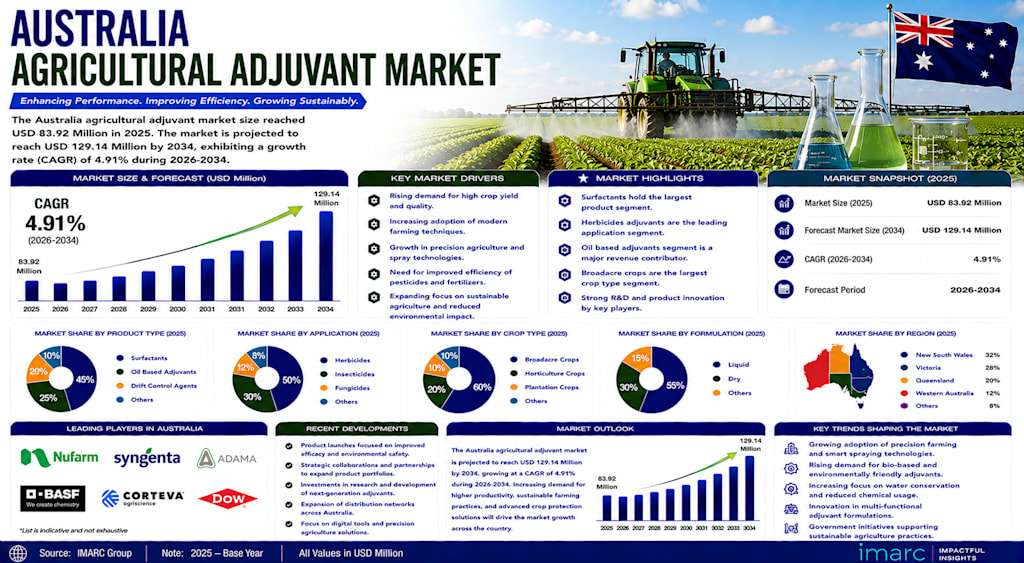
The Australia agricultural adjuvant market is expanding steadily as grain growers, horticultural producers, broadacre farmers and agricultural supply companies increasingly deploy specialised additives to maximise the performance of crop protection chemicals and foliar fertilisers. Agricultural adjuvants — encompassing activator adjuvants, oil‑based agents, surfactants, water conditioners and utility formulations — are used extensively in tank mixes with herbicides, fungicides, insecticides and fertilisers to improve spray droplet coverage, increase active ingredient penetration, reduce drift and optimise overall application efficiency across Australia's diverse cropping environments. According to IMARC Group, the market size reached USD 83.92 Million in 2025 and is projected to reach USD 129.14 Million by 2034, exhibiting a compound annual growth rate (CAGR) of 4.91% during 2026–2034. As Australian agriculture accelerates its uptake of precision spraying technologies, confronts mounting weed resistance pressures and responds to government incentives for climate‑smart farming, adjuvants have moved from optional tank‑mix additives to indispensable components of modern, efficient and sustainable crop protection programmes.
What's Driving Market Growth?
Rapid Adoption of Precision Agriculture & Autonomous Spraying Technologies. Australian farms are undergoing a profound technological transformation, with widespread adoption of GPS‑guided equipment, satellite imagery, field drones, IoT‑connected sensors and variable‑rate application systems that allow growers to apply inputs precisely where and when they are needed. Precision spraying systems now operate with variable‑rate capabilities that demand optimised spray characteristics to maximise effectiveness and minimise waste. In February 2025, Yamaha Motor established Yamaha Agriculture, Inc., marking its strategic entry into precision agriculture utilising AI and autonomous technologies following acquisitions of Robotics Plus and The Yield. Yamaha Agriculture aims to offer robotic solutions for spraying, weeding, and various field tasks, utilising sophisticated data analytics and AI to facilitate precision farming for producers of wine grapes, apples and other specialty crops in North America, Australia and New Zealand. These advanced systems deliver optimised droplet sizes and targeting capabilities; however, they also require adjuvant formulations that enhance coverage, penetration and absorption on target surfaces while reducing spray drift and off‑target movement, creating substantial and sustained demand for high‑performance adjuvant products.
Government Investment in Climate‑Smart & Sustainable Agriculture. The Australian Government's substantial commitment to climate‑smart agriculture is creating a highly favourable environment for adjuvant adoption. The $302.1 million Climate‑Smart Agriculture Program, funded over five years from 2023‑24 to 2027‑28 through the Natural Heritage Trust, demonstrates the government's strategic focus on sustainable and natural resource management practices across the country. The program drives the development, trialling and roll‑out of climate‑smart, sustainable and innovative tools and on‑farm practices that enhance agricultural productivity and profitability. Adjuvants play a critical role in this framework by improving the efficiency of agrochemical applications and reducing the volume of chemicals required to achieve effective pest, weed and disease control, thereby supporting lower environmental footprints and aligning with best‑practice chemical use. Australian agriculture maintains strong sustainability credentials, with chemical and fertiliser use at world best‑practice levels, and agricultural adjuvants are increasingly recognised as essential tools for maintaining these standards while optimising crop protection programmes and supporting the transition to more sustainable farming systems.
Herbicide‑Resistant Weed Populations & Farm Labour Shortages Intensify Crop Protection Demands. Australian grain growers continue to face mounting biosecurity challenges from herbicide‑resistant weed biotypes. The evolution of herbicide‑resistant weed populations has intensified the need for adjuvants that can enhance penetration and absorption of active ingredients, ensuring effective control even against resistant populations. Weeds pose a major biosecurity threat to Australian crops, leading to reduced yields and significant financial losses for producers, which has driven herbicides to become the dominant segment in Australia's crop protection chemicals market. Adding further pressure, a notable shortage of farm labour — particularly for manual tasks such as hand‑weeding — has emerged, making chemical weed control increasingly critical for maintaining farm productivity. In 2024, the Australian Government introduced a $4.1 million initiative to promote advanced mechanisation technology in the vegetable sector, specifically targeting high input costs and labour issues that affect grower profitability, with efficient chemical application — enhanced by adjuvants — recognised as essential to managing these production challenges.
Market Segmentation & Key Insights
By Type, the market is segmented into activator adjuvants and utility adjuvants. Activator adjuvants — which include surfactants, oil‑based agents and ammonium‑based additives — enhance the biological activity of agrochemicals by improving penetration, spreading and absorption. Utility adjuvants modify spray characteristics such as droplet size, drift potential and water quality.
By Crop Type, major segments include cereals and oilseeds, fruits and vegetables, and others. Cereals and oilseeds represent the largest segment, reflecting the scale of Australia's broadacre grain production, while fruits and vegetables are a significant and growing segment driven by high‑value horticultural production requiring precise application technologies.
By Application, the market includes herbicides, fungicides, insecticides and others. Herbicides represent the dominant application segment, driven by the widespread use of spray adjuvants to manage herbicide‑resistant weed populations in Australia's vast broadacre cropping systems.
By Region, major markets include Australia Capital Territory & New South Wales, Victoria & Tasmania, Queensland, Northern Territory & Southern Australia, and Western Australia. New South Wales and Victoria lead the market due to their extensive cropping areas, high adoption of precision agriculture and concentration of agricultural input suppliers.
What the Opportunities Are?
Innovative Bio‑Based & Low‑Environmental‑Impact Adjuvant Formulations. Growing awareness of ecosystem impacts and regulatory attention on agricultural chemical runoff is accelerating demand for environmentally friendly adjuvants with minimal ecological footprint. The trend toward adjuvant formulations derived from natural, renewable sources — including plant‑based surfactants and biodegradable oil systems — that deliver equivalent or superior performance compared to conventional products presents a significant innovation opportunity for manufacturers. Australian farmers increasingly seek adjuvant products that support integrated pest management principles, reduce overall chemical loads and align with consumer expectations for sustainable food production. Companies that invest in R&D to develop efficacious, low‑environmental‑impact adjuvant technologies will capture premium market segments and build durable brand loyalty.
Precision Application & Tank‑Mix Optimisation Services. The rapid integration of variable‑rate technology and autonomous spraying systems on Australian farms is creating strong demand for technical services that optimise tank‑mix performance and adjuvant selection. Suppliers that offer formulation guidance, tank‑mix compatibility testing, water quality analysis and real‑time application support will secure long‑term customer relationships and generate recurring service revenue. The growing sophistication of digital agronomy platforms presents an opportunity to embed adjuvant recommendations directly into farm management software based on crop stage, weather conditions, water hardness and specific pest or weed targets.
Enhanced Penetrant & Absorption Technology for Resistant Weed Management. With herbicide resistance continuing to spread across weed populations in Australian cropping systems, there is strong opportunity for adjuvant manufacturers to develop advanced penetrant and absorption technologies that enhance the efficacy of existing active ingredients. Oil‑based adjuvants that help oil‑soluble herbicides penetrate through the weed's waxy cuticle and reduce evaporation rates of spray droplets from leaves are already recognised as essential tools in resistance management programmes. Further innovation in formulation chemistry to improve uptake and translocation of systemic active ingredients — even against resistant weed biotypes — will capture significant market share among growers seeking to extend the useful life of their herbicide portfolios.
Water Conditioning & Spray Quality Solutions for Variable Water Sources. Australian cropping regions rely on diverse water sources with wide variation in pH, hardness and contamination levels, all of which can significantly affect agrochemical performance. Ammonium‑based adjuvants and water conditioning agents that buffer spray solutions, improve droplet uniformity and prevent antagonistic reactions between water quality parameters and active ingredients represent a substantial and growing market segment. Manufacturers offering cost‑effective, easy‑to‑use water conditioning solutions tailored to Australia's unique water quality challenges will find receptive customers across both broadacre and horticultural sectors.
Distribution Channel Innovation & E‑Commerce Expansion. The increasing reliance of Australian farms on digital advisory services and online procurement platforms creates opportunities for adjuvant suppliers to bypass traditional distribution channels. Direct‑to‑farmer e‑commerce platforms, virtual agronomy consulting and subscription‑based supply models for tank‑mix additives can reduce transaction costs, improve supply chain transparency and build direct customer relationships. Leading players are already focusing on developing innovative formulations to cater to evolving farmer needs and regulatory requirements, investing in R&D to introduce environmentally friendly and cost‑effective solutions.
Recent News and Developments in Australia Agricultural Adjuvant Market
February 2025: Nufarm Australia announced a collaboration with KingAgroot, a Chinese agricultural biotechnology firm, to create a new broad‑spectrum, non‑selective herbicide for the Australian market as an independent knockdown solution. Nufarm's Regional General Manager for Asia Pacific stated that through the partnership, the company aimed to secure registration of the Flufenoximacil (FFO) molecule for the Australian market, creating future demand for compatible adjuvant products.
May 2024: BASF introduced its innovative insecticide, Cimegra, in Australia, expanding the company's crop protection portfolio. The launch demonstrated BASF's commitment to providing Australian farmers with advanced pest management solutions that require optimized application technologies, in turn creating demand for compatible adjuvants that enhance product performance and spray efficiency.
2025: The Yamaha Agriculture, Inc. entry into precision agriculture — utilising AI and autonomous technologies following acquisitions of Robotics Plus and The Yield — marked a significant industry development. The company aims to offer robotic solutions for spraying, weeding, and various field tasks, with sophisticated data analytics facilitating precision farming for producers of wine grapes, apples and other specialty crops in North America, Australia and New Zealand.
2025–2026: The $302.1 million Climate‑Smart Agriculture Program continued to drive development and adoption of sustainable, innovative tools and on‑farm practices, reinforcing the role of adjuvants in reducing chemical volumes while maintaining crop yields.
Why Should You Know About Australia Agricultural Adjuvant Market?
You should know about this market because it captures how precision farming adoption, resistance management pressures and climate‑smart policy intersect to create steady growth in a high‑efficiency crop protection segment. Agricultural adjuvants are no longer viewed as optional add‑ons — they are essential performance enhancers that help Australian grain growers reduce chemical inputs, enable autonomous spraying systems to achieve optimal coverage and support horticultural producers in maintaining yields while complying with world‑best‑practice chemical use standards.
For investors, the agricultural adjuvant market offers exposure to a growth‑oriented agricultural input category anchored in Australia's structurally rising precision agriculture adoption, ongoing herbicide resistance challenges and the government's $302 million Climate‑Smart Agriculture Program. The projected CAGR of 4.91% reflects consistent baseline demand, while higher‑growth sub‑segments — including bio‑based activator adjuvants, advanced penetrant technologies for resistance management, water conditioning solutions and digital optimisation services — offer differentiated upside potential.
For agronomists, farm input suppliers, agricultural technology developers and grain growers, understanding adjuvant segmentation, precision application requirements, water quality interactions and emerging bio‑based formulations helps shape intelligent procurement decisions, spray programme designs and technology investments that deliver measurable economic, environmental and productivity outcomes.
In essence, the Australia agricultural adjuvant market captures how spray efficiency, chemical resistance stewardship and sustainable intensification converge — making it a compelling area for investors, innovators and agricultural professionals seeking smarter approaches to crop protection optimisation, input cost management and long‑term farming systems resilience across Australia's diverse and highly productive agricultural landscape.
About the Creator
Thomas
Market Research Analyst | Industry Trends & Forecasting | Turning market data into clear, actionable business insights across global sectors.
Enjoyed the story? Support the Creator.
Subscribe for free to receive all their stories in your feed.
Comments
There are no comments for this story
Be the first to respond and start the conversation.