
Australia Advanced Glass Market 2026: Smart Buildings, Renewables Integration & Sovereign Manufacturing Surge
How self-tinting glazing, building integrated solar glass and a landmark $1.2 billion float glass investment are reshaping Australia's high performance glass landscape

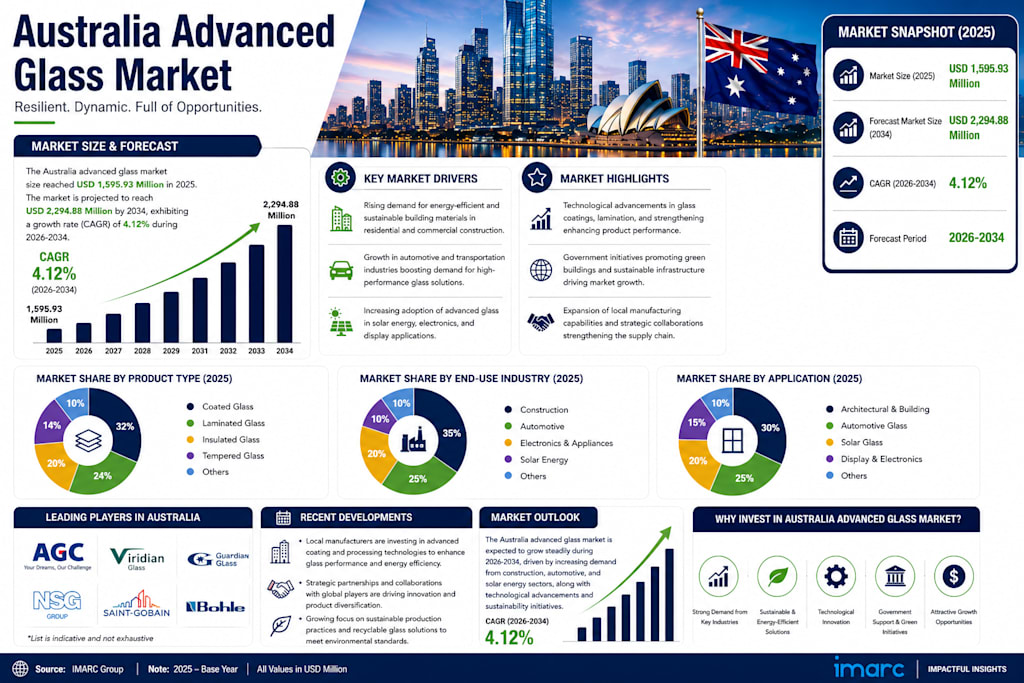
The Australia advanced glass market is experiencing dynamic growth as architects, renewable energy developers and infrastructure builders increasingly deploy next generation materials that combine transparency with intelligence. Advanced glass — including coated, laminated, toughened, ceramic and smart glass varieties — is deployed across commercial facades, residential glazing, solar panels, automotive safety systems and aerospace canopies to optimise energy efficiency, enhance security and enable sustainable design. According to IMARC Group, the market size reached USD 1,595.93 Million in 2025 and is projected to reach USD 2,294.88 Million by 2034, exhibiting a compound annual growth rate (CAGR) of 4.12% during 2026–2034. Technological progress, rising construction demand and renewable energy expansion are driving the advanced glass market in Australia. As the National Construction Code (NCC) 2025 takes effect and building integrated photovoltaics move from concept to commercial reality, advanced glass has become a strategic asset for the built environment, energy transition and manufacturing sovereignty.
What's Driving Market Growth?
Technological Advancements and Smart Glass Integration. Ongoing breakthroughs in coating applications, lamination methods and nanotechnology are producing advanced glass capable of dynamically managing heat, light and glare according to environmental conditions. Smart glass technologies such as electrochromic and photochromic glass enable automatic transparency modifications that improve energy efficiency while enhancing occupant comfort. The integration of IoT connectivity allows advanced glass to seamlessly blend into smart building systems, optimising lighting and temperature management while lowering energy usage. Electrochromic glass — which uses a low voltage electrical signal to transition from transparent to tinted, with minimal ongoing power consumption — is particularly well suited to energy saving building applications. These advancements are transforming glass from a passive building element into an active component focused on both aesthetics and performance, fundamentally reshaping market competitiveness.
Strengthening Construction Standards and Green Building Regulations. The Australia advanced glass market is being propelled by the rising use of energy efficient, durable and high performance materials in the construction and infrastructure sectors. Advanced glass is increasingly essential to contemporary architectural designs due to its excellent insulation, sound management and solar control features, boosting both energy efficiency and indoor comfort. The enforcement of strict construction standards aimed at sustainability and lowering carbon emissions is encouraging developers to choose materials that meet these environmental goals. The National Construction Code (NCC) 2025 has tightened glazing performance standards significantly compared to previous editions, with provisions under Section J setting minimum thermal resistance and maximum heat transfer values for building envelopes based on climate zone and building classification. From May 1, 2026, the NCC 2025 will be adopted by Victoria, with other states and territories following, creating immediate demand for high performance glazing solutions that meet Deemed to Satisfy requirements.
Renewable Energy Expansion Driving Specialised Glass Demand. Australia's rapid growth in renewable energy is creating significant demand for specialised glass, particularly in solar energy applications. High performance glass improves the efficiency, longevity and overall performance of photovoltaic modules by boosting light transmittance, UV resistance and thermal stability. In 2025, Shoals Technologies Group partnered with PCL Construction and Gentari to begin constructing the 243 MW Maryvale Solar and 172 MW Energy Storage Project near Wellington, New South Wales — Australia's first utility scale DC coupled solar and battery hybrid plant. Sophisticated glass utilised in these initiatives guarantees increased energy output and reduced maintenance expenses through material advancements. For building integrated photovoltaics, companies like ASX listed ClearVue Technologies have unveiled Gen3 solar vision glass generating over 50 W/m² — a 66 % efficiency boost while halving production costs. The product delivered more than 66 % additional energy output per square metre compared to previous generation glass, with processing time for double glazed units cut by more than 50 %.
Surge in Sovereign Manufacturing and Domestic Production. A transformative development in the advanced glass market is the surge in domestic manufacturing capacity designed to close Australia's glass supply gap and reduce import dependency. In October 2025, GlassKote Float Glass Industries (GK) announced secured funding exceeding AUD 1.2 billion to build two of the most advanced low iron float glass plants globally — the first commencing in Queensland, Australia in early 2026, with the second in the United Arab Emirates to follow. The Queensland project will feature 700 tonnes per day of low iron glass for architectural, solar and specialty applications, alongside a 400 tonnes per day waste to energy facility using Cyrion technology to generate green hydrogen and renewable electricity with zero emissions. The facility includes silicon nanotube integration and DNA AI 'Living Glass' technology — enabling self healing, seismic resilient and energy optimising glass products — as well as integrated solar glass manufacturing for BIPV and smart glazing. The facility will close Australia's glass supply gap, generate its own renewable energy and export surplus power, making it one of the most sustainable glass plants ever built. The year following the Queensland launch, GK will commence construction of a second 700 TPD float glass plant in Australia. The facility proudly delivers 100 % Australian made glass, produced entirely from locally sourced materials and components, strengthening national manufacturing sovereignty.
Market Segmentation & Key Insights
By Product Type, the market includes coated glass, laminated glass, toughened glass and ceramic glass. Coated glass dominates due to its energy saving Low E and solar control properties, which are essential for meeting NCC 2025 glazing performance requirements.
By Function, the market covers safety and security, solar control, optics and lighting, and high performance. Safety and security holds the largest share, driven by stringent building codes for impact resistance in cyclone prone regions, while solar control is the fastest growing segment as energy efficiency regulations tighten.
By End Use Industry, key sectors include building and construction, aerospace and defence, automotive, electronics, sports and leisure, and optical. Building and construction accounts for the majority of demand, driven by commercial skyscraper developments, housing construction and the growing retrofitting of existing building stock with high performance glazing.
By Region, major markets include Australia Capital Territory & New South Wales, Victoria & Tasmania, Queensland, Northern Territory & Southern Australia and Western Australia. NSW and ACT represent the largest regional market, driven by Sydney's concentration of commercial high rise developments, premium residential projects and infrastructure investment.
What the Opportunities Are?
AI Driven 'Living Glass' and Self Healing Coatings. The emergence of DNA AI 'Living Glass' technology — enabling self healing, seismic resilient and energy optimising glass products — represents a frontier opportunity in the Australian market. Investors and technology developers focusing on AI integrated glass coatings that can autonomously repair micro cracks, adapt to environmental stressors and communicate with building management systems will capture premium segments. The technology also incorporates silicon nanotube integration, promising enhanced structural strength for demanding defence and aerospace applications.
Building Integrated Photovoltaics (BIPV) and Solar Vacuum Insulated Glazing. The partnership between ASX listed ClearVue and LandGlass to co develop and commercialise solar vacuum insulated glazing products, leveraging LandVac's advanced VIG technology with ClearVue's proprietary photovoltaic solutions, points to a high growth niche. The combined technologies create vacuum insulated glazing, cladding and spandrel products offering significant thermal performance improvements over traditional façade materials. ClearVue's Gen3 solar glass, now available in single, double or triple glazing options with integrated LandVac vacuum insulation technology, reduces manufacturing components from 17 to seven, lowering embedded carbon content. This integrated product category addresses both NZC building requirements and on site renewable generation, offering premium pricing potential in the Australian green building sector.
Low E and Thermal Break Glazing for NCC 2025 Compliance. As states and territories adopt NCC 2025 from May 1, 2026, the single largest opportunity lies in supplying compliant glazing solutions for commercial and multi residential buildings. For Class 2 residential apartment buildings, compliance requires meeting Section J energy efficiency requirements for common areas, building envelopes and centralised services. For Sydney, typical Deemed to Satisfy compliant glass on a west facade requires specific glazing performance criteria under J1.6 provisions. Glazing manufacturers and distributors that offer pre certified, climate zone specific glazing packages with documented compliance evidence will capture significant market share as developers race to meet the new requirements.
Circular Economy and High Recycling Content Glass. With Australia anticipated to reach more than 50 % glass recycled content by 2025, the use of recycled glass cullet in advanced glass manufacturing represents both an environmental win and an economic opportunity. The new GlassKote facility, delivering 100 % Australian made glass from locally sourced materials, sets a benchmark for closed loop manufacturing. Municipal glass only kerbside collection services are being introduced, with independent economic modelling showing setup costs of approximately $4 million per council. Technology providers offering advanced sorting equipment, cullet washing systems and low carbon melting technologies will support this transition.
EV and Automotive Lightweighting Solutions. The Australia automotive safety glass market reached USD 55.6 Million in 2025 and is projected to reach USD 98.0 Million by 2034 at a CAGR of 6.31 %, driven by rising vehicle sales and advanced safety features. The adoption of smart glass in automotive applications — including sunroofs, windows and mirrors — is gaining momentum, with electrochromic and SPD smart glass technologies offering dynamic light and heat regulation capabilities. Automotive tempered glass imports grew at 1.08 % in 2024, with a 2.45 % CAGR from 2020 to 2024, reflecting consistent demand. Lightweighting also supports EV range extension; every kilogram saved through advanced glazing reduces energy consumption across the vehicle fleet.
Recent News and Developments in Australia Advanced Glass Market
October 2025: GlassKote Float Glass Industries (GK) announced over AUD 1.2 billion in secured capital to build two advanced low iron glass manufacturing plants — one in Queensland, Australia (launching early 2026) featuring 700 TPD low iron float glass and a 400 TPD waste to energy facility, and another in the UAE (mid 2026). The projects feature AI driven production, 'Living Glass' technology with self healing and seismic resilient properties, and near zero energy costs.
September 2025: Perth based ClearVue Technologies unveiled Gen3 solar glass generating over 50 W/m² — a 66 % efficiency boost while halving production costs — using a simplified 7 component design that cuts waste, emissions and manufacturing time.
July 2025: ClearVue Technologies partnered with LandGlass Technology Co. subsidiary LandVac to co develop and commercialise solar vacuum insulated glazing products, creating building envelope solutions offering significant thermal performance improvements over traditional façade materials.
February 2026: The NCC 2025 preview edition was released, introducing mandatory ventilated wall cavities, updated condensation management provisions and commercial energy efficiency changes, with adoption by states and territories commencing May 1, 2026.
March 2026: The ACT Government announced pending development application approval, construction of a new Materials Recovery Facility would commence in 2026, operational by 2028, designed to increase glass resource recovery and reduce waste ending up in landfill.
January 2025: Sustainability Victoria projected Australia would reach more than 50 % glass recycled content target by 2025, with Victorian glass manufacturing capability mature and able to take increased amounts of clean, colour separated cullet.
Why Should You Know About Australia Advanced Glass Market?
You should know about this market because it captures how regulatory reform, renewable integration and manufacturing sovereignty intersect to create steady, multi sector growth in one of the country's most strategically important building material categories. Advanced glass is no longer just a transparent barrier — it is an active energy manager, a structural component for EV weight reduction, a substrate for solar power generation and a compliance instrument for the NCC 2025.
For investors, the advanced glass market offers exposure to a stable growth construction and materials category anchored in Australia's building code transition, $1.2 billion domestic manufacturing investment and accelerating adoption of smart building technologies. The projected CAGR of 4.12 % reflects consistent baseline demand, while higher growth sub segments — including electrochromic smart glass (projected 10 % CAGR), AI driven 'Living Glass' technologies, building integrated photovoltaics and high recycling content glass — offer differentiated upside potential.
For architects, building engineers, renewable developers and procurement specialists, understanding advanced glass segmentation, NCC 2025 compliance pathways, solar glass efficiency metrics and sustainability certification requirements helps shape intelligent specification decisions, technology adoption and strategic sourcing that deliver measurable energy savings, compliance assurance and lifecycle value.
In essence, the Australia advanced glass market captures how material science, climate policy and manufacturing capability converge — making it a compelling area for investors, developers and technology partners seeking smarter approaches to the built environment, energy transition and sustainable industrial growth across Australia's rapidly evolving construction and renewable energy landscape.
About the Creator
Thomas
Market Research Analyst | Industry Trends & Forecasting | Turning market data into clear, actionable business insights across global sectors.
Enjoyed the story? Support the Creator.
Subscribe for free to receive all their stories in your feed.
Comments
There are no comments for this story
Be the first to respond and start the conversation.