
Australia Advanced Carbon Dioxide Sensors Market 2026: IAQ Mandates, Green Buildings & Smart Infrastructure
How NCC 2025 ventilation limits, net-zero commitments and IoT integration are driving precision CO₂ monitoring across Australia

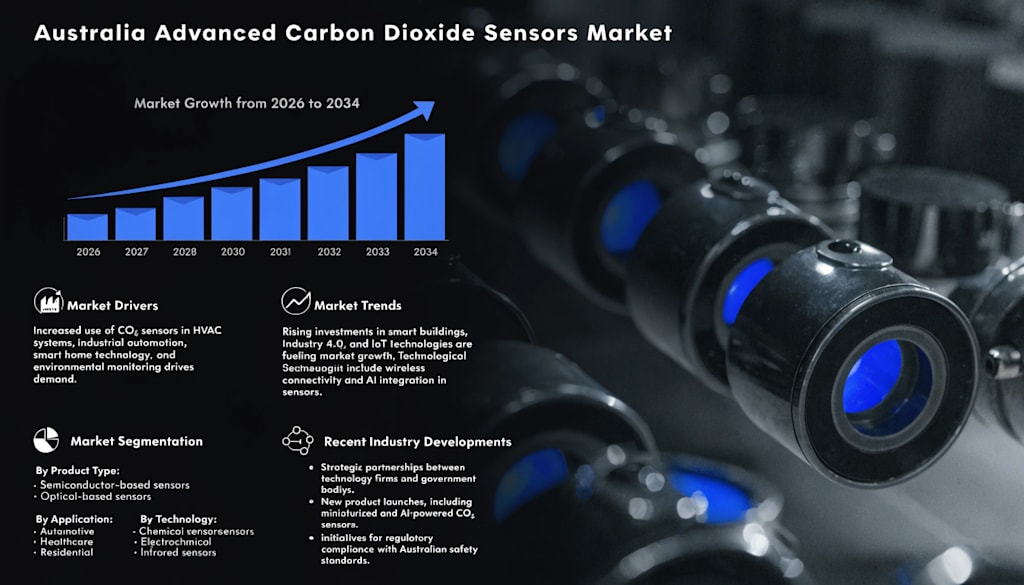
The Australia advanced carbon dioxide sensors market is expanding rapidly as building managers, industrial operators and government regulators increasingly deploy precision monitoring technologies to improve indoor air quality, optimise energy consumption and demonstrate emissions compliance. Advanced CO₂ sensors — spanning non dispersive infrared (NDIR), chemical and photoacoustic technologies in fixed and portable configurations — are deployed across commercial buildings, healthcare facilities, industrial sites and agricultural operations to measure carbon dioxide concentrations in real time, enabling demand controlled ventilation, workplace safety and environmental reporting. According to IMARC Group, the market size reached USD 59.19 Million in 2025 and is projected to reach USD 103.89 Million by 2034, exhibiting a compound annual growth rate (CAGR) of 6.45% during 2026–2034. As Australia strengthens building ventilation codes, expands carbon capture investment and accelerates smart building retrofits, advanced CO₂ sensors have become indispensable tools for balancing occupant health, energy efficiency and climate compliance.
What's Driving Market Growth?
NCC 2025 Mandates and Demand Controlled Ventilation. The National Construction Code (NCC) 2025 has established a CO₂ verification limit of 850 parts per million over 8 hours, based on 450 ppm above an ambient outdoor baseline of 400 ppm. This regulatory framework has fundamentally reshaped commercial building ventilation design. Demand controlled ventilation systems using wall mounted or duct mounted CO₂ sensors adjust outdoor air supply based on real time occupancy rather than fixed maximum design loads, delivering substantial energy savings in spaces with variable occupancy such as meeting rooms, open plan offices and educational facilities. A typical 150 m² meeting room requires 500 L/s of outdoor air at full occupancy but may sit empty half the day; DCV with CO₂ sensing reduces airflow to the minimum floor rate (0.35 L/s per m²) when unoccupied, cutting unnecessary cooling and heating costs. The control setpoint is typically 800 ppm, providing a 50 ppm buffer below the mandatory limit.
Landmark IAQ Research and Regulatory Momentum. Australia is experiencing a watershed moment in indoor air quality policy following the landmark 2024 national indoor air quality assessment that highlighted significant air quality deficiencies in Australian buildings. In May 2025, AIRAH convened a half day workshop with international experts to debate a critical question: "Is 800ppm CO₂ a good threshold value for ensuring adequate indoor air quality, or not?". While experts cautioned against using CO₂ as a perfect surrogate for overall IAQ, there was consensus that CO₂ monitoring is valuable for demand controlled ventilation and as an indicator of ventilation system performance. The Australian Academy of Science has called for a phased approach to establish enforceable indoor air quality performance standards in public buildings, beginning with monitoring and workplace reporting standards.
Government Emissions Reduction and Carbon Capture Investment. Australia's ambitious climate policy framework is a powerful foundation for CO₂ sensor deployment across multiple sectors. The federal government's commitment to achieving net zero emissions by 2050, coupled with the reformed Safeguard Mechanism that reduced covered facility emissions from 138.7 million tonnes in 2022 23 to 136.0 million tonnes in 2023 24, has intensified demand for accurate, continuous CO₂ monitoring in industrial and commercial environments. The AU$566 million investment announced in 2024 for carbon capture and storage projects is creating substantial demand for precision CO₂ monitoring solutions across industrial and environmental applications. The implementation of the New Vehicle Efficiency Standard in January 2025, which sets annual CO₂ emission targets for new light duty vehicles, further reinforces the national focus on carbon measurement.
Smart Building Integration and IoT Enabled Systems. The rapid adoption of smart building technologies and IoT enabled sensor systems is revolutionising energy management practices. CO₂ sensors are increasingly integrated with building automation systems to enable real time optimisation of HVAC operations and indoor environmental quality. Johnson Controls launched the NSW8000 Series wireless network sensor, offering optional CO₂ sensing alongside temperature, humidity and occupancy detection, with most sensors featuring 10 year battery life and secure AES 128 bit encryption. Vaisala's XMW85 CO₂, humidity and temperature transmitter provides accurate measurement for HVAC and building automation applications. These integrated systems enable facility managers to reduce energy consumption while maintaining occupant comfort and regulatory compliance.
Industrial Safety and Mining Compliance. Workplace health and safety regulations are driving sustained demand for CO₂ monitoring in mining, oil and gas, and confined space operations. Accumax Global reports that between 2011 and 2020, 1,451 Australians died from occupational lung disease, with over 80% linked to mineral dust and hazardous airborne contaminants. With new Workplace Exposure Limits taking effect in December 2026, continuous monitoring is no longer optional. Testo's portable flue gas analysers (models 340 and 350) are deployed across Australian mining operations to measure CO₂ alongside CO, NOx and SO₂, ensuring worker safety and regulatory compliance.
Market Segmentation & Key Insights
By Technology, Non Dispersive Infrared (NDIR) CO₂ sensors dominate the market due to their high accuracy, long term stability and real time monitoring capabilities. NDIR technology operates on the principle that CO₂ molecules absorb infrared light at a specific wavelength (approximately 4.26 µm), with the degree of absorption proportional to gas concentration. Chemical and semiconductor sensors serve cost sensitive applications, while photoacoustic sensors occupy specialty niches.
By Product Type, fixed CO₂ sensors account for the largest share, deployed permanently in HVAC systems, industrial facilities and commercial buildings, while portable CO₂ sensors are rapidly growing for spot checks, safety inspections and personal monitoring.
By Connectivity, wired CO₂ sensors remain dominant in traditional installations, but wireless and IoT enabled sensors are the fastest growing segment, enabling real time data transmission, cloud analytics and remote facility management.
By Application, building automation and HVAC represent the largest application segment, driven by NCC 2025 compliance and demand controlled ventilation adoption. Healthcare facilities use CO₂ sensors for patient monitoring and infection control, the petrochemical sector for process safety, and consumer electronics for emerging portable air quality devices.
By End User, the commercial segment leads, encompassing office towers, retail spaces, educational institutions and hospitality venues. The industrial segment is the second largest, driven by mining safety and emissions compliance. The residential segment is growing as consumers become more aware of indoor air quality.
By Region, New South Wales & ACT represent the largest market, driven by Sydney's dense commercial building stock, financial services concentration and early adoption of NCC 2025 compliance measures. Victoria and Queensland are rapidly growing, with major infrastructure projects and expanding industrial sectors.
Request a Sample Report with the Latest 2026 Edition
What the Opportunities Are?
AI Powered Predictive Maintenance and Automated Climate Control. Artificial intelligence is increasingly being integrated into CO₂ sensor systems to enable predictive maintenance, automated climate control optimisation and real time air quality management. AI algorithms can analyse patterns in CO₂ concentration data to anticipate ventilation needs, predict equipment failures before they occur, and automatically adjust HVAC systems based on occupancy patterns and external weather conditions, enhancing building management efficiency while reducing energy consumption. Companies developing AI driven analytics platforms that process sensor data across distributed building portfolios are well positioned to capture the premium segment of the market.
Indoor Air Quality as a Service (IAQaaS). With growing regulatory attention on mandatory IAQ monitoring, there is significant opportunity for subscription based models that bundle sensor hardware, cloud analytics, compliance reporting and maintenance into a single service offering. Building owners and facility managers increasingly prefer operational expenditure models over capital expenditure for sensor networks, particularly for multi site portfolios. IAQaaS platforms that provide real time dashboards, automated NCC compliance verification and actionable ventilation recommendations can generate recurring revenue while lowering barriers to sensor adoption.
Healthcare and Aged Care Facility Monitoring. The healthcare sector represents an underserved but rapidly growing opportunity for advanced CO₂ sensors. Hospitals, aged care facilities and clinics require precise indoor air quality management to protect vulnerable populations and reduce airborne infection risks. The 2024 national IAQ assessment's findings are catalyzing regulatory momentum toward mandatory CO₂ monitoring standards in healthcare facilities. Sensors designed specifically for healthcare environments — featuring antimicrobial housings, compatibility with infection control protocols and integration with clinical alarm systems — command premium pricing and long term supply contracts.
Greenhouse Agriculture and Controlled Environment Agriculture (CEA). Australia's expanding controlled environment agriculture sector is creating demand for CO₂ monitoring as a production optimisation tool. In greenhouse environments, CO₂ fertilisation — maintaining concentrations in the 800 1,500 ppm range — directly enhances photosynthesis and crop yields. NDIR CO₂ sensors such as Nexisense's MH 411D series provide oxygen independent, long term stable output for greenhouse environmental control systems, triggering fertilisation systems when levels drop below optimal thresholds. With CEA investment accelerating across Australia, sensor suppliers that develop agriculture specific calibration protocols and ruggedised housings for humid greenhouse conditions can capture this emerging market segment.
Wearable and Portable Personal Air Quality Monitors. The miniaturisation of NDIR CO₂ sensing technology is opening opportunities in wearable and portable devices for personal health monitoring. Professional drivers, construction workers, laboratory technicians and individuals with respiratory conditions increasingly seek real time air quality data for personal safety. The CozIR Blink solid state NDIR sensor, calibrated to measure CO₂ concentrations, exemplifies the trend toward compact, low power sensing suitable for battery operated portable devices. Manufacturers integrating CO₂ sensing into smartwatches, fitness trackers and personal safety badges can address consumer demand for health optimised environments.
Aftermarket Retrofits and Sensor Calibration Services. Much of Australia's commercial building stock predates NCC 2025 and requires retrofitting with CO₂ sensors to achieve compliance. The retrofit market — spanning sensor installation, BMS integration and commissioning — represents a significant service opportunity. Additionally, NDIR sensors require periodic calibration to maintain accuracy; providers offering calibration as a service, on site validation and sensor replacement programmes can secure long term customer relationships and recurring revenue.
Recent News and Developments in Australia Advanced Carbon Dioxide Sensors Market
May 2025: AIRAH convened a half day workshop at RMIT Melbourne preceding the IAQ Conference, titled "Is 800ppm CO₂ a good threshold value for ensuring adequate indoor air quality, or not?" The event brought together international experts to debate the merits of CO₂ based IAQ regulation.
May 2025: Johnson Controls launched the NSW8000 Series wireless network sensor for Metasys building automation systems, featuring real time temperature, humidity and occupancy detection with optional CO₂ sensing. The sensor offers a 150 foot wireless range and AES 128 bit encryption for secure data transmission.
September 2025: CCC Engineering published design guidance on demand controlled ventilation with CO₂ sensors, highlighting NCC 2025's 850 ppm 8 hour CO₂ verification limit and providing practical implementation advice for building services engineers.
October 2025: The Australian government released an expansion roadmap for NABERS, the national building energy rating scheme, signaling broader integration of indoor air quality metrics into building performance ratings.
January 2025: Adoption of indoor air quality monitoring accelerated following the landmark 2024 national IAQ assessment, with organisations investing in advanced sensors to monitor air quality in workplaces, schools and public spaces.
October 2025: Testo industry specialists highlighted the critical importance of accurate low concentration gas measurement for Australian mining compliance, noting that legal penalties and permit suspensions apply to operators failing to comply with work health and safety duties.
December 2025: AIRAH published a summary of workshop outcomes, documenting expert discussions on whether 800ppm CO₂ is an appropriate threshold for ensuring adequate indoor air quality, contributing to ongoing regulatory development.
March 2026: The Australian Academy of Science's blueprint for national indoor air quality standards continued to gain policy traction, with calls for a phased approach to establish enforceable IAQ performance standards in public buildings.
April 2026: The Australia advanced carbon dioxide sensors market was valued at USD 59.19 million in 2025, with IMARC Group projecting robust growth at a CAGR of 6.45% through 2034, driven by government led emissions reduction policies, building standards and smart building integration.
Why Should You Know About Australia Advanced Carbon Dioxide Sensors Market?
You should know about this market because it captures how building regulation reform, climate policy and smart infrastructure investment intersect to create sustained growth in a precision monitoring category that directly impacts occupant health, energy costs and emissions compliance. Advanced CO₂ sensors are no longer niche industrial instruments — they are essential components of NCC 2025 compliant ventilation systems, enablers of net zero carbon capture projects, and intelligence nodes in the rapidly digitising Australian commercial building stock.
For investors, the advanced CO₂ sensors market offers exposure to a growth oriented environmental technology category anchored in Australia's net zero 2050 commitment, mandatory building ventilation standards, and the accelerating retrofit of commercial buildings with smart IoT systems. The projected CAGR of 6.45% reflects strong confidence in regulatory tailwinds, technological differentiation and recurring demand tied to building compliance cycles and preventive maintenance programmes. The broader Australian gas sensor market, within which CO₂ sensors were the largest revenue generating product in 2025, reinforces the segment's foundational strength.
For building services engineers, facility managers, HVAC contractors and sustainability consultants, understanding CO₂ sensor technology segmentation, NCC 2025 compliance pathways, AI integration strategies and retrofit methodologies helps shape intelligent procurement decisions, system designs and compliance verification programmes that deliver measurable indoor air quality, energy efficiency and regulatory outcomes.
In essence, the Australia advanced carbon dioxide sensors market captures how public health protection, climate accountability and building intelligence converge — making it a compelling area for investors, technology developers and built environment professionals seeking smarter approaches to ventilation management, emission reduction and sustainable building operations across Australia's rapidly evolving regulatory landscape.
About the Creator
Thomas
Market Research Analyst | Industry Trends & Forecasting | Turning market data into clear, actionable business insights across global sectors.
Enjoyed the story? Support the Creator.
Subscribe for free to receive all their stories in your feed.
Comments
There are no comments for this story
Be the first to respond and start the conversation.