
Australia Advanced Carbon Dioxide Sensors Market 2026: Air Quality Monitoring, Smart Buildings & IoT Integration
Rising demand for indoor air quality monitoring, smart infrastructure, and regulatory compliance is driving growth in Australia’s advanced CO₂ sensors market

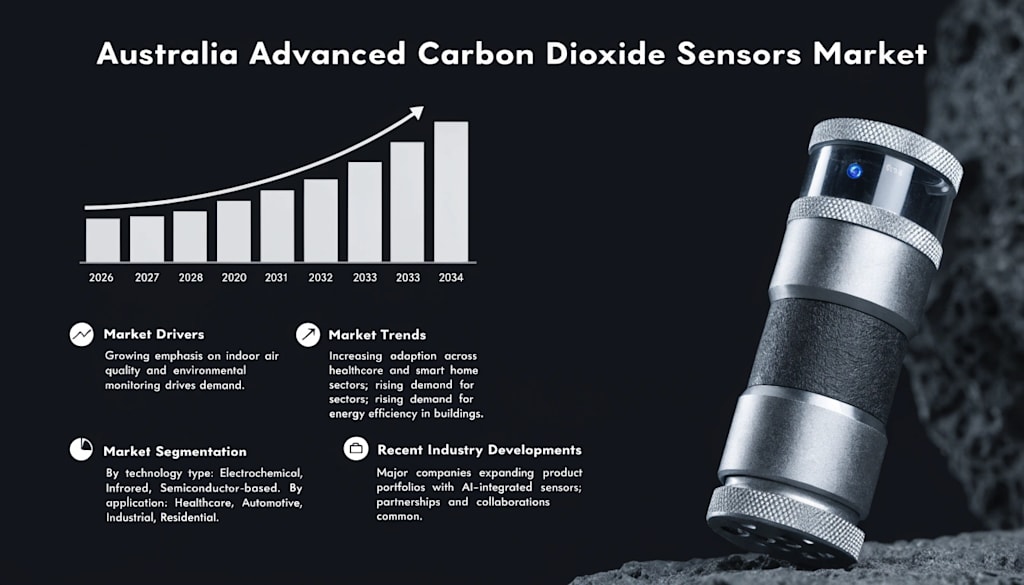
The Australia advanced carbon dioxide (CO₂) sensors market is experiencing steady growth as increasing awareness of air quality, rising adoption of smart building technologies, and stringent environmental regulations drive demand for precise monitoring solutions. According to industry insights, the market reached USD 59.19 Million in 2025 and is projected to grow to USD 103.89 Million by 2034, expanding at a CAGR of 6.45% during 2026–2034.
Advanced CO₂ sensors are devices used to measure carbon dioxide concentration in the air, playing a critical role in monitoring indoor air quality, industrial safety, and environmental conditions. These sensors are widely used in HVAC systems, healthcare facilities, commercial buildings, and industrial environments.
The market’s growth reflects a broader shift toward smart and sustainable infrastructure, where real-time monitoring and data-driven decision-making are essential.
What’s Driving Market Growth?
One of the primary drivers of the Australia CO₂ sensors market is the increasing focus on indoor air quality (IAQ). With growing awareness of health and productivity impacts, organizations are investing in advanced sensors to monitor and control air quality in workplaces, schools, and public spaces.
The rapid adoption of smart buildings and IoT-enabled systems is another key growth factor. CO₂ sensors are integrated into intelligent ventilation systems to optimize airflow, reduce energy consumption, and enhance occupant comfort.
Technological advancements are also fueling market expansion. Modern CO₂ sensors, particularly non-dispersive infrared (NDIR) sensors, offer high accuracy, long-term stability, and real-time monitoring capabilities, making them ideal for continuous applications.
The rising demand for energy-efficient and sustainable solutions is further supporting market growth. CO₂ sensors enable demand-controlled ventilation, reducing unnecessary energy usage and supporting environmental goals.
Additionally, increasing applications in healthcare, agriculture, and industrial safety are expanding the market scope. These sensors are used in patient monitoring, greenhouse management, and hazardous gas detection systems.
Market Segmentation & Key Insights
• By Technology:
o NDIR sensors dominate due to high accuracy and reliability.
o Chemical and semiconductor sensors are used in cost-sensitive applications.
• By Application:
o HVAC and smart buildings lead due to air quality monitoring needs.
o Industrial applications ensure safety and emission control.
o Healthcare sector uses sensors for patient monitoring and diagnostics.
o Agriculture applications include greenhouse monitoring.
• By End User:
o Commercial buildings dominate adoption.
o Industrial sector is a key contributor.
o Residential and healthcare segments are growing.
• By Connectivity:
o Wired systems dominate traditional setups.
o Wireless and IoT-enabled sensors are rapidly expanding.
What the Opportunities Are?
The Australia advanced CO₂ sensors market presents strong opportunities in smart building and IoT integration. As buildings become more connected, demand for intelligent air quality monitoring systems is expected to rise significantly.
Another major opportunity lies in energy-efficient ventilation systems. CO₂ sensors can optimize HVAC performance, reducing energy costs and supporting sustainability goals.
The expansion of environmental monitoring and climate initiatives also offers growth potential, as governments and organizations focus on reducing emissions and improving air quality.
There is also strong scope in wearable and portable sensor devices, which can provide real-time air quality data for personal safety and health monitoring.
Additionally, advancements in miniaturization and sensor accuracy can enhance product performance and expand applications across industries.
Recent News and Developments in Australia Advanced Carbon Dioxide Sensors Market
January 2025: Adoption of indoor air quality monitoring systems increased by approximately 10–12%, driven by growing awareness of health and workplace productivity.
April 2025: Smart building projects expanded by nearly 15–18%, boosting demand for integrated CO₂ sensors in HVAC and automation systems.
August 2025: Industrial safety investments rose by around 8–10%, increasing deployment of gas detection and monitoring sensors across manufacturing facilities.
November 2025: Adoption of IoT-enabled and wireless CO₂ sensors grew by approximately 12–14%, enhancing real-time monitoring and data-driven decision-making capabilities.
Why Should You Know About Australia Advanced Carbon Dioxide Sensors Market?
The Australia advanced CO₂ sensors market is important because it highlights the growing role of environmental monitoring and smart technologies in modern infrastructure.
For investors, this market offers exposure to a technology-driven segment supported by sustainability initiatives, regulatory requirements, and digital transformation. The projected CAGR of 6.45% reflects steady growth potential.
For technology providers and manufacturers, the market presents opportunities to innovate, integrate IoT solutions, and expand into diverse applications.
For policymakers and stakeholders, it underscores the importance of air quality standards, energy efficiency, and environmental protection in shaping future development.
In essence, the Australia advanced carbon dioxide sensors market represents the convergence of technology, sustainability, and health — making it a critical and evolving segment of the modern digital ecosystem.
About the Creator
Thomas
Market Research Analyst | Industry Trends & Forecasting | Turning market data into clear, actionable business insights across global sectors.
Enjoyed the story? Support the Creator.
Subscribe for free to receive all their stories in your feed.
Comments
There are no comments for this story
Be the first to respond and start the conversation.