
Australia Adipic Acid Market 2026: Polymer Demand, EV Lightweighting & Bio-Based Chemistry
How automotive electrification, high-performance nylon and sustainable manufacturing are reshaping Australia's adipic acid landscape

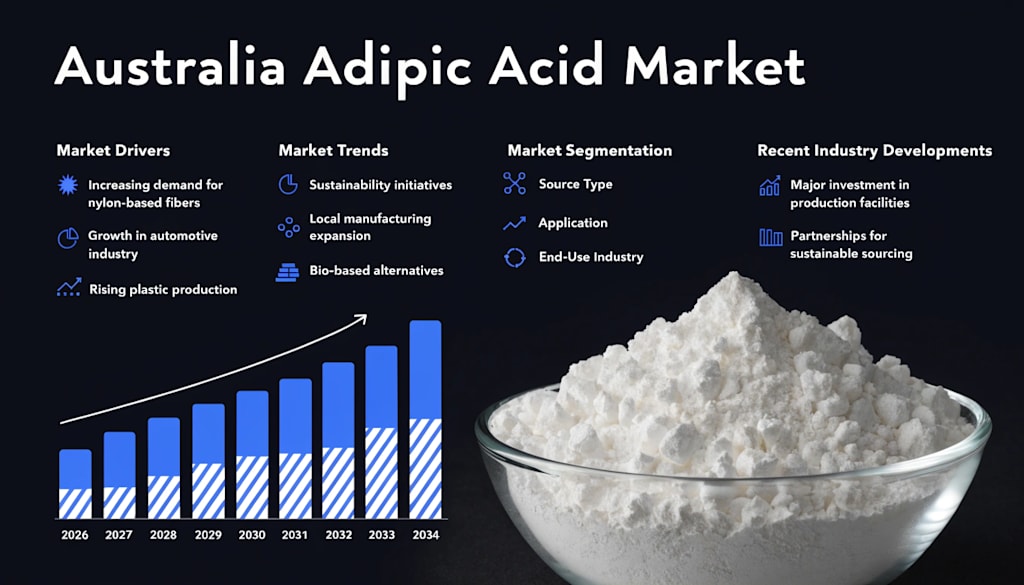
The Australia adipic acid market is expanding steadily as automotive manufacturers, polymer producers and industrial coating formulators increasingly prioritise lightweight materials, high-performance polymers and sustainable chemistry. Adipic acid — a white crystalline dicarboxylic acid — serves as a critical intermediate in the production of nylon 6,6, polyurethane systems, plasticisers, synthetic lubricants and industrial coatings, delivering durability, thermal stability and resistance to abrasion across demanding applications. According to IMARC Group, the market size reached USD 138.6 Million in 2025 and is projected to reach USD 215.05 Million by 2034, exhibiting a compound annual growth rate (CAGR) of 5.00% during 2026–2034. As Australia's materials sector integrates advanced polymers into automotive, construction and technical textile applications, adipic acid has become an indispensable enabler of lightweighting, durability and circular economy initiatives.
What's Driving Market Growth?
Automotive Lightweighting and Electric Vehicle Adoption. The automotive sector's transition toward lightweight materials and electric mobility solutions is a primary driver of adipic acid demand. Nylon 6,6 derived from adipic acid is increasingly essential for producing high-strength, lightweight automotive components, including battery housings, structural reinforcements, interior parts and under-the-hood applications where temperature resistance and mechanical strength are paramount. Australia's electric vehicle market has experienced remarkable expansion, supported by the Australian government's National Electric Vehicle Strategy, which aims to increase EV uptake to reduce emissions. Electric vehicles require extensive use of lightweight polymers to offset battery weight while maintaining vehicle performance and range, creating sustained demand for adipic acid as a key precursor material. Advanced composites such as carbon fiber-reinforced plastics and nylon-based engineering resins are increasingly adopted by automakers to meet stringent emission norms and consumer expectations for sustainable mobility solutions.
Shift Toward Bio-Based and Sustainable Chemical Manufacturing. Environmental sustainability has emerged as a critical driver reshaping the adipic acid industry. Conventional adipic acid production through the oxidation of petroleum-based feedstocks releases significant quantities of nitrous oxide — a potent greenhouse gas. In response, the chemical industry is actively developing bio-based adipic acid production routes that utilise renewable feedstocks and eliminate harmful emissions. This bio-based production route combines fermentation technology to convert non-edible sugars into muconic acid with specialised hydrogenation processes to transform it into high-purity bio-adipic acid, avoiding the nitrous oxide emissions associated with traditional chemical synthesis. Australian industries are becoming more conscious of their environmental impact, and the availability of sustainable bio-based adipic acid alternatives supports the nation's broader commitment to circular economy principles and emission reduction targets.
Expansion of Technical Textiles and Performance Materials. Australia's textile and apparel sector is undergoing significant transformation driven by sustainability imperatives and growing demand for high-performance technical textiles. Adipic acid plays a crucial role in producing nylon fibers that exhibit exceptional durability, elasticity and resistance to abrasion, making them indispensable for activewear, industrial textiles and technical applications across automotive, aerospace and defence sectors. The growing emphasis on technical textiles for specialised applications, including automotive interiors, safety equipment, industrial filtration and medical textiles, further strengthens demand for high-quality nylon fibers produced from adipic acid.
Growth in Industrial Coatings and Polyurethane Systems. Polyurethane systems made from adipic acid and its derivatives are extensively utilised in coatings, adhesives, sealants and elastomers (CASE), providing strong barrier characteristics, adaptability and resistance to corrosion — attributes critical in construction, industrial coatings and protective packaging. Australia's infrastructure investments — propelled by urbanisation, building renovation demand and government-backed construction projects — are contributing to adipic acid growth through polyurethane foams, insulation materials and specialty coatings that increase material performance and support energy-efficient buildings.
Market Segmentation & Key Insights
By End Product, the market includes nylon 66 fibers, nylon 66 engineering resins, polyurethanes, adipate esters and others. Nylon 66 engineering resins and fibers collectively account for a substantial share of demand, driven by automotive lightweighting and technical textile applications.
By Application, the market is segmented into plasticisers, unsaturated polyester resins, wet paper resins, coatings, synthetic lubricants, food additives and others. Plasticisers and coatings represent significant segments, supported by durable goods manufacturing, while synthetic lubricants maintain steady demand from industrial and automotive sectors.
By End User, key industries include automotive, electrical and electronics, textiles, food and beverage, personal care, pharmaceuticals and others. Automotive, electrical and electronics, and textiles collectively constitute the largest end-user clusters, reflecting the critical role of adipic acid-derived materials in component manufacturing and protective equipment.
By Region, major markets include Australia Capital Territory & New South Wales, Victoria & Tasmania, Queensland, Northern Territory & Southern Australia, and Western Australia. NSW and ACT represent the largest regional market, driven by the concentration of automotive component manufacturing, polymer processing facilities and industrial coating operations in Sydney and surrounding industrial zones.
What the Opportunities Are?
Bio Based and Low Carbon Adipic Acid Production. Global sustainability trends are encouraging the development of greener adipic acid production methods, including bio-based pathways and emissions-reducing processes. Bio-based adipic acid produced from renewable feedstocks — such as non-edible sugars, nut shells or wood waste — can achieve up to 99 percent purity while generating significantly lower greenhouse gas emissions compared to conventional petroleum-based routes. Producers that invest in renewable feedstocks, lower carbon footprints and waste-minimising technologies can differentiate themselves and appeal to environmentally focused buyers. The bio-based adipic acid market is positioned to capture growing demand as Australian industries align with circular economy principles.
Advanced Material Innovation and Specialty Derivatives. There are strong opportunities for innovation in specialty adipic acid derivatives that target high-temperature polymers, hybrid composites and premium surface coatings. Material scientists are innovating adipic acid derivatives that deliver enhanced properties such as improved thermal stability, abrasion resistance and compatibility with composite systems. Specialty formulations for demanding applications — including aerospace components, defence equipment and industrial filtration systems — command premium margins and support product differentiation in advanced industrial segments.
Export Expansion and Regional Trade Networks. Australia's proximity to Asia-Pacific industrial markets — including manufacturing hubs in Southeast Asia, Japan and South Korea — positions the country for strategic export growth. Building delivery and trade partnerships can amplify market reach and create regional supply chain integration for adipic acid and its derivatives. Value-added chemical products, including specialty nylon resins and custom polyurethane systems, are particularly well-suited for export markets seeking high-quality Australian formulations.
Collaborative R&D and Industrial Chemistry Partnerships. Partnerships between academic research institutions and industrial chemists can accelerate new material development, catalyse innovative formulations and improve performance outcomes. Collaborative R&D can strengthen commercial pipelines and reduce time to market for cutting-edge material innovations. Australia's research capabilities in polymer science and sustainable chemistry offer fertile ground for industry-university collaborations targeting next-generation adipic acid applications.
Value-Added Chemical Services and Technical Support. Adipic acid producers can enhance competitiveness by offering value-added services such as custom formulation consulting, technical support, supply chain optimisation and integrated logistics solutions. Educating customers on performance advantages, regulatory compliance and material specifications adds strategic value beyond raw material supply.
Recent News and Developments in Australia Adipic Acid Market
July 2025: Leading chemical manufacturers in Australia announced collaborative projects to explore greener adipic acid production technologies, focusing on renewable feedstocks and reduced greenhouse gas emissions. These initiatives aimed to align production facilities with emerging sustainability frameworks and industry expectations, marking a strategic shift toward cleaner chemical manufacturing.
September 2025: Several downstream polymer producers reported increased procurement of adipic acid derivatives for specialised polyurethane systems used in construction and industrial coatings. Analysts noted that enhanced performance requirements and expanding construction projects were key drivers of this procurement trend, reflecting cross-sector demand growth.
November 2025: Industry associations revealed that adipic acid demand continued to rise steadily, driven by strong performance in automotive parts manufacturing and packaging material supply chains. Market observers highlighted that collaborations with supply chain partners and quality certification frameworks supported commercial stability despite broader global chemical price volatility.
March 2025 (Global Context): The global adipic acid market was valued at approximately USD 6–7 billion, with analysts projecting continued growth driven by automotive and textile industry demand. Australia's market growth reflects alignment with these global trends while maintaining distinct regional characteristics tied to domestic manufacturing and export opportunities.
Why Should You Know About Australia Adipic Acid Market?
You should know about this market because it illustrates how automotive lightweighting, polymer science and sustainable chemistry intersect to create steady growth opportunities in a mission-critical segment of Australia's industrial materials landscape. Adipic acid is no longer just a chemical intermediate — it is an essential building block that enables EV battery housings, high-performance engineering plastics, durable technical textiles and low-emission polyurethane systems that help manufacturers meet both performance and environmental targets.
For investors, the adipic acid market offers exposure to a stable growth industrial chemicals category anchored in Australia's expanding electric vehicle adoption, infrastructure investment and accelerating shift toward bio-based manufacturing. The projected CAGR of 5.00% reflects consistent baseline demand, while higher-growth sub-segments — including bio-based adipic acid, specialty polymer derivatives and export-oriented formulations — offer differentiated upside potential.
For chemical manufacturers, polymer producers, automotive suppliers and supply chain planners, understanding adipic acid segmentation, end-product dynamics, bio-based pathways and regional trade opportunities helps shape intelligent investment decisions, procurement strategies and research collaborations that deliver measurable sustainability, performance and profitability outcomes.
In essence, the Australia adipic acid market captures how material science, industrial electrification and green chemistry converge — making it a compelling area for innovators, investors and organisations seeking smarter approaches to high-performance materials, circular manufacturing and long-term industrial competitiveness.
About the Creator
Thomas
Market Research Analyst | Industry Trends & Forecasting | Turning market data into clear, actionable business insights across global sectors.
Enjoyed the story? Support the Creator.
Subscribe for free to receive all their stories in your feed.
Comments
There are no comments for this story
Be the first to respond and start the conversation.