
Australia Acute Respiratory Distress Syndrome Market 2026: ECMO Innovation, Precision Therapies & ICU Expansion
How artificial intelligence, advanced extracorporeal technology and targeted drug trials are reshaping critical respiratory care across Australia

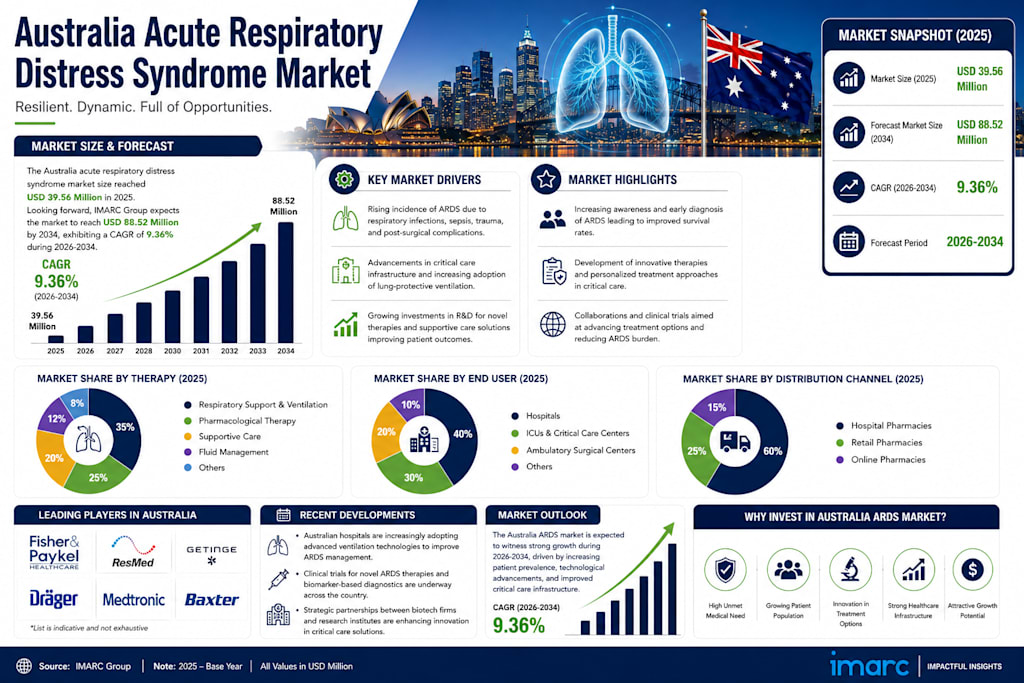
The Australia acute respiratory distress syndrome (ARDS) market is undergoing rapid transformation as intensive care specialists, hospital systems and medical technology developers increasingly deploy life-saving innovations to combat one of the most lethal conditions in critical care medicine. ARDS – a severe inflammatory lung injury that impairs oxygen exchange – affects up to five million people globally each year and claims up to half of its victims. Management protocols encompass advanced mechanical ventilation, extracorporeal membrane oxygenation (ECMO), inhaled nitric oxide delivery, diagnostic monitoring and an expanding arsenal of investigational drug therapies. According to IMARC Group, the market size reached USD 39.56 Million in 2025 and is projected to reach USD 88.52 Million by 2034, exhibiting a strong compound annual growth rate (CAGR) of 9.36% during 2026–2034. As Australia confronts an ageing population, elevated rates of chronic respiratory disease and the lingering pulmonary legacy of COVID-19, ARDS therapies have become a strategic priority for health policymakers, hospital administrators and medical technology investors alike.
What's Driving Market Growth?
Expansion of ICU Capacity and Healthcare Infrastructure Investment. The Australian government is actively strengthening healthcare infrastructure through sustained investments in intensive care unit capacity expansion and advanced respiratory care capabilities. These strategic investments address growing demand driven by an ageing population, increased rates of chronic respiratory conditions and heightened awareness of post-COVID lung damage complications. In August 2024, the Canberra Hospital commenced operations of its new Critical Services Building featuring an expanded 48 bed Intensive Care Unit, representing Australia's first all electric hospital structure. The expansion encompasses not only physical infrastructure but also workforce development, with significant investments in recruiting and training specialised intensive care physicians, respiratory therapists and critical care nurses.
Advancements in ECMO Technology and Mechanical Ventilation. Modern ECMO systems have evolved to provide life saving circulatory and respiratory support for critically ill patients with severe ARDS. Contemporary systems feature enhanced portability, user friendly interfaces and improved biocompatibility, reducing complications related to clotting and bleeding. Mechanical ventilation has become increasingly sophisticated, utilising advanced monitoring techniques such as electrical impedance tomography to provide real time imaging of lung ventilation. The Australia and New Zealand V V ECMO Guideline – the first in a series of nationally developed, evidence based recommendations for extracorporeal life support – supports the use of V V ECMO as a conditional recommendation in carefully selected patients after failure of optimal conventional therapy, noting short term mortality benefit with moderate certainty.
Rising Prevalence of Respiratory Diseases Amid an Ageing Population. Australia is witnessing a significant surge in chronic respiratory ailments, such as chronic obstructive pulmonary disease (COPD), pneumonia and severe influenza, which are among the major causes of ARDS. In 2022, an estimated 8.5 million (34 per cent) Australians had chronic respiratory diseases, including asthma and COPD, with approximately 638,000 (2.5 per cent) having COPD. Pneumonia alone causes thousands of intensive care admissions and hundreds of deaths each year in Australia.
AI Integration and Predictive Analytics. The integration of artificial intelligence and machine learning into respiratory support systems further enhances treatment precision by analysing large datasets from electronic health records and medical imaging to identify early ARDS signs, predict disease progression and recommend personalised treatment protocols. In 2026, Australian hospitals utilising predictive AI models reduced emergency readmissions by 22 per cent, shifting the national medical approach from reactive treatment to proactive intervention. AI powered systems are now embedded in bedside monitoring, offering continuous analysis of physiological parameters and early warning indicators that reduce clinician workload and enhance situational awareness.
Market Segmentation & Key Insights
By Treatment Modality, the market is divided into medication/drug class (vasoconstrictors, bronchodilators, corticosteroids, antibiotics, sedatives, paralytics and surfactants) and medical device segments (mechanical ventilators, ECMO and artificial lung systems, inhaled nitric oxide delivery systems and diagnostic monitoring devices). ECMO and mechanical ventilation devices represent the largest revenue generating device categories, driven by continuous technological innovation and growing adoption across tertiary hospitals.
By Cause of Lung Injury, the market is segmented into direct injury (pneumonia, aspiration, inhalation injury) and indirect injury (sepsis, pancreatitis, major trauma). Both pathways contribute substantially to Australia's ARDS caseload.
By Severity, the market covers mild, moderate and severe classifications. Severe ARDS accounts for the majority of ECMO utilisation and advanced device spending.
By End User, the market is segmented into hospitals and intensive care units, specialty clinics and others. Hospitals and ICUs dominate ARDS treatment delivery, with major tertiary referral centres serving as ECMO hubs.
By Region, major markets include Australia Capital Territory & New South Wales, Victoria & Tasmania, Queensland, Northern Territory & Southern Australia and Western Australia. NSW and ACT represent the largest regional market, driven by the concentration of tertiary referral hospitals, academic medical centres and ECMO retrieval services centred in Sydney.
What the Opportunities Are?
AI Powered Predictive Analytics and Early Detection Systems. The integration of artificial intelligence into respiratory support systems presents a frontier opportunity. AI powered algorithms can analyse electronic health records and medical imaging to identify early ARDS signs and recommend personalised treatment protocols before clinical deterioration becomes irreversible. Australian hospitals already utilise advanced predictive algorithms that continuously monitor vital signs from ICU patients, and the application of these technologies specifically for ARDS prediction represents a significant growth frontier.
Biomarker Driven Precision Medicine and Platform Clinical Trials. The GuARDS trial (Glucocorticoids in adults with ARDS), funded with $1.89 million by the Medical Research Future Fund and led by Monash University, is a randomised clinical trial investigating whether dexamethasone can reduce death rates in ARDS patients. Ethics approval was obtained in December 2025 with recruitment commencing in early 2026. Additionally, a Phase 2/3 trial is evaluating vadadustat for nonintubated ARDS secondary to pathogen associated lung injury. These precision medicine approaches position Australia at the forefront of ARDS drug development.
Innovative Drug Discovery and Regenerative Medicine. Queensland researchers launched the first human study exploring Biofluid Induced Lung Injury (BILI) – a previously overlooked mechanism explaining how inflammatory fluid spreads through lung tissue, damaging previously healthy areas. The pilot study, funded by Wesley Research Institute, will collect blood and lung fluid samples from ARDS patients within 48 hours of diagnosis. Potential outcomes include simple bedside changes such as optimised patient positioning alongside new drug targets to halt injury spread. A Phase 3 study of JadiCell™, an investigational umbilical cord derived mesenchymal stem cell therapy with immunomodulatory and regenerative properties, is also underway. Any pharmacotherapy demonstrating mortality benefit would generate blockbuster commercial potential.
Portable, Next Generation ECMO and Respiratory Support Devices. In September 2024, Medtronic introduced the VitalFlow ECMO System to the Australian market – a flexible, modular platform designed to bridge the gap between bedside care and intra hospital transport. Devices offering enhanced portability, simplified user interfaces and reduced complications open distribution channels beyond major metropolitan ECMO centres to regional hospitals and retrieval services.
Workforce Development and Specialised Training Services. The expansion of ARDS treatment capabilities encompasses significant investments in recruiting and training specialised intensive care physicians, respiratory therapists and critical care nurses. Demand is growing for professional training programmes, simulation based education, certification courses, and ECMO circuit maintenance services that help ICUs maximise technology ROI.
Recent News and Developments in Australia Acute Respiratory Distress Syndrome Market
March 2026: The Australia and New Zealand V V ECMO Guideline was published – the first in a series of nationally developed, evidence based recommendations for extracorporeal life support using GRADE methodology – providing practical guidance on patient selection, timing and management of V V ECMO in adult respiratory failure with a focus on severe ARDS.
December 2025: Queensland researchers launched the first human study exploring Biofluid Induced Lung Injury, funded by Wesley Research Institute's 2025 research grant rounds. The team expects to complete the pilot around mid 2027.
September 2024: Medtronic introduced the VitalFlow ECMO System to the Australian market, a flexible and modular extracorporeal membrane oxygenation platform designed to bridge bedside care and intra hospital transport.
August 2024: Canberra Hospital commenced operations of its new Critical Services Building featuring an expanded 48 bed Intensive Care Unit – Australia's first all electric hospital building.
May 2026: SA Health's Winter Demand Plan incorporated an additional 50 step down beds at College Grove to support older patients who no longer require acute hospital care, reflecting ongoing capacity expansion to manage seasonal respiratory pressures.
Why Should You Know About Australia Acute Respiratory Distress Syndrome Market?
You should know about this market because it captures how technological innovation, health system capacity expansion and precision medicine intersect to create strong growth opportunities in one of Australia's most clinically urgent and technologically dynamic medical segments. ARDS is no longer managed with one size fits all ventilation protocols – it is increasingly treated with AI guided respiratory support, portable ECMO platforms, biomarker stratified pharmacotherapy and immunomodulatory cellular therapies that address underlying inflammatory pathology rather than merely compensating for oxygenation failure.
For investors, the ARDS market offers exposure to a high growth medical technology and pharmaceutical category anchored in Australia's ageing population, rising chronic respiratory disease burden and sustained government investment in ICU infrastructure. The projected CAGR of 9.36% reflects strong confidence in adoption trends, technological differentiation and recurring demand tied to critical care equipment sales, consumables, service contracts and emerging pharmaceutical pipelines.
For healthcare executives, critical care specialists, medical device manufacturers, pharmaceutical developers and health policymakers, understanding ARDS segmentation, ECMO guideline evolution, AI integration pathways and emerging stem cell and small molecule therapeutics helps shape intelligent investment decisions, clinical trial strategies and technology procurement that deliver measurable patient survival, functional recovery and health system resilience outcomes.
In essence, the Australia acute respiratory distress syndrome market captures how critical care engineering, molecular medicine and health system preparedness converge – making it a compelling area for innovators, investors and healthcare organisations seeking smarter approaches to the management of severe respiratory failure, the protection of long term pulmonary health and the sustainable resourcing of intensive care services across Australia's evolving healthcare landscape.
About the Creator
Thomas
Market Research Analyst | Industry Trends & Forecasting | Turning market data into clear, actionable business insights across global sectors.
Enjoyed the story? Support the Creator.
Subscribe for free to receive all their stories in your feed.
Comments
There are no comments for this story
Be the first to respond and start the conversation.