
Australia Account Reconciliation Software Market: AI Powered Automation, Financial Compliance & Cloud Modernisation
How regulatory reform, AI driven transaction matching and the BFSI sector's digital transformation are reshaping Australia's financial control landscape

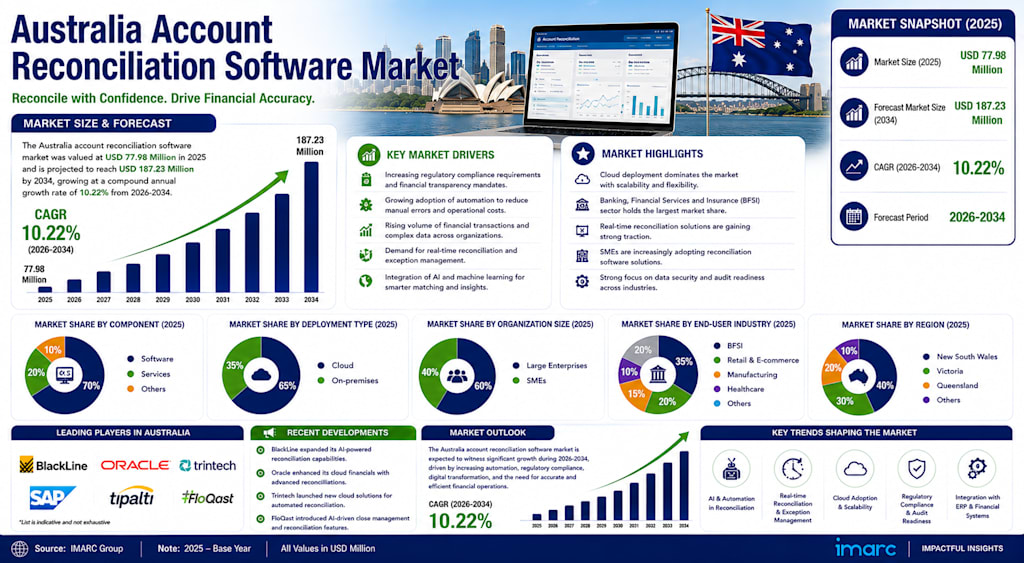
The Australia account reconciliation software market is undergoing a significant transformation as financial institutions, corporate enterprises and accounting practices increasingly deploy automated platforms to replace manual spreadsheet based processes. Account reconciliation software — encompassing cloud based and on premises solutions with AI powered matching capabilities, real time analytics and compliance monitoring — is deployed across banking, insurance, manufacturing, healthcare and retail sectors to ensure financial accuracy, reduce operational risk and meet evolving regulatory requirements. According to IMARC Group, the market size reached USD 77.98 Million in 2025 and is projected to reach USD 187.23 Million by 2034, exhibiting a strong compound annual growth rate (CAGR) of 10.22% during 2026–2034. As Australia's financial services sector embraces automated reconciliation and accounting firms shift toward advisory roles, intelligent reconciliation platforms have become indispensable tools for financial control and regulatory compliance.
What's Driving Market Growth?
Regulatory Modernisation and Compliance Mandates. The implementation of the Financial Accountability Regime (FAR) has significantly intensified demand for automated reconciliation solutions across Australia's financial sector. FAR commenced for banking institutions in March 2024 and was extended to the insurance and superannuation sectors by March 2025, requiring accountable entities to maintain transparent audit trails and enhanced governance controls. Enterprises are increasingly recognising that manual spreadsheet based reconciliation processes cannot adequately address the volume and complexity of contemporary financial transactions. ATO mandated reporting requirements, including Single Touch Payroll (STP), further compel organisations to adopt reconciliation software that can ensure payroll accuracy and prevent costly compliance errors.
Dominance of the BFSI Sector. The banking, financial services and insurance (BFSI) sector exerts clear dominance in the Australia account reconciliation software market, accounting for 33.9% of the market share in 2025. This leadership position is driven by stringent regulatory compliance requirements, complex intercompany transactions and the critical need for accurate financial reporting across banking and insurance operations. Financial institutions process millions of daily transactions across multiple payment rails, creating an operational imperative for automated reconciliation that manual processes cannot satisfy. The largest segment is software, which dominates the market with 73.8% of the share in 2025, owing to the comprehensive functionality of standalone and bundled platforms designed to automate transaction matching, real time reporting and compliance monitoring.
Cloud First Deployment Accelerating Adoption. Cloud based deployment leads the market with 63.2% of the share in 2025, driven by superior scalability, flexibility and cost effectiveness compared to on premises alternatives. Organisations are prioritising cloud deployment for seamless remote access, automatic updates and reduced infrastructure investments. Australian accounting firms in 2026 are under constant pressure to deliver faster, more accurate work with limited resources, and cloud platforms like Xero and MYOB have evolved into mature, reliable systems with features tailored to local compliance and workflows. Industry benchmarks show firms that move fully to cloud accounting reduce time spent on routine tasks by 20–40% on average. Cloud platforms automate bank reconciliation through direct bank feeds and AI assisted categorisation, reducing reconciliation time from 2–4 hours per client per month to just 15–30 minutes.
Market Segmentation & Key Insights
By Component, the market is divided into software (73.8% share in 2025) and services, with software dominating due to comprehensive functionality for transaction matching, real time reporting and compliance monitoring. Growing enterprise demand for intelligent cloud based solutions with AI capabilities is accelerating adoption. By Deployment Mode, cloud based leads with 63.2% share in 2025, driven by scalability, flexibility and cost effectiveness compared to on premises alternatives. By Organization Size, large enterprises comprise the largest segment with 68.6% share in 2025, reflecting their complex financial operations, higher transaction volumes and substantial IT budgets enabling investment in comprehensive reconciliation automation platforms. By End User, BFSI exhibits clear dominance with 33.9% share in 2025, driven by stringent regulatory compliance requirements and the critical need for accurate financial reporting. By Region, Australia Capital Territory & New South Wales represents the largest region with 37.5% share in 2025, attributed to the concentration of major financial institutions in Sydney and the presence of numerous corporate headquarters.
What the Opportunities Are?
AI Powered Reconciliation and Autonomous Matching. The integration of artificial intelligence and machine learning technologies is fundamentally transforming reconciliation software capabilities. Xero has begun a global beta rollout of automatic bank reconciliation, introducing an AI tool that matches and reconciles bank transactions directly inside its accounting platform. Xero has set an internal goal for its JAX AI financial superagent to reconcile more than 80% of bank statement lines in real time, with remaining items requiring human review. The system analyses each bank line against prior reconciliation behaviour and patterns drawn from anonymised transactions across the wider user base. Early adopters report significant time savings: "It saves probably about 4 hours a week which is pretty big… I went away last week and come back yesterday and only have a few transactions to reconcile which was amazing," reported one early user.
AI Enhanced Financial Close and Anomaly Detection. Trintech has expanded the embedded artificial intelligence tools in its financial close workflows, adding AI assisted journal entry preparation, transaction matching, automatic match rule generation, anomaly detection and close task prioritisation. At the centre of the rollout is Beacon, Trintech's AI assistant for finance users, which provides in application guidance, contextual prompts and real time insights during the close process. "AI in finance isn't about replacing accountants; it's about giving them their time back and now we're doing that at a whole new level," said Tamir Sigal, Chief Marketing Officer at Trintech. The company's software can now generate reconciliation narratives and documentation to support audit preparation and improve record keeping, reducing the administrative burden on finance teams while enhancing audit readiness.
Enterprise Grade Reconciliation Platform Modernisation. In May 2026, the Commonwealth Bank of Australia (CBA), the nation's largest bank, selected FIS to streamline reconciliations through FIS Data Integrity Manager. The SaaS solution will be integrated into CBA's infrastructure via Microsoft Azure, replacing fragmented reconciliation processes with a single, unified platform capable of processing over 150 million transactions daily. FIS will provide CBA with risk, security and compliance capabilities, as well as SOC1 and SOC2 certifications – independent audit reports verifying internal controls for financial reporting and security. This landmark deal demonstrates how tier 1 Australian financial institutions are investing in modernised reconciliation infrastructure, creating opportunities for platform vendors with proven enterprise grade capabilities.
SME Accounting Automation and Integration Ecosystems. The widespread adoption of cloud accounting platforms among small and medium enterprises presents significant growth opportunities for reconciliation software providers. Xero and MYOB dominate the SME landscape, and both platforms have embedded advanced AI reconciliation capabilities directly into their core workflows. MYOB's automatic bank reconciliation matches transactions efficiently, supported by rules based learning that improves over time, while Xero's JAX system learns from historical transaction patterns to suggest and often complete matches with high accuracy. Integration platforms that connect reconciliation software with major ERPs and accounting systems are capturing value as organisations seek seamless data flows across their financial technology stacks.
Recent News and Developments in Australia Account Reconciliation Software Market
May 2026: Commonwealth Bank of Australia selected FIS Data Integrity Manager to consolidate and automate reconciliation across the bank. The SaaS solution, delivered on Microsoft Azure, will replace fragmented reconciliation processes with a single platform and process over 150 million transactions daily.
April 2026: Trintech expanded its AI tools for financial close workflows, adding AI assisted journal entry preparation, transaction matching, automatic match rule generation, anomaly detection and reconciliation narratives to support audit preparation.
December 2025: Xero began a global beta rollout of automatic bank reconciliation using its JAX AI assistant, available on Xero Grow plans in Australia, New Zealand and the UK. The system aims to reconcile more than 80% of bank statement lines in real time.
March 2026: FloQast strengthened its position in the APAC market with its Xero integration, enabling general ledger trial balances to flow directly into FloQast for efficient account reconciliation and discrepancy analysis.
February 2026: Industry analysis confirmed that Australian accounting firms using cloud platforms like Xero and MYOB reduce time spent on routine tasks by 20–40% on average, with bank reconciliations that once took 2–4 hours per client per month now completing in 15–30 minutes.
Why Should You Know About Australia Account Reconciliation Software Market?
You should know about this market because it captures how regulatory enforcement, artificial intelligence maturity and cloud first infrastructure intersect to create strong growth in a mission critical segment of Australia's financial technology landscape. Account reconciliation software is no longer just a tool for matching transactions — it is an intelligent control layer that helps financial institutions meet FAR requirements, enables accounting firms to shift from compliance to advisory services, and gives CFOs real time visibility into financial positions across complex enterprise structures.
For investors, the account reconciliation software market offers exposure to a high growth financial technology category anchored in Australia's robust regulatory environment, the accelerating adoption of AI powered automation and the structural shift away from manual financial processes. The projected CAGR of 10.22% reflects strong confidence in adoption trends, technological differentiation and recurring SaaS revenue opportunities tied to financial close and reconciliation workflows.
For financial controllers, technology procurement specialists, accounting practice leaders and enterprise finance executives, understanding reconciliation software segmentation, AI integration capabilities, regulatory compliance requirements and cloud deployment economics helps shape intelligent investment decisions, platform selection and workflow automation roadmaps that deliver measurable efficiency, accuracy and control outcomes.
In essence, the Australia account reconciliation software market captures how financial governance, intelligent automation and data driven control converge — making it a compelling area for innovators, investors and finance leaders seeking smarter approaches to transaction matching, compliance assurance and financial operations excellence across Australia's rapidly digitising economy.
About the Creator
Thomas
Market Research Analyst | Industry Trends & Forecasting | Turning market data into clear, actionable business insights across global sectors.
Enjoyed the story? Support the Creator.
Subscribe for free to receive all their stories in your feed.
Comments
There are no comments for this story
Be the first to respond and start the conversation.