
Australia Accent Chairs Market 2026: Personalised Living, Sustainable Sourcing & Digital Commerce
How home renovation spending, urban densification and government green procurement are reshaping Australia's accent furniture landscape

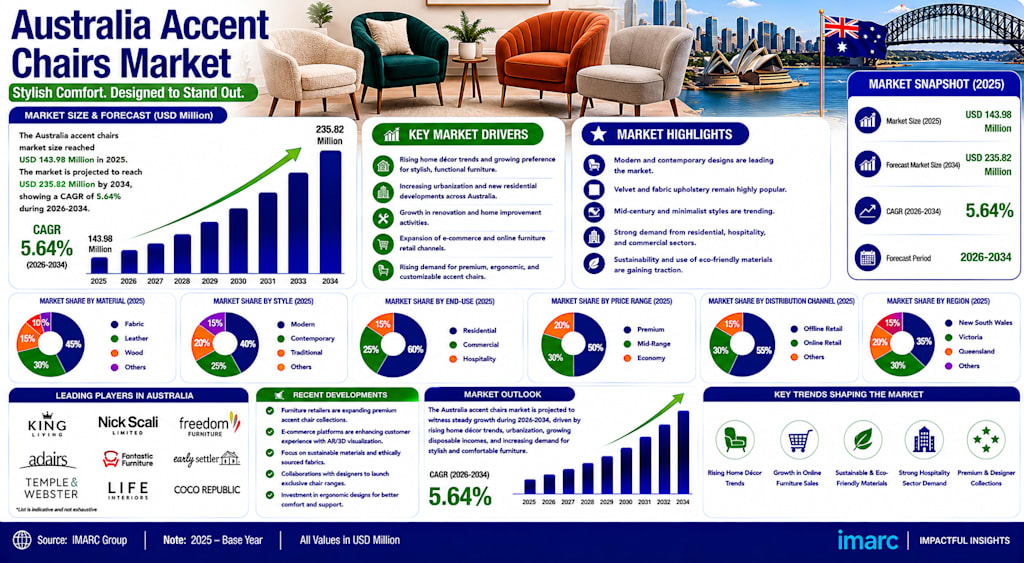
The Australia accent chairs market is expanding steadily as Australian households, interior designers and commercial buyers increasingly prioritise personalised aesthetics, multifunctional living and verifiable sustainability credentials. Accent chairs — spanning armchairs, swivel chairs, club chairs, wingbacks and lounge chairs — are deployed across living rooms, bedrooms, home offices and hospitality settings to deliver visual focal points, comfort and adaptable seating solutions that complement rather than dominate contemporary interiors. According to IMARC Group, the market size reached USD 143.98 Million in 2025 and is projected to reach USD 235.82 Million by 2034, exhibiting a compound annual growth rate (CAGR) of 5.64% during 2026–2034. As the broader Australia furniture market expands from USD 19.7 billion in 2025 toward USD 32.9 billion by 2034, accent chairs are emerging as a favoured entry point for homeowners seeking to refresh interiors without full-room overhauls, supported by rising online retail penetration and a deepening embrace of circular, low-impact materials.
What's Driving Market Growth?
Home Renovation Spending & Personalised Interiors. The home renovation market in Australia is projected to reach AUD 40 billion, driven by sustained homeowner interest in upgrading living spaces. This wave of refreshment — across both new builds and existing dwellings — is directly fuelling demand for accent chairs. The residential segment accounts for the majority of furniture sales, with homeowners prioritising personalised interior design and increased furniture replacement frequencies. Australian interiors are shifting away from minimalism toward expressive, layered spaces, with searches for walnut timber pieces rising 95% and chocolate sofa and chair sales surging 165%.
Urban Densification & Multifunctional Design. Australia's major cities are experiencing sustained residential construction activity — with 47,645 units commencing in the March 2025 quarter alone — alongside rising apartment living. This is driving demand for compact, multifunctional accent chairs that offer maximum aesthetic appeal while optimising space utilisation. Compact urban living areas are influencing furniture selections, boosting the need for space-efficient accent chairs that serve multiple purposes, such as extra seating in compact apartments, decorative elements in living rooms and functional pieces in home offices — particularly in metropolitan areas like Sydney and Melbourne.
E Commerce Dominance & Omnichannel Retail. The Australia online furniture market is growing rapidly, driven by increasing internet penetration and changing consumer buying behaviour. Online furniture sales now represent 25–30% of total market share annually, worth approximately $2.95 billion. E commerce platforms offer extensive catalogues, competitive pricing and doorstep delivery, with augmented reality tools enabling customers to visualise products within their actual living spaces. A 2025 industry survey found that 79% of leading furniture retailers now report that 3D and AR visualisation technologies are overtaking traditional photos as the preferred way to showcase products online. Direct-to-consumer brands are intensifying price competition by removing intermediary markups, while established retailers are investing heavily in omnichannel platforms, virtual showrooms and integrated inventory management.
Sustainability Mandates & Circular Economy. Sustainability has become a decisive factor in Australian furniture purchasing. The Australian Government's Environmentally Sustainable Procurement Policy (ESPP) — introduced in May 2024 and set for full implementation by July 2025 — mandates that businesses bidding for government furniture contracts valued at AUD 1 million or more must demonstrate measurable environmental responsibility, including the use of recycled materials, carbon minimising production and circular design approaches. Beyond compliance, Australian consumers are increasingly prioritising eco friendly options, with Sydney based brand Potato and Sprout designing 100% recycled plastic lounge chairs using locally sourced post-consumer waste, manufactured with 100% renewable energy, and fully circular at end of life. The shift toward circular economy principles is gaining momentum, as an estimated 250,000 tonnes of furniture is sent to landfill annually in Australia.
Premiumisation & Local Craftsmanship. The luxury furniture segment is growing steadily as consumers invest in high-quality pieces that combine durability, craftsmanship and aesthetic value. Customisable accent chairs — featuring bespoke fabrics, finishes, colours and ergonomic features — offer greater appeal for buyers seeking personalised interior solutions rather than mass-market options. Mid range and premium segments are growing as consumers increasingly see value in higher quality, longer lasting pieces. Leading retailers such as Adairs offer options ranging from sumptuous velvet and bouclé fabrics to classic leather and linen tones, with velvet providing a plush, elegant feel and bouclé delivering textured, cosy comfort.
Market Segmentation & Key Insights
By Type, the market includes armchairs, armless chairs, swivel chairs, recliners, lounge chairs, club chairs, wingback chairs and others. Armchairs and lounge chairs are among the most popular due to their comfort and versatility. By Material, the market covers wood, metal, plastic, upholstered and others. Upholstered and wooden chairs dominate due to their durability and aesthetic appeal. By Price Range, the market is divided into economy, mid range, premium and luxury. By Distribution Channel, offline retail still leads, but online retail is the fastest growing segment. By End Use, residential dominates, although commercial applications — including office spaces, hotels and public venues — are expanding under ESPP sustainability requirements. By Region, major markets include New South Wales & ACT, Victoria & Tasmania, Queensland, Western Australia, South Australia and the Northern Territory; NSW and Victoria currently lead demand due to higher population densities and concentrated design activity.
What the Opportunities Are?
AI Powered Visualisation & Virtual Staging. Artificial intelligence is transforming the accent chair purchase journey through virtual staging and augmented reality applications. Tools like IKEA Kreativ enable customers to digitally place accent chairs into scanned living spaces, enhancing purchase confidence and reducing return rates. AI driven personalisation engines recommend styles based on individual preferences and existing décor, while supply chain optimisation algorithms improve inventory management and demand forecasting across the market.
Sustainable Sourcing & Circular Business Models. Manufacturers adopting recycled materials, FSC certified wood and low VOC finishes will capture growing eco conscious demand. With an estimated 250,000 tonnes of furniture waste ending up in Australian landfills annually, companies offering take back schemes, refurbishment services and modular designs that extend product lifecycles can differentiate themselves in an increasingly regulated market. The ESPP is catalyzing industry-wide innovation, influencing private sector purchasing behaviour as corporations increasingly align with green procurement standards. The sustainable furniture segment is experiencing strong demand for reclaimed wood, bamboo (20% harder than red oak), recycled plastics and organic textiles.
Direct to Consumer & Subscription Models. The accelerating shift toward online purchasing — supported by 25-30% of total furniture sales now occurring online — creates strong opportunities for niche accent chair brands to bypass traditional retail entirely. Subscription based rental models for accent chairs, targeting renters and young professionals, represent an emerging growth avenue. Virtual design consultations, augmented reality previews and flexible delivery options make accent chairs more accessible to a wider audience.
Compact & Multi functional Designs for Urban Living. As apartment living becomes increasingly common, particularly among first time homeowners, accent chairs with built in storage compartments, convertible features and slimline profiles are positioned for strong uptake. The demand for compact and space saving furniture is particularly pronounced in metropolitan areas, where space constraints influence furniture preferences.
B2B Sustainable Procurement. With the ESPP mandating environmental responsibility for government furniture contracts valued over AUD 1 million, suppliers offering verifiable recycled content, carbon footprint data and circular design documentation will secure commercial and public sector contracts, creating a competitive advantage for early movers.
Recent News and Developments in Australia Accent Chairs Market
January 2026: Retail giant Kmart unveiled its largest homewares collection to date, featuring accent chairs with marble look finishes, velvet upholstery and sculptural silhouettes, demonstrating that affordable elegance can capture on trend design at accessible price points.
February 2025: Potato and Sprout was featured for its range of 100% recycled plastic lounge chairs, made in Australia from locally sourced post-consumer waste and agricultural plastic, manufactured with 100% renewable energy, with each product fully circular and recyclable at end of life.
May 2025: IconByDesign research identified a clear shift toward timeless, versatile furniture pieces, with velvet accent chair searches falling by 47% year on year, signalling a preference for more durable, low maintenance materials over highly textured bouclé and rattan.
July 2025: A leading industry survey found that 79% of furniture retailers report that 3D and AR visualisation technologies are overtaking traditional photos as the preferred way to showcase products online, accelerating investment in virtual staging capabilities.
2025: Temple & Webster trend research revealed that 68% of furniture shoppers believe true luxury lies in the experience of a space, not its price tag, while 67% believe meaningful objects give a home its true soul — reinforcing demand for expressive, curated interiors where accent chairs serve as personal statement pieces.
Why Should You Know About Australia Accent Chairs Market?
You should know about this market because it captures how home renovation spending, regulatory sustainability mandates and digital commerce innovation intersect to create steady growth in a foundational segment of Australia's furniture industry. Accent chairs are no longer mere decorative fillers — they are strategic design anchors that allow homeowners to test new aesthetics, demonstrate sustainability commitments and adapt living spaces to increasingly compact urban footprints.
For investors, the accent chairs market offers exposure to a stable growth consumer goods category anchored in Australia's AUD 40 billion home renovation economy, accelerating online retail adoption (25-30% of furniture sales) and the enforceable ESPP framework that ties government procurement to verifiable environmental performance. The projected CAGR of 5.64% reflects consistent baseline demand, while higher growth sub segments — including AR enabled DTC brands, recycled material certified products and multifunctional compact designs — offer differentiated upside potential.
For furniture manufacturers, retailers, procurement specialists and interior designers, understanding segmentation across material, price range and distribution channels helps shape intelligent product development, supply chain resilience and sustainability reporting that deliver measurable consumer appeal, compliance and commercial outcomes.
In essence, the Australia accent chairs market captures how individual expression, environmental responsibility and digital convenience converge — making it a compelling area for investors, designers and retailers seeking smarter approaches to seating, style and sustainable growth across Australia's evolving residential and commercial interior landscape.
About the Creator
Thomas
Market Research Analyst | Industry Trends & Forecasting | Turning market data into clear, actionable business insights across global sectors.
Enjoyed the story? Support the Creator.
Subscribe for free to receive all their stories in your feed.
Comments
There are no comments for this story
Be the first to respond and start the conversation.