
Australia 3D Printing Materials Market: Additive Manufacturing Surge, Metal Powder Dominance & Sustainable Innovation
How aerospace precision, medical customisation and a 31.17% CAGR are reshaping Australia's advanced manufacturing landscape

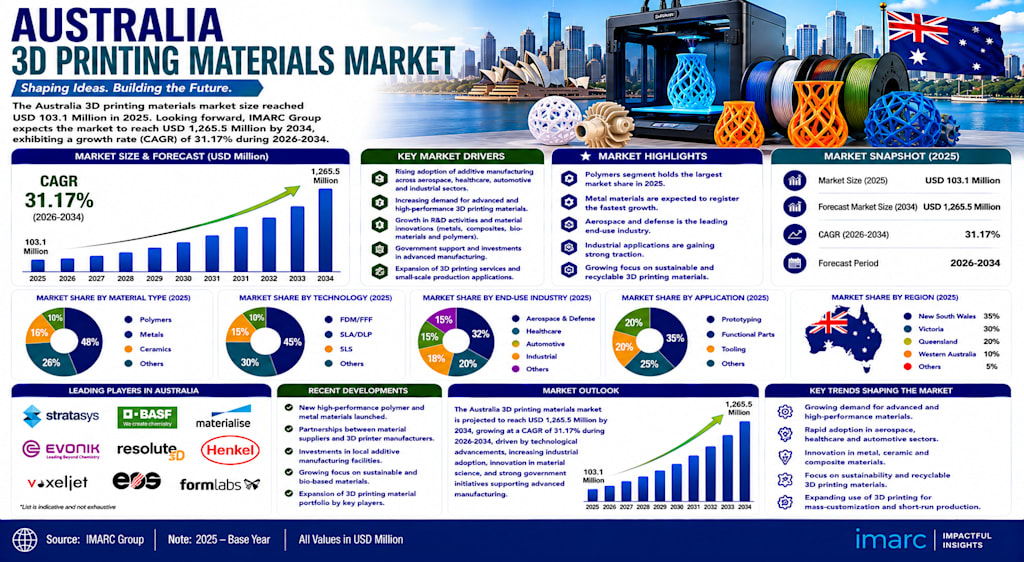
The Australia 3D printing materials market is undergoing an explosive transformation as the nation positions itself at the forefront of additive manufacturing innovation. From aerospace components and custom medical implants to sustainable construction materials and high performance polymers, 3D printing materials are the foundational inputs driving a manufacturing revolution across the continent. According to IMARC Group, the market size reached USD 103.1 Million in 2025 and is projected to reach USD 1,265.5 Million by 2034, exhibiting a stellar compound annual growth rate (CAGR) of 31.17% during 2026–2034. As Australia's automotive industry recorded record breaking new car sales in 2023 and the aerospace sector increasingly embraces lightweighting, 3D printing materials have moved from prototyping tools to essential production inputs for high performance industries.
What's Driving Market Growth?
Aerospace and Automotive Industry Expansion. Australia's aerospace and automotive sectors are the primary drivers of 3D printing materials demand. The country's aerospace industry is increasingly embracing additive manufacturing for high performance and lightweight components, lowering production costs and increasing efficiency. Innovative metal powders and composite materials are being used by domestic manufacturers to create robust parts for challenging environments. In the automotive sector, 3D printing is transforming small batch production and prototyping, enabling businesses to create complex designs with unprecedented precision. Australian vehicle deliveries exceeded 1.2 million units in 2023, setting a new record and driving the need for advanced metal printing materials that meet the industry's rigorous performance and durability requirements.
Medical and Bioprinting Technological Advances. The healthcare sector stands as one of the biggest drivers behind Australia's 3D printing materials market. The nation is at the forefront of medical innovation, employing additive manufacturing to create surgical instruments, implants and prosthetics. Hospitals and research centers are collaborating to develop biocompatible polymers and metal alloys that improve patient outcomes. The growth of bioprinting is driving demand for specialised materials for tissue scaffolds and regenerative medicine applications. Australian universities and biotech companies are developing novel formulations that meet the particular requirements of the medical sector while ensuring adherence to strict safety regulations.
Metal 3D Printing Materials Leading the Charge. Demand for metal 3D printing materials in Australia is increasing strongly, driven by advancements in aerospace, automotive and medical sectors. Metal additive manufacturing enables the production of complicated geometries that are challenging or unachievable in traditional manufacturing, resulting in cost efficient, high performance products. Titanium, nickel based superalloys and aluminium powders are increasingly used to manufacture components for aerospace and defence applications. The metal powders market for additive manufacturing in Australia is expanding rapidly, with titanium and nickel alloys being integral to producing lightweight, corrosion resistant and heat tolerant components.
High Performance Polymers for Industrial Applications. The utilisation of high performance polymers within the market is positively impacting market development. Compounds including PEEK, PEI and ULTEM offer outstanding mechanical characteristics such as high temperature stability, chemical resistance and strength, making them suitable for industries that need robust materials for crucial applications. Sectors including aerospace, automotive and electronics are adopting these high performance polymers to produce components that withstand harsh operating conditions. The application of these polymers for both prototype and end use production is increasing their market appeal.
Bio Based and Sustainable 3D Printing Materials. In accordance with global sustainability trends, there is growing demand for eco friendly and bio based 3D printing materials in Australia. As businesses attempt to shrink their carbon footprint, bio based threads manufactured from renewable feedstocks like PLA and PHA are gaining traction. These materials present a biodegradable alternative to typical petroleum based plastics and are suitable for a variety of uses ranging from packaging and product development to consumer products. Research institutions and companies are exploring new materials derived from agricultural waste, such as hemp and algae based filaments, which can be used in 3D printing without contributing to environmental degradation.
Government Initiatives and Research Investments. Australia's government plays a crucial role in driving the 3D printing materials market through funding and policy support. Different programs promote local fabrication and innovation, furthering the creation of new materials appropriate for additive manufacturing. The Additive Manufacturing Cooperative Research Centre (AMCRC) has been established with substantial Commonwealth Government funding, bringing together 12 Australian universities, CSIRO and more than 60 industry organisations to accelerate the adoption and commercialisation of additive manufacturing across Australia. The AMCRC's total budget has reached AUD 271 million, including AUD 58 million in government funding. Research facilities are granted funding for discovery of new material compositions, with emphasis on sustainability and performance improvement.
Market Segmentation & Key Insights
By Type, the market includes plastic (photopolymer, ABS, PLA, polyamide), metal (titanium alloys, nickel based superalloys, aluminium), ceramic and other materials. Metal 3D printing materials are the fastest growing segment, driven by aerospace and medical applications.
By Form, the market is segmented into powder, liquid and filament. Powder dominates the metal additive manufacturing segment, while filament remains the preferred form for polymer based consumer and industrial 3D printing.
By End Use Industry, the market covers aerospace and defence, healthcare, automotive, consumer goods, construction and others. Aerospace and defence sectors are the major end users of the 3D printing powder market in Australia, while healthcare is the fastest growing segment due to custom implants and bioprinting applications.
By Region, major markets include New South Wales, Victoria, Queensland and Western Australia, with the eastern states leading due to the concentration of advanced manufacturing facilities and research institutions.
What the Opportunities Are?
Australian Made Metal Powders from Recycled Feedstock. A high tech spinout from Swinburne University of Technology is delivering Australian made high performance High Entropy Material (HEM) powders, developed from recycled industrial feedstocks, to advanced manufacturing and 3D printing facilities. This represents a significant opportunity for domestic metal powder production, reducing import dependency while offering sustainable, high performance alloys designed for extreme conditions.
Waste to Filament Circular Economy Models. The UNSW SMaRT Centre has successfully transformed waste plastics from electronic waste into the first sustainable plastics filament for 3D printers. Commercial Plastics Filament MICROfactories have been established under licence, including a facility in Lane Cove, Sydney. This technology can turn Australia's waste plastic exports into valuable filament for domestic use, creating Australian jobs while addressing plastic waste challenges.
Ceramic 3D Printing for Advanced Applications. Specialised companies are emerging as leaders in advanced ceramic 3D printing, leveraging state of the art additive manufacturing technologies for applications in aerospace, defence and medical sectors. Ceramic 3D printing offers unique properties including high temperature resistance, biocompatibility and wear resistance that complement metal and polymer technologies.
Large Format Additive Manufacturing for Marine and Construction. Large Format Additive Manufacturing (LFAM) is gaining traction for producing large components for marine, construction, defence and education uses through a manufacturing as a service model. This segment offers opportunities for companies specialising in high volume, large scale 3D printing of construction materials and marine components.
3D Construction Printing for Housing Solutions. With Australia facing a housing supply crisis, 3D construction printing is transitioning from concept to reality. Companies have built Australia's first multistorey 3D printed concrete home with a 12 week build time, with proponents claiming 3D printed homes can be up to 30% cheaper than traditional construction. This technology opens substantial opportunities for construction grade 3D printing materials, including specialised concrete blends and sustainable building compounds.
Advanced Bioprinting and Personalised Medicine. Research institutions are developing handheld bioprinters that allow surgeons to introduce, pattern and sculpt hydrogels and stem cells directly in joints for cartilage repair. Brisbane's Herston Biofabrication Institute is creating 3D printed body parts for cancer patients. The development of biodegradable bone scaffolds that support natural bone regrowth represents a frontier opportunity for biocompatible and bioresorbable 3D printing materials.
Recent News and Developments in Australia 3D Printing Materials Market
May 2026: AMCRC announced the launch of its first CORE projects with an AUD 11 million investment in additive manufacturing research, backed by industry partners and research institutions, reinforcing Australia's commitment to AM commercialisation.
March 2025: A spinout from Swinburne University of Technology secured funding to deliver Australian made High Entropy Material (HEM) powders developed from recycled industrial feedstocks for advanced manufacturing and 3D printing facilities.
March 2025: The first commercially run Plastics Filament MICROfactorie was officially launched in Lane Cove, Sydney, following a collaboration between UNSW SMaRT Centre and IT asset management company Renew IT.
2025: Australia's import trend for the 3D printing materials market exhibited a notable growth rate of 20.76% from 2023 to 2024, with a compound annual growth rate of 28.9% for the period 2020 2024, indicating strong and sustained demand for advanced materials.
2025: Australia's first multistorey 3D printed concrete home was completed in Tapping, demonstrating the viability of additive manufacturing for residential construction and opening new markets for construction grade 3D printing materials.
Why Should You Know About Australia 3D Printing Materials Market?
You should know about this market because it captures how advanced manufacturing, sustainability and medical innovation intersect to create one of the world's fastest growing additive manufacturing markets. 3D printing materials are no longer limited to hobbyist filaments — they are mission critical inputs for producing aerospace components that reduce aircraft weight, custom implants that improve patient outcomes, and affordable housing that addresses supply shortages.
For investors, the 3D printing materials market offers exposure to a high growth advanced manufacturing category anchored in Australia's record breaking automotive production, expanding aerospace sector, and government backed research initiatives including the AUD 271 million AMCRC. The projected CAGR of 31.17% — transforming a USD 103 million market into a USD 1.27 billion market by 2034 — reflects exceptional confidence in adoption trends, material innovation and the accelerating shift from prototyping to end use production.
For manufacturers, engineers and technology investors, understanding segmentation across metal powders, high performance polymers and sustainable filaments, the emerging opportunities in large format additive manufacturing and 3D construction printing, and the growing ecosystem of Australian made materials helps shape intelligent investment decisions, product development roadmaps and supply chain strategies that deliver measurable performance, sustainability and competitive advantage.
In essence, the Australia 3D printing materials market captures how material science, precision engineering and circular economy principles converge — making it a compelling area for investors, innovators and manufacturers seeking smarter approaches to lightweighting, customisation and sustainable production in one of the world's most rapidly evolving additive manufacturing landscapes.
About the Creator
Thomas
Market Research Analyst | Industry Trends & Forecasting | Turning market data into clear, actionable business insights across global sectors.
Enjoyed the story? Support the Creator.
Subscribe for free to receive all their stories in your feed.
Comments
There are no comments for this story
Be the first to respond and start the conversation.