
ATI Inc.: Aggressive Buybacks Meet Surging Earnings Amid Liquidity Headwinds
Why are institutional giants hoarding 88% of ATI Inc. while the company’s cash reserves plummet and interest expenses skyrocket?

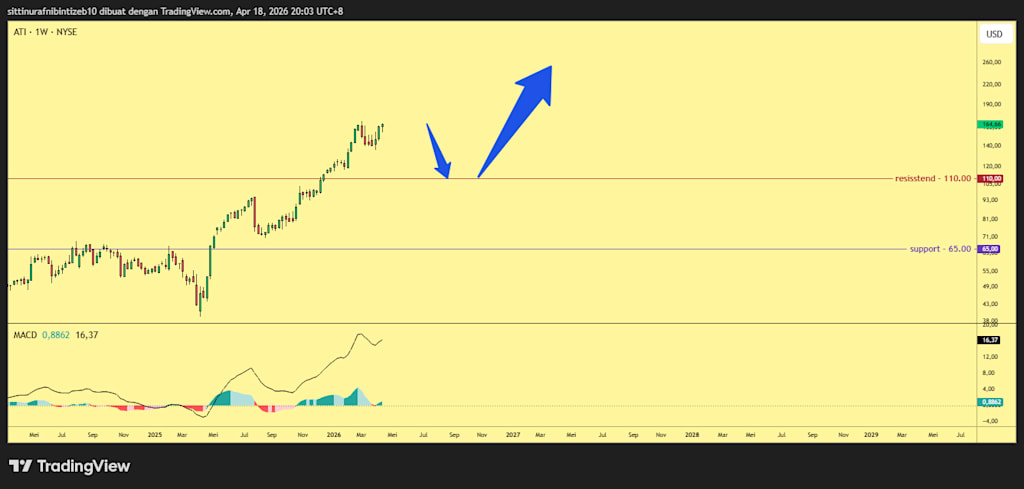
Investment Thesis
ATI Inc. is currently exhibiting a high-octane growth profile that significantly outpaces the broader market. The company’s earnings growth for the current year is estimated at 30.24%, a figure that substantially eclipses the S&P 500’s projected growth of 17.59%. This bullish outlook is anchored by a heavy institutional presence, with 88.68% of shares held by institutions, signaling deep-pocketed confidence in the firm’s strategic trajectory.
Market sentiment is further bolstered by a clear consensus among analysts regarding the company's fundamental strengthening. Over the last 30 days, three analysts have revised their 2026 earnings estimates upward , while the upcoming March and June 2026 quarters have seen zero downward revisions. The 2027 EPS estimate has accelerated from 4.68 to 5.14 in the last 90 days, suggesting that ATI’s performance is a sustained trend rather than a cyclical fluke.
Growth Catalysts
The primary engine behind ATI’s valuation surge is a combination of operational efficiency and a dramatic turnaround in cash flow. Operating Income grew from 150,800 to 170,700 by late 2025 , while Normalized EBITDA climbed to 202,300. Most importantly, Free Cash Flow (FCF) executed a massive pivot, swinging from a negative -145,800 in March 2025 to a positive 223,100 by December 2025
Beyond operations, management is aggressively returning capital to shareholders, a move that often precedes further stock appreciation. Treasury stock holdings increased from 82,600 to 502,700 , with TTM share repurchases totaling -504,100. This aggressive buyback strategy, paired with a surge in Retained Earnings from 64,300 to 468,700, demonstrates that the company is successfully generating and reinvesting internal capital.
Valuation Analysis
From a valuation standpoint, ATI trades at a premium with a Forward P/E Ratio of 39.06. However, when adjusted for growth, the PEG Ratio (5-year expected) sits at 1.20. This suggests that the stock is reasonably priced relative to its long-term earnings potential, despite a high Price/Book (P/B) Ratio of 12.45, which is typical for high-growth firms in an expansionary phase.
The quality of ATI’s earnings remains exceptionally high. The Operating Cash Flow (TTM) of 614,300 significantly exceeds the Net Income (TTM) of 418,600, indicating that reported profits are backed by actual cash inflows rather than accounting maneuvers. Meanwhile, the company continues to invest in its competitive moat, with Capital Expenditures (CapEx) for property, plant, and equipment reaching -280,600 on a TTM basis.
Risk Factors
Investors must weigh this growth against a ballooning debt service burden. Interest Expense increased significantly from 23,000 to 36,200 by the end of 2025. This contributes to a massive Long-Term Debt profile of 1,718,300 , resulting in a Net Debt position of 1,332,700. These liabilities could tighten margins if the cost of capital continues to rise.
Liquidity is another area of concern, as Cash and Cash Equivalents dropped from 721,200 in March 2025 to 416,700 in December 2025. On the technical front, a rise in Shares Short to 3.76M (up from 2.64M) and a decrease in Average Volume suggest that some market participants are positioning for a pullback or are becoming wary of the current $22.47B Market Cap
Conclusion: Buy or Avoid?
ATI Inc. presents a compelling Buy case for aggressive growth investors, provided they maintain a strict eye on the company's leverage. The combination of consistent earnings surprises , robust FCF generation , and aggressive share buybacks creates a powerful tailwind for the stock. With a PEG ratio of 1.20, the current entry price represents "Growth at a Reasonable Price" (GARP) in a market where such opportunities are increasingly rare.
However, the rapid decline in cash reserves and the spike in interest expenses necessitate a tactical approach. Investors should consider a tiered entry strategy, adding to positions as the company proves it can manage its debt obligations while sustaining its high 30.24% growth rate. Monitoring the 1.75 Short Ratio will be essential for gauging when market sentiment might shift from optimism to caution.
About the Creator
Lena
Financial Analyst & Content Creator 7 Yrs Exp. Merging Fundamental Research PEG/Value with Advanced Technical Analysis. Specialist in Equities & Crypto narratives that turn complex data into high stakes Alpha.
Enjoyed the story? Support the Creator.
Subscribe for free to receive all their stories in your feed.
Comments
There are no comments for this story
Be the first to respond and start the conversation.