
Asia-Pacific Spinal Fusion Market to Reach US$ 4.23 Billion by 2033 Amid Rising Demand for Minimally Invasive Spine Surgeries
Aging Population, Technological Innovation, and Expanding Healthcare Infrastructure Accelerate Growth Across China, India, Japan, and South Korea

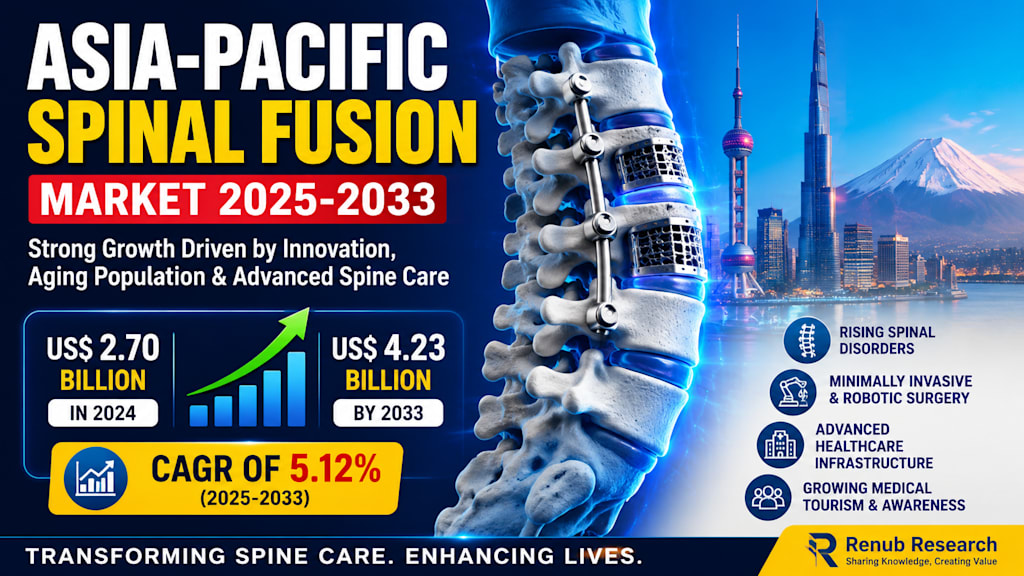
The Orthopedic Surgery sector across the Asia-Pacific region is witnessing rapid transformation as spinal disorders continue to rise among aging populations and sedentary lifestyles become increasingly common. According to Renub Research, the Asia-Pacific Spinal Fusion Market is projected to grow from US$ 2.70 billion in 2024 to US$ 4.23 billion by 2033, expanding at a CAGR of 5.12% during the forecast period from 2025 to 2033.
The market’s expansion is being fueled by several interconnected factors, including increasing incidences of degenerative disc disease, scoliosis, spinal stenosis, traumatic spinal injuries, rising healthcare expenditure, technological advancements in spinal implants, and growing awareness regarding minimally invasive spine surgeries.
Asia-Pacific countries such as China, Japan, India, and South Korea are emerging as major hubs for advanced spinal care, supported by improved healthcare infrastructure, expanding insurance access, and increasing medical tourism.
Rising Burden of Spinal Disorders Driving Market Demand
The increasing prevalence of spinal disorders remains one of the strongest growth catalysts for the Asia-Pacific spinal fusion market. Degenerative spine conditions are becoming more common because of aging populations, obesity, poor posture, physically demanding occupations, and inactive lifestyles.
Conditions such as herniated discs, scoliosis, degenerative disc disease, and spinal trauma frequently lead to chronic pain, mobility limitations, and reduced quality of life. As awareness regarding spinal health grows, more patients are opting for surgical intervention to restore mobility and relieve pain.
Spinal fusion procedures are increasingly considered an effective long-term treatment solution because they stabilize affected vertebrae and reduce nerve compression. Hospitals and specialty clinics across the region are reporting growing patient volumes for both open and minimally invasive spinal surgeries.
The trend is especially prominent in countries with rapidly aging populations such as Japan and South Korea, where elderly patients are more vulnerable to degenerative spine disorders.
Minimally Invasive Spine Surgery Revolutionizing Patient Care
One of the most transformative trends reshaping the regional market is the growing adoption of minimally invasive spine surgery (MISS).
Compared to conventional open surgeries, minimally invasive spinal fusion techniques offer numerous benefits, including:
- Smaller incisions
- Reduced blood loss
- Faster recovery times
- Shorter hospital stays
- Lower risk of infection
- Reduced postoperative pain
- Minimal muscle damage
These clinical advantages are encouraging both surgeons and patients to prefer minimally invasive approaches whenever feasible.
Advancements in surgical navigation systems, robotic-assisted surgery, real-time imaging technologies, and precision-guided instrumentation are further improving surgical outcomes. The integration of robotics and AI-assisted surgical planning is enabling enhanced procedural accuracy, especially in complex spinal cases.
Medical device companies are aggressively investing in product innovation to capitalize on this trend. New spinal implants featuring bioresorbable materials and 3D-printed structures are also improving patient compatibility and long-term outcomes.
Healthcare Infrastructure Expansion Supporting Regional Growth
Governments throughout the Asia-Pacific region are significantly increasing investments in healthcare infrastructure development.
Public and private hospitals are being equipped with advanced surgical systems, dedicated orthopedic departments, and specialized spine care centers. Improvements are not limited to metropolitan cities alone; semi-urban and tier-2 cities are also gaining access to advanced spine surgery capabilities.
The growing availability of skilled spine surgeons, modern diagnostic imaging systems, and enhanced post-operative rehabilitation services is supporting greater accessibility to spinal fusion procedures.
Medical education institutions are also expanding orthopedic and spinal surgery training programs to address the shortage of specialized healthcare professionals.
In countries like India and Thailand, medical tourism is further boosting the market as international patients seek affordable yet high-quality spinal procedures.
Technological Advancements Reshaping the Competitive Landscape
Technology is becoming a defining force in the Asia-Pacific spinal fusion market. Innovations such as robotic-assisted surgery, navigation-guided procedures, biologics, and personalized implants are transforming spinal care.
The adoption of 3D-printed spinal implants is particularly noteworthy. These implants provide better anatomical compatibility, improved fusion rates, and enhanced patient-specific customization.
Similarly, advanced biologics are helping accelerate bone healing and fusion success rates. Companies are increasingly focusing on regenerative medicine approaches that improve surgical recovery while reducing complication risks.
Robotics integration is another major breakthrough. Robot-assisted spinal fusion procedures offer enhanced precision, reduced surgical variability, and improved implant placement accuracy.
As healthcare providers continue modernizing surgical capabilities, technological differentiation is expected to become a key competitive advantage among medical device manufacturers.
High Costs Continue to Challenge Wider Adoption
Despite strong growth potential, the Asia-Pacific spinal fusion market continues to face several challenges. One of the most significant barriers remains the high cost associated with spinal fusion procedures and advanced implants.
Spinal fusion surgeries often require sophisticated implants, specialized surgical tools, and lengthy rehabilitation programs, making treatment expensive for many patients.
In several developing economies across Asia-Pacific, healthcare insurance penetration remains limited. As a result, patients frequently bear substantial out-of-pocket expenses, restricting broader market adoption.
Cost sensitivity remains particularly evident in rural and lower-income populations, where access to advanced spine care remains constrained.
Manufacturers and healthcare policymakers are increasingly exploring strategies to reduce treatment costs through localized manufacturing, improved reimbursement frameworks, and public-private partnerships.
Concerns Over Surgical Risks and Complications
Post-surgical complications continue to create hesitation among some patients considering spinal fusion surgery.
Potential complications include:
- Infection
- Nerve damage
- Blood clots
- Failed fusion
- Persistent pain
- Limited mobility after surgery
Recovery periods can also vary depending on patient age, overall health, and surgical complexity.
Although modern technologies and minimally invasive approaches are helping reduce these risks, patient concerns regarding long-term outcomes remain a challenge for healthcare providers.
Improved patient education, enhanced rehabilitation protocols, and continued surgical innovation are expected to help strengthen confidence in spinal fusion procedures over time.
China Emerging as a Major Growth Engine
China is rapidly becoming one of the most important markets for spinal fusion procedures in Asia-Pacific.
The country’s aging population, increasing incidence of spinal disorders, and rapid healthcare modernization are driving substantial demand for spinal surgeries.
Chinese hospitals are increasingly adopting minimally invasive spinal techniques and advanced implants, improving procedural outcomes and recovery rates.
Government investments in healthcare infrastructure and medical technology innovation are further strengthening market growth. At the same time, rising public awareness regarding spinal health is encouraging earlier diagnosis and treatment.
However, disparities between urban and rural healthcare access continue to present challenges for nationwide adoption.
Japan Witnessing Strong Demand from Elderly Population
Japan represents one of the most mature spinal fusion markets in Asia-Pacific due to its rapidly aging population.
More than 29% of Japan’s population is aged 65 or older, significantly increasing the prevalence of degenerative spinal disorders.
The country has become a leader in advanced spinal surgical technologies, including robotic-assisted surgery and minimally invasive procedures. Strong healthcare infrastructure and high technology adoption rates continue supporting market expansion.
Japanese healthcare providers are increasingly focused on improving patient outcomes through precision-guided surgical systems and enhanced rehabilitation services.
Nevertheless, rising healthcare costs and shortages of specialized surgeons remain ongoing concerns.
India Becoming a Key Medical Tourism Hub
India’s spinal fusion market is experiencing rapid growth because of expanding healthcare infrastructure, increasing spinal disorder prevalence, and rising adoption of advanced surgical technologies.
India has also become a preferred destination for international medical tourists seeking affordable spinal procedures combined with high-quality care.
The country’s growing network of multi-specialty hospitals and spine care centers is improving treatment accessibility across urban regions. Minimally invasive spine surgeries and robotic-assisted procedures are gaining popularity among Indian healthcare providers.
Government initiatives aimed at improving healthcare access and encouraging medical technology innovation are expected to further strengthen market development.
However, affordability and shortages of highly trained spine surgeons continue to challenge broader penetration.
South Korea Strengthening Position Through Advanced Medical Technology
South Korea continues to strengthen its reputation as a global leader in advanced spinal surgeries and medical tourism.
The country’s healthcare system is highly advanced, featuring cutting-edge hospitals, sophisticated imaging technologies, and specialized spine care facilities.
South Korean healthcare providers are increasingly adopting minimally invasive spinal fusion procedures because of their reduced recovery times and lower complication risks.
Strong government support for healthcare innovation and medical tourism is helping the country maintain a competitive edge within the regional market.
Recent Developments by Leading Companies
1. Stryker Corporation
In February 2024, Stryker expanded its presence in India by launching spine surgeon training centers in Pune and Chandigarh focused on robotics integration and navigation-assisted spinal fusion procedures.
2. Johnson & Johnson
In January 2024, Johnson & Johnson Medical India introduced the SYMPHONY OCT System designed to improve visibility and precision during complex spinal fusion surgeries.
3. Medtronic Plc.
Medtronic continues expanding its minimally invasive spine surgery portfolio with advanced navigation-assisted spinal fusion technologies across Asia-Pacific hospitals.
4. Zimmer Biomet Holdings
Zimmer Biomet is increasing investments in biologics and smart spinal implant technologies to improve fusion success rates and recovery outcomes.
5. Globus Medical Inc.
Globus Medical is strengthening robotic-assisted spinal surgery capabilities through AI-powered navigation systems and advanced imaging integration.
6. NuVasive Inc.
NuVasive continues expanding surgeon training programs focused on minimally invasive spinal fusion techniques across emerging Asia-Pacific markets.
7. Orthofix Medical Inc.
Orthofix is investing in regenerative biologics and bone growth stimulation technologies to improve spinal fusion outcomes.
8. Alphatec Holdings Inc.
Alphatec is accelerating innovation in patient-specific spinal implants and advanced surgical workflow solutions.
9. Xtant Medical Holdings
Xtant Medical is enhancing its biologics portfolio and expanding partnerships with regional healthcare distributors across Asia-Pacific.
10. Stryker Corporation
Stryker is increasingly integrating robotic guidance systems into spinal fusion workflows to improve surgical precision and reduce recovery times.
Final Thoughts
The Asia-Pacific spinal fusion market is entering a period of sustained expansion driven by demographic changes, technological innovation, and rising healthcare investments. Growing awareness regarding spinal disorders and the increasing popularity of minimally invasive surgical techniques are creating substantial opportunities for medical device manufacturers, hospitals, and healthcare investors.
While affordability concerns and surgical risks continue to challenge wider adoption, ongoing advancements in robotics, biologics, 3D-printed implants, and navigation-assisted procedures are reshaping the future of spinal care.
As governments continue strengthening healthcare infrastructure and medical tourism expands throughout the region, Asia-Pacific is expected to become one of the most influential growth centers in the global spinal fusion industry over the next decade.
About the Creator
Enjoyed the story? Support the Creator.
Subscribe for free to receive all their stories in your feed.
Comments
There are no comments for this story
Be the first to respond and start the conversation.