
Asia Pacific Sleep Apnea Devices Market to Reach US$ 4.62 Billion by 2033 as Demand for Home-Based Sleep Care Accelerates
Rising Awareness of Sleep Disorders Is Driving a New Healthcare Trend Across Asia Pacific

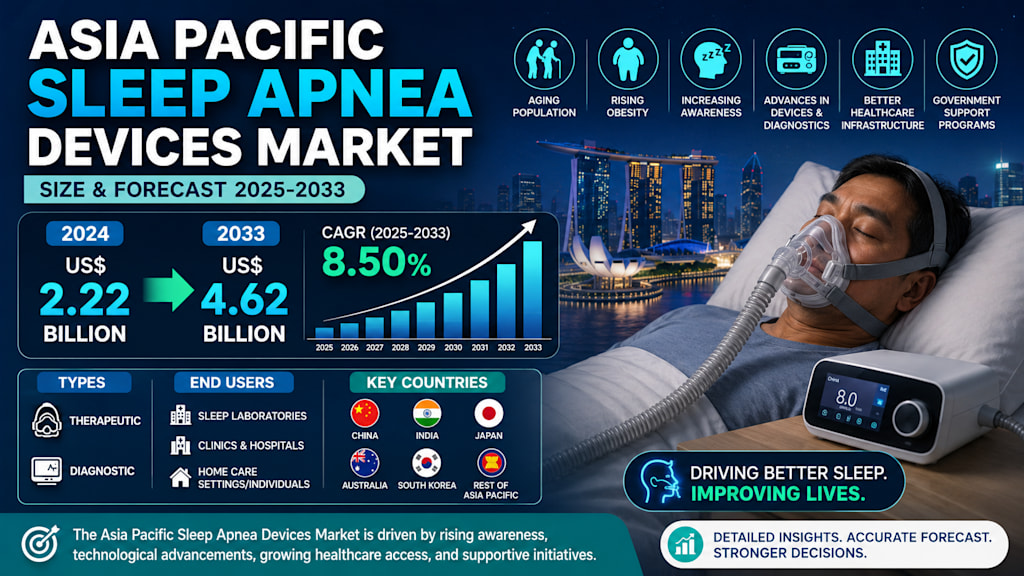
The Asia Pacific sleep apnea devices market is witnessing strong momentum as healthcare systems across the region focus more aggressively on respiratory health, sleep quality, and early disease diagnosis. According to Renub Research, the Asia Pacific Sleep Apnea Devices Market is projected to increase from US$ 2.22 billion in 2024 to US$ 4.62 billion by 2033, growing at a CAGR of 8.50% from 2025 to 2033. The market expansion is being fueled by the growing elderly population, increasing obesity rates, wider awareness regarding sleep disorders, and rapid technological innovation in diagnostic and therapeutic sleep equipment.
Sleep apnea has emerged as one of the most underdiagnosed but serious health conditions in modern healthcare systems. The disorder interrupts breathing during sleep and is closely associated with cardiovascular disease, hypertension, obesity, diabetes, fatigue, and reduced quality of life. In many Asia Pacific countries, urban lifestyles, stress, changing dietary patterns, and sedentary routines are contributing to a steady increase in sleep-related disorders.
The market now includes a broad range of products, including Continuous Positive Airway Pressure (CPAP) devices, BiPAP machines, Adaptive Servo-Ventilation systems, sleep screening devices, respiratory polygraphs, polysomnography equipment, and wearable monitoring tools. These devices are becoming increasingly important in hospitals, sleep laboratories, clinics, and home care settings throughout the region.
Increasing Prevalence of Sleep Apnea Is Creating Long-Term Market Opportunities
The growing prevalence of obstructive sleep apnea (OSA) remains the strongest growth driver for the Asia Pacific market. Healthcare professionals across the region are witnessing a sharp rise in sleep-disorder cases linked to obesity, aging populations, smoking, alcohol consumption, stress, and unhealthy lifestyles.
According to the uploaded report, a 2024 study published by Springer Nature estimated that obstructive sleep apnea incidence in Japan reached approximately 20%, highlighting the seriousness of the issue across developed Asian economies. Similar trends are also emerging in countries such as China, India, South Korea, and Australia, where rising obesity levels are increasing the risk of sleep-related breathing disorders.
The increase in diagnosis rates is creating higher demand for both diagnostic and therapeutic sleep apnea devices. More hospitals and sleep centers are now recommending sleep studies and long-term PAP therapy, resulting in stronger device adoption throughout the region.
In addition, sleep apnea is increasingly being linked with cardiovascular complications and metabolic disorders, forcing healthcare providers to focus more on preventive treatment strategies. As awareness improves, more patients are seeking medical attention earlier than before, supporting continuous market growth.
Technological Advancements Are Improving Patient Comfort and Compliance
Technology continues to reshape the sleep apnea devices industry. Traditional bulky machines are gradually being replaced by compact, quieter, smarter, and more patient-friendly devices. Manufacturers are focusing heavily on improving comfort because patient adherence remains one of the biggest challenges in sleep apnea therapy.
Modern CPAP and BiPAP devices now include AI-supported monitoring systems, wireless connectivity, cloud-based reporting, auto-adjusting pressure systems, smartphone integration, and digital compliance tracking. These innovations are helping healthcare professionals monitor treatment outcomes remotely while improving patient experience.
The uploaded report highlights the launch of Primasun, developed through collaboration between ResMed and Verily, Alphabet’s life sciences division. The platform helps healthcare providers and employers identify individuals who may be suffering from complex sleep disorders and enables better digital management of treatment pathways.
Portable sleep testing systems are also transforming diagnosis. Earlier, sleep apnea diagnosis required overnight monitoring inside specialized laboratories. However, portable home-based sleep testing devices now allow patients to undergo diagnostic assessments conveniently from home, reducing cost and improving accessibility.
Wearable technologies and connected respiratory monitoring devices are further strengthening market expansion, particularly in urban populations seeking convenient healthcare solutions.
Home Care Settings Are Becoming a Major Growth Segment
One of the biggest changes in the Asia Pacific sleep apnea devices market is the rapid shift toward home healthcare. Patients increasingly prefer diagnosis and treatment solutions that can be used comfortably at home instead of requiring repeated hospital visits.
The report notes that home care settings and individual users are becoming important end-user segments alongside sleep laboratories and hospitals.
Home-based sleep apnea management offers several advantages, including lower healthcare costs, greater patient comfort, easier long-term monitoring, and reduced pressure on hospital infrastructure. These benefits became even more important after the pandemic accelerated demand for remote and home-based healthcare solutions.
Manufacturers are therefore investing heavily in lightweight portable devices, mobile-app connectivity, easy-to-use interfaces, and compact travel-friendly equipment. Companies are also focusing on quieter motors and more comfortable mask designs to improve long-term patient adherence.
This shift toward patient-centered care is expected to remain one of the most important long-term growth trends in the market.
China Sleep Apnea Devices Market Continues to Expand Rapidly
China represents one of the largest opportunities within the Asia Pacific sleep apnea devices market. Rising obesity levels, increasing urbanization, and an aging population are significantly contributing to the growing burden of sleep disorders in the country.
According to the uploaded report, 34.8% of China’s population is overweight while 14.1% is classified as obese, creating substantial risk factors for sleep apnea.
Government healthcare reforms and investments under the 14th Five-Year Development Plan are also supporting expansion of healthcare infrastructure and improved access to advanced medical devices. As a result, sleep apnea diagnosis and treatment capabilities are improving rapidly across both urban and secondary healthcare centers.
International manufacturers such as ResMed and Philips are increasingly introducing AI-integrated and portable solutions in China to capture rising demand for digital respiratory care technologies.
India Emerging as a High-Growth Sleep Apnea Devices Market
India is rapidly becoming one of the most promising markets for sleep apnea devices in Asia Pacific. Rising awareness regarding respiratory health, increasing obesity prevalence, growing disposable income, and expansion of private healthcare facilities are supporting market growth.
The report highlights that home sleep testing is gaining popularity in India because it offers a more affordable and convenient alternative to traditional laboratory testing.
Technological advancements are also helping improve device acceptance among Indian patients. Modern CPAP systems now provide better comfort, reduced noise levels, and improved compliance monitoring, making long-term therapy easier for patients.
North India currently accounts for a major market share due to better healthcare infrastructure and stronger awareness levels, although adoption is gradually increasing across other regions as well.
India’s expanding middle-class population and increasing focus on preventive healthcare are expected to support continued growth during the forecast period.
Japan Market Benefits From Aging Population and Advanced Healthcare Infrastructure
Japan remains one of the most technologically advanced markets for sleep apnea devices in Asia Pacific. The country’s aging population is creating sustained demand for respiratory monitoring and sleep disorder treatment solutions.
According to the uploaded report, Japan had over 36 million senior citizens by 2023, making age-related health conditions a growing healthcare priority.
Japanese healthcare providers are increasingly adopting advanced sleep diagnostic systems and modern PAP therapies to improve patient outcomes. Device manufacturers are also focusing on patient comfort through quieter machines, improved mask technologies, and enhanced data-tracking capabilities.
Government healthcare initiatives and strong reimbursement systems are helping maintain steady market growth while creating opportunities for both domestic and international manufacturers.
High Device Costs Continue to Challenge Wider Adoption
Despite positive growth trends, the Asia Pacific sleep apnea devices market still faces several challenges. One of the biggest barriers remains the high cost of sleep apnea diagnosis and therapy.
The uploaded report states that many CPAP devices, diagnostic systems, and monitoring technologies remain expensive for a large portion of the population, especially in low- and middle-income economies. Limited insurance coverage and high out-of-pocket healthcare expenses often discourage patients from seeking treatment.
Long-term adherence also remains a concern because some patients find PAP devices uncomfortable during extended use. Although manufacturers are improving comfort features, patient education and ongoing clinical support remain essential for successful therapy outcomes.
Regulatory Differences Across Countries Create Market Complexity
Another challenge facing manufacturers is the fragmented regulatory environment across Asia Pacific. Different countries have varying medical device approval systems, compliance requirements, and import regulations.
According to the report, these regulatory differences can delay product registration and market entry, especially in emerging economies where healthcare policies are evolving rapidly.
Manufacturers must therefore invest additional time and resources to ensure regulatory compliance across multiple countries, which can increase operational complexity and product launch timelines.
Recent Developments by Major Companies
- ResMed launched the AirFit F40 full-face CPAP mask in 2024, focusing on comfort and lightweight design for improved patient adherence.
- ResMed also introduced AirCurve 11 bilevel devices to strengthen personalized sleep apnea therapy solutions.
- Philips Respironics continued expanding support services and replacement programs for sleep and respiratory care devices.
- Fisher & Paykel Healthcare launched the F&P Solo Nasal mask to improve mask comfort and therapy experience.
- Fisher & Paykel Healthcare unveiled the Nova Micro mask, designed as one of its lightest sleep apnea masks.
- Wellell introduced the WiZARD 330 Nasal Pillow Mask with simplified wearability features.
- BMC Medical launched the M1 Mini Auto CPAP System focused on portability and travel-friendly therapy.
- Inspire Medical Systems received approval for its Inspire V system to strengthen sleep apnea treatment innovation.
- ResMed strengthened its digital health ecosystem through continued expansion of AI-supported monitoring platforms.
- Several manufacturers expanded home sleep testing and cloud-based compliance tracking capabilities across Asia Pacific healthcare networks.
Competitive Landscape Remains Strong
The market remains highly competitive, with global and regional companies focusing heavily on innovation, partnerships, digital integration, and patient comfort. Major players covered in the report include ResMed Inc., Koninklijke Philips NV, Fisher & Paykel Healthcare Corporation Ltd., Nihon Kohden Corporation, Wellell Inc., BMC Medical Co. Ltd., Compumedics Ltd., and Inspire Medical Systems Inc.
Competition is increasingly centered around smart technologies, cloud-based monitoring, AI-supported therapy optimization, and user-friendly designs rather than only hardware performance.
Final Thoughts
The Asia Pacific sleep apnea devices market is entering a transformative phase driven by rising disease awareness, technological innovation, expanding home healthcare, and increasing healthcare investment. Renub Research’s projection of the market reaching US$ 4.62 billion by 2033 reflects the growing importance of respiratory health and sleep disorder management across the region.
As healthcare providers focus more on early diagnosis and long-term patient management, demand for advanced diagnostic systems, wearable technologies, and comfortable PAP devices is expected to remain strong. Although cost barriers and regulatory complexities continue to challenge the market, continuous innovation and expanding healthcare access are likely to create substantial opportunities for manufacturers over the coming decade.
The future of sleep apnea management in Asia Pacific will increasingly revolve around connected care, home-based monitoring, AI-enabled diagnostics, and patient-centric treatment solutions, positioning the market as one of the fastest-growing segments within the regional medical devices industry.
About the Creator
Enjoyed the story? Support the Creator.
Subscribe for free to receive all their stories in your feed.
Comments
There are no comments for this story
Be the first to respond and start the conversation.