
Asia Pacific Non-Invasive Prenatal Testing Market Set for Remarkable Growth Through 2033
Rising Awareness, Advanced Genetic Screening, and Expanding Healthcare Access Fuel the Future of Prenatal Diagnostics Across Asia Pacific

The Asia Pacific healthcare sector is experiencing a major transformation, and one of the most rapidly evolving segments is Non-Invasive Prenatal Testing (NIPT). As awareness regarding prenatal health rises and healthcare systems across the region continue to modernize, NIPT is becoming an increasingly essential component of pregnancy care.
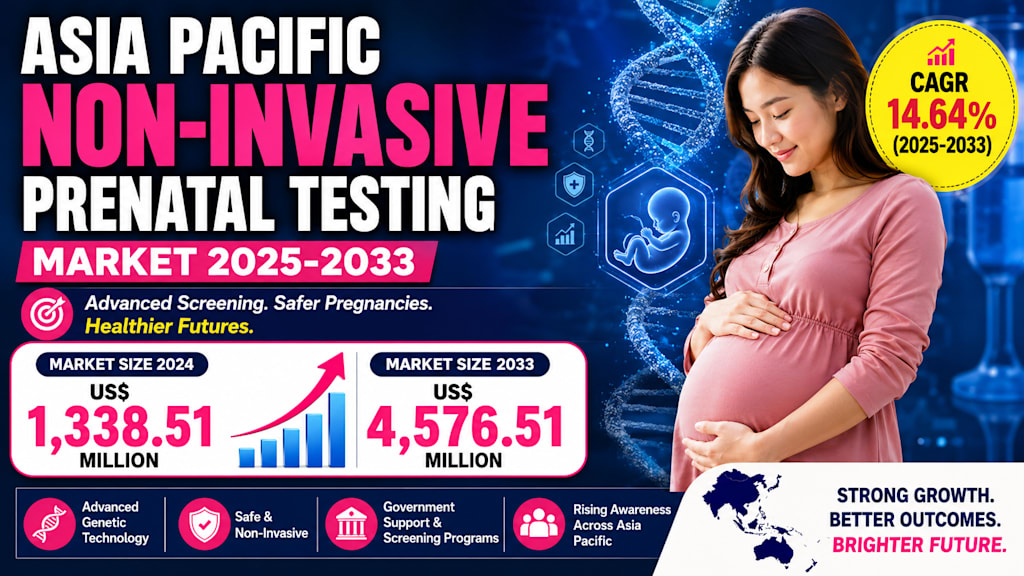
According to Renub Research, the Asia Pacific Non-Invasive Prenatal Testing Market is projected to grow from US$ 1,338.51 million in 2024 to US$ 4,576.51 million by 2033, expanding at a strong CAGR of 14.64% during 2025–2033.
This remarkable growth reflects the increasing demand for safer prenatal screening solutions, improvements in genetic testing technologies, and the growing importance of early fetal health diagnosis among expecting parents.
Understanding Non-Invasive Prenatal Testing
Non-Invasive Prenatal Testing, commonly known as NIPT, is a modern genetic screening method used during pregnancy to detect chromosomal abnormalities in a fetus. Unlike traditional invasive procedures such as amniocentesis, NIPT only requires a maternal blood sample, making the process safer and less stressful for both mother and baby.
The test primarily identifies conditions including:
Down Syndrome (Trisomy 21)
Edwards Syndrome (Trisomy 18)
Patau Syndrome (Trisomy 13)
Turner Syndrome
Other chromosomal abnormalities
Because of its high accuracy and low risk, NIPT has rapidly gained acceptance across hospitals, diagnostic labs, and prenatal care centers throughout Asia Pacific.
Why the Asia Pacific Region Is Becoming a Key Growth Hub
Asia Pacific represents one of the world’s most diverse healthcare markets. Countries such as China, Japan, South Korea, and Singapore possess highly advanced medical systems, while emerging economies like India, Indonesia, Thailand, and Malaysia are experiencing rapid healthcare modernization.
This unique blend creates significant growth opportunities for prenatal testing companies.
Several factors are driving market expansion across the region:
Increasing Maternal Age
Many women across Asia Pacific are choosing to delay pregnancy due to career priorities, urban lifestyles, and financial planning. Advanced maternal age increases the risk of chromosomal abnormalities, making prenatal screening more important than ever.
As awareness grows, more families are turning toward accurate and early-stage screening solutions such as NIPT.
Technological Advancements Are Reshaping Prenatal Care
One of the strongest growth catalysts in the NIPT market is rapid innovation in genetic testing technologies.
Modern Next-Generation Sequencing (NGS) platforms and advanced bioinformatics systems have significantly improved:
Test accuracy
Processing speed
Cost efficiency
Reliability of results
These innovations allow healthcare providers to analyze fetal DNA more effectively using maternal blood samples, reducing both diagnostic risks and waiting times.
As technology becomes more affordable, NIPT is gradually moving from premium healthcare services into mainstream prenatal care across multiple Asian countries.
Government Support Accelerating Market Adoption
Government initiatives and public healthcare policies are playing a major role in expanding prenatal screening accessibility.
Countries such as Japan and Singapore have integrated prenatal genetic screening into national healthcare systems, particularly for high-risk pregnancies. These efforts encourage early detection of genetic disorders and reduce dependency on invasive testing methods.
Public awareness campaigns are also helping families understand the importance of prenatal screening, contributing to higher adoption rates throughout urban and semi-urban populations.
In several Asia Pacific countries, expanding insurance coverage for prenatal care is further supporting market growth.
Expansion of Private Healthcare Driving Accessibility
Private healthcare providers are becoming key contributors to the growing NIPT ecosystem.
In countries like India and Thailand, private hospitals and diagnostic centers are rapidly introducing advanced prenatal testing services to meet increasing consumer demand.
This expansion benefits patients in several ways:
Faster testing and results
Better counseling services
Access to modern genetic laboratories
Improved patient experience
Competition among private healthcare providers is also helping reduce pricing barriers, gradually making NIPT more accessible to middle-income populations.
Major Challenges Still Exist
Despite strong growth potential, the Asia Pacific NIPT market continues to face several important challenges.
High Cost of Testing
The biggest barrier remains affordability.
In many developing countries, NIPT is still considered an expensive healthcare procedure. Reports suggest that the average cost of NIPT in India ranges between US$ 350 and US$ 400, while testing in Australia can exceed US$ 500.
For many families, especially in lower-income segments, these costs remain difficult to manage.
As a result, adoption rates are still uneven across urban and rural populations.
Regulatory and Standardization Issues
Another challenge affecting market development is inconsistent regulation across countries.
Different Asia Pacific nations follow different standards regarding:
Laboratory certification
Genetic counseling
Testing quality
Clinical protocols
Without unified standards, patient confidence and service reliability may vary significantly between regions.
Industry experts believe stronger regulatory frameworks will be essential to ensure long-term market credibility.
Infrastructure Gaps in Emerging Economies
Healthcare infrastructure limitations also restrict broader adoption.
Rural areas in developing countries often lack:
Specialized diagnostic laboratories
Trained genetic counselors
Modern testing facilities
Reliable healthcare access
This creates a significant urban-rural healthcare gap.
To overcome this challenge, governments and private healthcare providers must continue investing in medical infrastructure, digital health systems, and laboratory expansion.
India Emerging as a Major Growth Market
India is quickly becoming one of the most promising NIPT markets in Asia Pacific.
Growing awareness regarding maternal healthcare, expanding private healthcare infrastructure, and improvements in genetic testing capabilities are supporting market expansion.
Urban populations are increasingly adopting prenatal genetic screening due to:
Rising healthcare literacy
Higher disposable incomes
Improved access to diagnostics
Growing focus on preventive healthcare
However, rural accessibility and affordability remain major concerns that still need attention.
Government healthcare reforms and rising insurance penetration may help address these challenges in the coming years.
China Leading Regional Expansion
China continues to dominate the Asia Pacific NIPT landscape due to its large population base and rapidly advancing healthcare sector.
The country has witnessed strong demand for safer prenatal diagnostic techniques, particularly in metropolitan areas where advanced medical infrastructure is widely available.
China’s healthcare investments, insurance support, and technological innovation are expected to strengthen market growth further over the next decade.
Both domestic and international companies are heavily investing in China’s prenatal diagnostics industry, creating a highly competitive business environment.
Japan’s Advanced Healthcare System Supporting Stable Growth
Japan represents one of the most mature NIPT markets in Asia Pacific.
The country benefits from:
Advanced healthcare systems
Strong genetic testing capabilities
High public awareness
Government healthcare support
NIPT has become a routine prenatal screening option for many high-risk pregnancies in Japan.
Several companies including SRL, BGI Genomics, Macrogen Japan, and LSI Medience continue to strengthen the country’s prenatal testing ecosystem through partnerships and technological innovation.
Although rural access challenges remain, Japan’s continued healthcare investments are expected to support long-term market expansion.
Competitive Landscape Intensifying
The Asia Pacific NIPT market is becoming increasingly competitive as global healthcare and biotechnology companies expand their presence across the region.
Leading market participants are focusing on:
Product innovation
Strategic partnerships
Geographic expansion
Laboratory network development
Improved testing accuracy
Major companies operating in the market include:
Eurofins Scientific
F. Hoffmann-La Roche Ltd
Invitae Corporation
Illumina Inc.
Natera Inc.
Centogene NV
Qiagen
These companies are investing heavily in research and development to improve prenatal screening efficiency and affordability.
10 Recent Developments from Major Companies
1. Illumina Expanded NGS Capabilities
Illumina strengthened its next-generation sequencing portfolio to improve prenatal screening accuracy and processing speed.
2. Roche Enhanced Prenatal Diagnostic Solutions
Roche introduced improved molecular diagnostic technologies designed for faster and more reliable prenatal testing.
3. Natera Focused on International Expansion
Natera expanded partnerships across Asia Pacific to increase accessibility to advanced prenatal testing services.
4. Qiagen Improved Genetic Analysis Platforms
Qiagen launched upgraded bioinformatics solutions supporting more precise chromosomal abnormality detection.
5. Eurofins Scientific Expanded Laboratory Networks
Eurofins invested in regional laboratory expansion to improve testing accessibility in emerging Asian markets.
6. Invitae Advanced Personalized Genetic Screening
Invitae strengthened its personalized genetic testing offerings for expecting mothers seeking comprehensive prenatal analysis.
7. BGI Genomics Increased Market Presence in China
BGI continued expanding its prenatal testing services across major Chinese healthcare institutions.
8. Macrogen Japan Strengthened Genomic Research
Macrogen Japan invested in genomic sequencing technologies supporting higher prenatal testing accuracy.
9. Diagnostic Labs Across India Expanded NIPT Services
Several private diagnostic chains introduced affordable NIPT packages targeting middle-income urban populations.
10. Healthcare Providers Increased Digital Genetic Counseling
Many providers adopted virtual counseling systems to improve patient education and prenatal screening awareness.
Future Outlook Remains Highly Promising
The future of the Asia Pacific Non-Invasive Prenatal Testing market appears exceptionally strong.
As healthcare systems continue evolving and genetic testing technologies become more affordable, NIPT is expected to transition from a premium diagnostic service into a standard prenatal healthcare solution across much of the region.
Key trends likely to shape future growth include:
AI-driven genetic analysis
Expansion of telehealth genetic counseling
Improved insurance reimbursement
Lower testing costs
Wider rural healthcare access
Growth of personalized medicine
The increasing emphasis on preventive healthcare and early diagnosis will continue driving demand for advanced prenatal screening solutions throughout Asia Pacific.
Final Thoughts
The Asia Pacific Non-Invasive Prenatal Testing market is entering a transformative phase fueled by technology, healthcare modernization, and rising awareness among expecting parents.
While affordability and infrastructure challenges still exist, the region’s strong healthcare investments and expanding diagnostic capabilities are creating substantial opportunities for future growth.
With a projected market value exceeding US$ 4.5 billion by 2033, NIPT is expected to become a cornerstone of prenatal healthcare across Asia Pacific, offering safer, faster, and more reliable genetic screening solutions for millions of families.
As innovation continues and healthcare access expands, the prenatal diagnostics industry is likely to witness one of its most significant growth periods in the coming decade.
About the Creator
Enjoyed the story? Support the Creator.
Subscribe for free to receive all their stories in your feed.
Comments
There are no comments for this story
Be the first to respond and start the conversation.