
Asia Pacific A2P Messaging Market Set to Reach USD 39.13 Billion by 2033 Amid Rising Demand for Real-Time Digital Communication
Mobile-First Economies, Fintech Expansion, and E-commerce Growth Are Accelerating the Future of Application-to-Person Messaging Across Asia Pacific

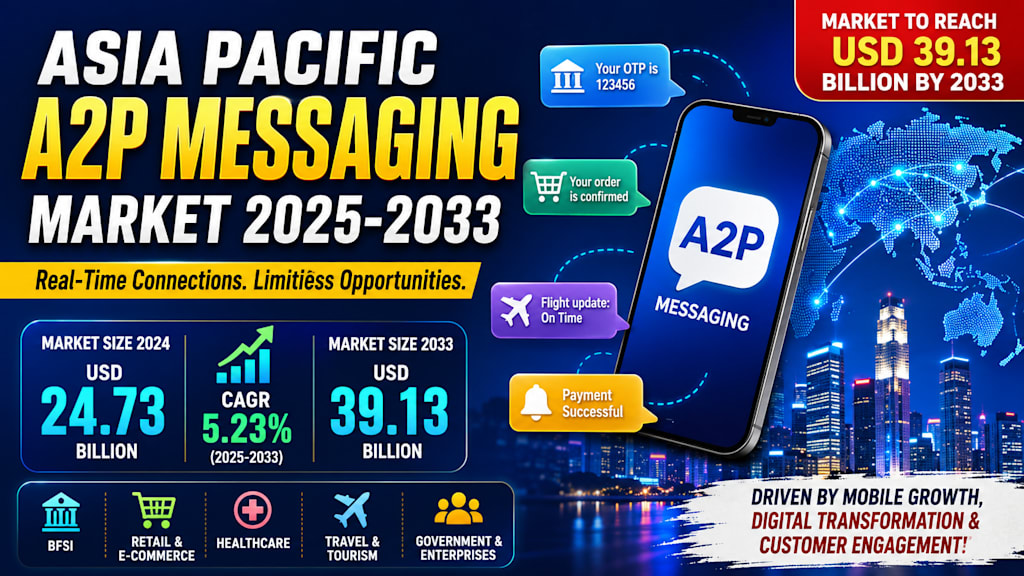
The Asia Pacific region is rapidly becoming one of the world’s most dynamic digital communication hubs, and Application-to-Person (A2P) messaging is playing a central role in this transformation. From banking alerts and OTP verifications to promotional campaigns and healthcare reminders, businesses are increasingly relying on automated messaging systems to connect with consumers instantly and securely.
According to recent industry analysis by Renub Research, the Asia Pacific A2P Messaging Market was valued at USD 24.73 billion in 2024 and is projected to grow to USD 39.13 billion by 2033, expanding at a CAGR of 5.23% during 2025–2033.
This remarkable growth reflects the region’s increasing smartphone adoption, booming e-commerce activity, expanding fintech ecosystem, and growing need for real-time customer engagement solutions.
What Is A2P Messaging and Why Does It Matter?
Application-to-Person messaging refers to automated text messages sent from software applications directly to users’ mobile phones. These messages are commonly used for:
One-Time Passwords (OTPs)
Banking notifications
Appointment reminders
Delivery tracking updates
Promotional offers
Customer support alerts
Security authentication
Unlike traditional person-to-person messaging, A2P messaging is designed for large-scale communication and enterprise automation. Its reliability, speed, and exceptionally high open rates make it one of the most effective digital communication channels available today.
In Asia Pacific, where mobile-first consumer behavior dominates internet usage, A2P messaging has become essential for businesses seeking direct customer interaction.
Smartphone Penetration Driving Market Expansion
One of the strongest growth drivers for the Asia Pacific A2P messaging industry is the rapid increase in smartphone and internet penetration across emerging economies such as India, Indonesia, Vietnam, and the Philippines.
Millions of first-time internet users are joining digital platforms every year, enabling companies to interact with customers through mobile-based services. Businesses in banking, healthcare, travel, and retail sectors are heavily investing in SMS communication strategies to improve engagement and trust.
The GSMA’s Mobile Economy Asia Pacific report predicts that the mobile sector’s contribution to the regional economy will exceed USD 1 trillion by 2030, supported by accelerating 5G adoption and expanding digital infrastructure.
As mobile connectivity grows deeper across rural and urban markets alike, A2P messaging demand is expected to rise substantially.
E-commerce and Fintech Boom Fueling Demand
Asia Pacific’s thriving e-commerce and digital payment industries are another major catalyst for A2P messaging growth.
Online shopping platforms depend heavily on automated messaging to deliver:
Payment confirmations
Delivery notifications
Transaction alerts
Fraud prevention messages
Login verification codes
Fintech companies also rely on secure SMS authentication to protect users and maintain compliance with financial regulations.
India’s UPI ecosystem processed over 89 billion transactions in 2022, making it one of the world’s most active digital payment infrastructures. China’s Internet Banking Payment System also continues to witness enormous transaction volumes.
As consumers increasingly expect real-time updates from digital platforms, A2P messaging remains an indispensable communication tool.
Enterprises and Governments Accelerating Adoption
Government agencies and enterprises across Asia Pacific are increasingly integrating A2P messaging into operational and customer communication strategies.
Public institutions use SMS platforms for:
Emergency notifications
Public health alerts
Utility reminders
Election updates
Citizen engagement campaigns
Meanwhile, businesses use A2P messaging for:
Workforce communication
CRM notifications
Customer engagement
Marketing automation
Security verification
Countries such as Singapore, Japan, South Korea, and Australia are leading enterprise-grade adoption due to strong digital maturity and advanced telecom ecosystems.
The region’s growing cloud infrastructure is also making messaging platforms more scalable and cost-effective for businesses of all sizes.
Cloud-Based Messaging Platforms Becoming Mainstream
Cloud deployment models are transforming the A2P messaging landscape across Asia Pacific.
Businesses increasingly prefer cloud-based communication platforms because they offer:
Faster deployment
Lower operational costs
High scalability
Better analytics integration
Easier API connectivity
Cloud-based A2P services are particularly attractive for small and medium enterprises seeking affordable digital engagement tools without investing heavily in infrastructure.
At the same time, on-premise messaging solutions continue to hold importance in highly regulated sectors such as defense, healthcare, and banking, where data privacy and compliance remain critical concerns.
BFSI Sector Leading Market Consumption
The Banking, Financial Services, and Insurance (BFSI) sector remains the largest consumer of A2P messaging services across Asia Pacific.
Financial institutions depend on SMS communication for:
Transaction alerts
Fraud detection
OTP verification
Credit card updates
Loan notifications
Customer authentication
The growing cybersecurity threat landscape has further strengthened the importance of secure SMS-based verification systems.
Despite the rise of app-based authentication methods, SMS remains highly reliable because it does not require internet connectivity and works across all mobile devices.
Healthcare Industry Increasing SMS Utilization
Healthcare organizations across Asia Pacific are increasingly adopting A2P messaging solutions to improve patient communication and operational efficiency.
Hospitals and clinics use SMS services for:
Appointment reminders
Prescription notifications
Test result alerts
Vaccination reminders
Telemedicine updates
Countries such as India and Australia have successfully integrated mobile messaging into healthcare outreach programs, especially after the COVID-19 pandemic accelerated digital health adoption.
Because SMS is accessible even in low-connectivity regions, healthcare providers view it as an effective and inclusive communication channel.
Challenges Facing the A2P Messaging Industry
Despite strong growth momentum, the Asia Pacific A2P messaging market also faces several challenges.
Competition from OTT Messaging Apps
Platforms like WhatsApp, WeChat, and LINE are reshaping customer communication behavior.
Businesses increasingly explore OTT channels because they offer:
Rich media support
Interactive messaging
Multimedia capabilities
AI chatbot integration
This creates competitive pressure on traditional SMS providers, especially in digitally mature markets.
Regulatory Complexity and Spam Concerns
Different countries across Asia Pacific maintain varying regulatory frameworks for SMS communication.
India, for example, has implemented Distributed Ledger Technology (DLT)-based systems to control spam and fraudulent messaging.
While such regulations improve consumer protection, they also increase compliance complexity for A2P service providers operating across multiple jurisdictions.
Additionally, rising phishing attacks and spam-related concerns are pushing telecom regulators to tighten messaging rules further.
China Continues to Dominate Regional Market
China remains one of the largest and most technologically advanced A2P messaging markets in Asia Pacific.
Major digital ecosystems including Alibaba Group and WeChat Pay rely heavily on transactional messaging for authentication and customer engagement.
Even as OTT platforms expand, SMS continues to serve critical business communication needs because of its reliability and universal accessibility.
China’s massive digital economy and sophisticated telecom infrastructure are expected to sustain long-term market growth.
India Emerging as a Key Growth Engine
India is rapidly becoming one of the most influential A2P messaging markets globally.
The country’s enormous mobile subscriber base, growing fintech sector, expanding digital governance initiatives, and rising online commerce activity are driving unprecedented demand.
From Aadhaar verification to banking OTPs and educational alerts, A2P messaging has become deeply integrated into India’s digital ecosystem.
The Indian government’s stronger anti-spam regulations and DLT implementation are also helping create a more secure messaging environment.
Japan’s Focus on Secure Communication
Japan’s A2P messaging market is characterized by high service reliability and strong focus on data privacy.
Japanese enterprises extensively use SMS communication in:
Banking
Logistics
Healthcare
Insurance
Enterprise IT systems
Consumers in Japan continue to value trusted communication channels, which keeps transactional SMS highly relevant even amid growing OTT adoption.
10 Recent Developments from Leading Companies
1. Globe Teleservices
In March 2025, Globe Teleservices signed a three-year agreement with Malaysian telecom operator CelcomDigi to implement advanced A2P SMS firewall solutions.
2. Infobip
Infobip partnered with China Mobile International Malaysia in February 2024 to enhance A2P SMS traffic sharing and cloud communication capabilities.
3. Bharat Sanchar Nigam Limited (BSNL)
BSNL launched its Bulk Push SMS A2P Platform in January 2025 while achieving 99% fiberization of enterprise customers across India.
4. Twilio
Twilio expanded AI-powered customer engagement tools for enterprise messaging automation throughout Asia Pacific markets.
5. Sinch AB
Sinch strengthened its regional cloud communication infrastructure to improve cross-border SMS delivery performance.
6. Tata Communications
Tata Communications enhanced enterprise-grade messaging APIs for fintech and e-commerce businesses across India and Southeast Asia.
7. Genesys
Genesys integrated omnichannel customer experience solutions with advanced messaging capabilities for enterprise clients.
8. 8x8 Inc.
8x8 expanded cloud-based communication services supporting SMS automation and customer engagement tools.
9. China Mobile
China Mobile continued strengthening international messaging partnerships to support growing A2P traffic demand.
10. AT&T
AT&T invested further in enterprise messaging services and communication APIs targeting multinational corporations operating in Asia Pacific.
Future Outlook: A2P Messaging Becoming More Intelligent
The future of the Asia Pacific A2P messaging market will likely be shaped by:
AI-powered communication platforms
Rich Communication Services (RCS)
Hyper-personalized messaging
Advanced customer analytics
Omnichannel communication strategies
Secure authentication technologies
Businesses are no longer viewing messaging as just a notification tool. Instead, it is evolving into a strategic customer engagement platform.
As digital ecosystems expand across Asia Pacific, A2P messaging will remain a foundational technology powering secure, real-time, and scalable communication.
Final Thoughts
The Asia Pacific A2P Messaging Market is entering a new phase of intelligent digital communication growth. Rapid smartphone adoption, booming e-commerce ecosystems, fintech innovation, and enterprise digital transformation are collectively creating strong momentum for the industry.
While OTT applications and regulatory complexities present challenges, the demand for secure, real-time, and reliable mobile communication continues to expand across sectors.
With the market expected to reach USD 39.13 billion by 2033, A2P messaging is poised to remain a critical pillar of Asia Pacific’s fast-evolving digital economy.
About the Creator
Enjoyed the story? Support the Creator.
Subscribe for free to receive all their stories in your feed.
Comments
There are no comments for this story
Be the first to respond and start the conversation.