
Artificial Sweetener Market to Reach US$ 6.94 Billion by 2034 as Sugar Reduction Trends Reshape Global Food Industry
The global artificial sweetener market is entering a strong growth phase as consumers increasingly shift toward low-calorie foods, sugar-free beverages, and healthier dietary choices. The market is projected to rise from US$ 4.45 billion in 2025 to US$ 6.94 billion by 2034, growing at a CAGR of 5.07% from 2026 to 2034. Rising diabetes rates, obesity concerns, and innovation in next-generation stevia and sweet protein formulations are accelerating global demand.

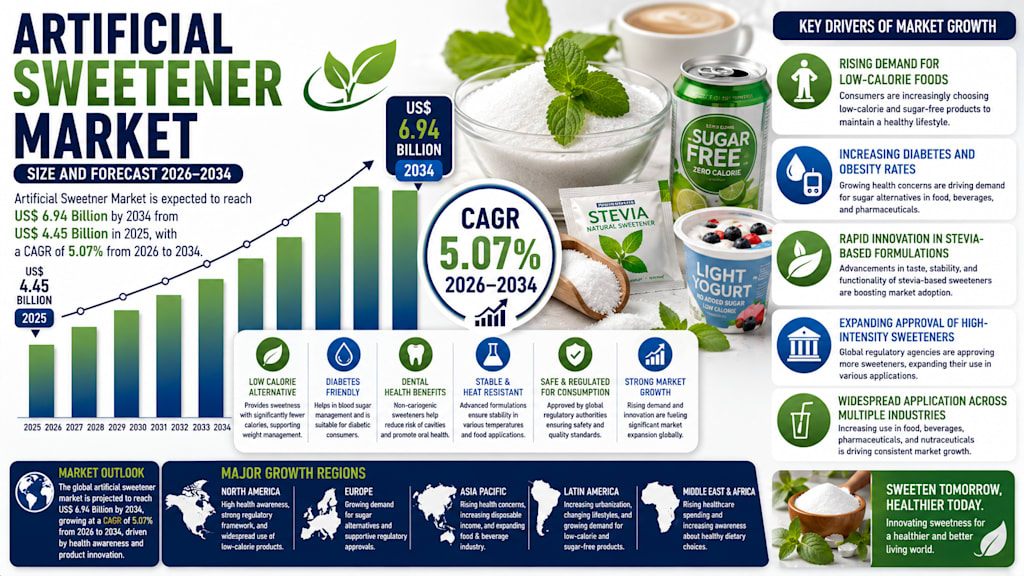
Artificial Sweetener Market Overview
Artificial sweeteners are low- or zero-calorie sugar substitutes used to provide sweetness without the metabolic impact of traditional sugar. They include synthetic sweeteners such as aspartame, sucralose, saccharin, and acesulfame-K, along with naturally derived alternatives like stevia and monk fruit extracts. These ingredients are widely used in beverages, bakery products, dairy items, pharmaceuticals, nutraceuticals, and confectionery applications. Their popularity comes from their high sweetness intensity, heat stability, and compatibility with diabetic and calorie-conscious diets. Regulatory bodies such as the U.S. FDA and the European Food Safety Authority continue to evaluate and approve these sweeteners for safe commercial use.
The market is expanding steadily because consumers around the world are actively reducing sugar consumption. Obesity, diabetes, and lifestyle-related health disorders are encouraging food manufacturers to reformulate products with lower sugar content. Beverage companies, snack manufacturers, and bakery brands are introducing sugar-free and reduced-calorie alternatives at an accelerated pace. Improved taste profiles, better solubility, and innovation in stevia formulations are also helping sweeteners move beyond niche dietary products into mainstream food categories.
Rising Demand for Healthier Food Choices Driving Market Expansion
Health awareness is becoming one of the strongest drivers of the artificial sweetener market. Consumers are paying closer attention to calorie intake, sugar consumption, and long-term health outcomes. Governments and healthcare organizations are also promoting sugar-reduction campaigns to combat obesity and diabetes. This shift is creating strong demand for food and beverage products that deliver sweetness without the caloric impact of traditional sugar.
Low-calorie beverages, sugar-free snacks, protein supplements, and functional foods are increasingly relying on artificial sweeteners to maintain flavor while meeting nutritional expectations. This demand is particularly strong among urban consumers, fitness-focused populations, and diabetic individuals seeking healthier dietary alternatives. The expansion of functional beverages and nutraceutical products is further widening the commercial opportunity for sweetener manufacturers.
Innovation in Stevia and Natural Sweeteners Reshaping the Industry
Innovation in natural sweeteners is transforming the competitive landscape. Traditional artificial sweeteners sometimes faced criticism because of bitterness or lingering aftertaste. However, manufacturers are now developing refined steviol glycoside blends and advanced sweet protein technologies that deliver a flavor profile much closer to traditional sugar.
One notable development came in May 2024, when HOWTIAN launched SoPure Andromeda, a proprietary stevia-blend sweetener created to improve taste performance in sugar-reduced beverages. This reflects the broader industry trend toward clean-label and plant-based formulations that meet consumer demand for healthier ingredients without compromising flavor.
The industry is also witnessing rapid progress in sweet proteins and fermentation-based alternatives. In February 2026, Amai Protein received an FDA GRAS “no safety concerns” determination for its Sweelin sweet protein, paving the way for wider commercialization in the U.S. market. Such approvals strengthen confidence in next-generation sweetener technologies and accelerate adoption across global food and beverage applications.
Advanced Solubility and Formulation Technologies Supporting Adoption
Improved solubility and formulation science are helping artificial sweeteners perform more effectively across diverse food and beverage applications. Earlier generations of stevia and natural sweeteners often struggled with taste inconsistency and limited compatibility in beverages. Today, advances in ingredient engineering are solving many of these issues.
Ingredion’s launch of PURECIRCLE Clean Taste Solubility Solution in April 2024 demonstrated how manufacturers are addressing these technical barriers. The technology reportedly offers more than 100-times the solubility of traditional Reb M, significantly improving beverage performance and sweetness delivery. These advancements are helping beverage companies reduce sugar while maintaining taste, texture, and stability.
Enhanced formulation technology is also improving sweetener application in dairy products, sauces, bakery goods, and ready-to-drink beverages. As product performance improves, major FMCG companies are increasingly adopting artificial sweeteners in mainstream product reformulation programs.
Regulatory Approvals Expanding Commercial Opportunities
Regulatory approvals remain essential for market growth because they validate product safety and encourage industry investment. Regulatory agencies in the United States, Europe, and Asia continue to review high-intensity sweeteners, fermentation-derived ingredients, and natural sugar alternatives.
In January 2024, Cargill’s Avansya joint venture received positive safety assessments from both EFSA and the UK Food Standards Agency for its EverSweet stevia sweetener. This milestone expanded commercial opportunities across European markets and encouraged wider adoption among food and beverage manufacturers. Regulatory clarity is especially important as companies launch new sugar-reduction products designed for health-conscious consumers.
The approval environment is becoming increasingly supportive of innovation, particularly for plant-based and precision-fermentation-derived sweeteners. These developments are expected to help manufacturers accelerate commercialization and expand into new regional markets.
Challenges Facing the Artificial Sweetener Market
Despite strong growth, the market continues to face several challenges. Taste and sensory limitations remain one of the biggest concerns. Some artificial sweeteners still produce bitterness, metallic notes, or lingering aftertaste when used in high concentrations. This can create formulation difficulties, especially in products where flavor precision is critical, such as soft drinks, bakery products, and dairy applications.
Manufacturers often combine multiple sweeteners or use flavor-masking systems to improve taste performance, but these strategies can increase production costs. Consumer skepticism regarding “artificial” ingredients also remains a challenge in certain markets, particularly among clean-label and natural-food buyers.
Regulatory complexity is another issue. Approval processes vary across countries, making international product launches more difficult. Companies must navigate different labeling standards, testing requirements, and compliance systems. Public debate surrounding long-term health impacts can also affect consumer confidence, even when scientific reviews confirm safety within approved intake levels.
United States Artificial Sweetener Market
The U.S. artificial sweetener market is growing rapidly as consumers seek healthier alternatives in beverages, snacks, dairy products, and nutritional supplements. Biotechnology-driven innovation is supporting the development of novel sweet proteins and plant-derived sweeteners alongside established ingredients like sucralose and stevia extracts.
A major milestone occurred in February 2026 when Sweelin, a precision-fermentation sweet protein, received FDA GRAS approval. This approval validated its safety for general sweetener use and opened the door for broader commercial adoption in food and beverage applications. The development aligns with the wider industry push toward healthier and lower-sugar formulations.
Germany Artificial Sweetener Market
Germany’s market is benefiting from strong consumer interest in healthier diets and reduced-sugar food products. Food and beverage companies across the country are increasingly adopting stevia and plant-based sweeteners to support clean-label product launches.
The launch of the Yume brand by Tate & Lyle and Manus in February 2026 introduced a new premium stevia-derived sweetener portfolio aimed at improving taste and functionality. This innovation is expected to influence product reformulation strategies across the broader European market, including Germany.
China Artificial Sweetener Market
China remains one of the most important suppliers of stevia-derived sweeteners and sugar-reduction ingredients globally. Domestic manufacturers are actively developing new steviol glycoside blends and advanced sweetener systems to meet rising demand for healthier beverage and food products.
The launch of HOWTIAN’s SoPure Andromeda in 2024 highlighted China’s focus on balancing taste performance, functionality, and cost efficiency in natural sweetener innovation. The country continues to play a major role in both domestic consumption and global ingredient exports.
Saudi Arabia Artificial Sweetener Market
Saudi Arabia’s artificial sweetener market is evolving alongside broader public health initiatives aimed at reducing sugar consumption. The country introduced a new excise tax on sweetened beverages beginning January 2026, encouraging beverage companies to adopt lower-sugar formulations and sugar substitutes.
In December 2024, Saudi Arabia introduced Milaf Cola, a soft drink made primarily from date sugars without added refined sugar. The product was positioned as a healthier soda alternative and demonstrated how regional manufacturers are using local agricultural resources to support sugar-reduction trends and healthier beverage innovation.
Aspartame Market Outlook
Aspartame continues to hold a significant position in the artificial sweetener industry because it provides a sugar-like taste profile and remains cost-effective for large-scale food and beverage manufacturing. It is widely used in carbonated drinks, powdered beverages, confectionery products, and tabletop sweeteners. Rising obesity and diabetes concerns are supporting continued demand for low-calorie beverage alternatives, helping sustain stable growth in the aspartame segment.
Artificial Sweetener in Bakery Products Market
Artificial sweeteners are becoming increasingly important in bakery products as manufacturers work to reduce sugar while maintaining taste, texture, and shelf stability. Cookies, cakes, pastries, and low-calorie baked snacks are increasingly formulated with sucralose, stevia blends, acesulfame-K, and aspartame systems. Advances in heat-stable sweeteners are helping manufacturers preserve sweetness even under high baking temperatures.
Demand for diabetic-friendly and “better-for-you” baked products is expected to continue supporting growth in this segment. Food manufacturers are also responding to stricter sugar regulations and changing consumer preferences by expanding reduced-sugar bakery portfolios.
Recent Developments in the Artificial Sweetener Market
In February 2026, Amai Protein received FDA GRAS clearance for its Sweelin sweet protein, accelerating commercialization opportunities in the United States.
In October 2025, Icon Foods announced plans to commercialize next-generation stevia extracts including Reb A and Reb M formulations.
In September 2025, Oobil secured an FDA GRAS no-questions letter for its brazzein-54 sweet protein.
In May 2024, HOWTIAN launched SoPure Andromeda to improve taste performance in sugar-reduced beverages.
In April 2024, Ingredion introduced PURECIRCLE Clean Taste Solubility Solution for enhanced Reb M solubility.
In January 2024, Cargill’s Avansya joint venture received favorable safety evaluations for EverSweet stevia sweetener in Europe and the UK.
Tate & Lyle and Manus launched the Yume sweetener portfolio in February 2026 for premium stevia-based applications.
Precision-fermentation sweet proteins gained stronger commercial traction in North America during 2025 and 2026.
Beverage companies globally accelerated sugar-reduction reformulation programs using next-generation stevia systems.
Clean-label and plant-based sweetener adoption continued expanding across dairy, bakery, and functional beverage categories.
Competitive Landscape and Key Players
Major companies operating in the market include Tate & Lyle PLC, Cargill Incorporated, Archer Daniels Midland Company, DuPont de Nemours Inc., Ajinomoto Co. Inc., Ingredion Incorporated, and GLG Life Tech Corporation. These companies are heavily investing in sweetener innovation, formulation science, and clean-label ingredient development to strengthen their market position.
Final Thoughts
The artificial sweetener market is evolving rapidly as sugar reduction becomes a global priority across food, beverage, and healthcare industries. Innovation in stevia, sweet proteins, and precision-fermentation technologies is improving taste performance and consumer acceptance, while regulatory approvals are opening new commercial opportunities worldwide. With the market projected to reach US$ 6.94 billion by 2034, artificial sweeteners are expected to play a central role in the future of healthier food and beverage formulations.
About the Creator
Enjoyed the story? Support the Creator.
Subscribe for free to receive all their stories in your feed.
Comments
There are no comments for this story
Be the first to respond and start the conversation.