
Argentina Real Estate Market Size Growth Share Trends Demand & Forecast 2034
The United States over the counter (OTC) drugs market size reached USD 44.2 Billion in 2025 to reach USD 69.6 Billion by 2034,

Argentina Real Estate Market Size, Share, and Growth Forecast (2026–2034)
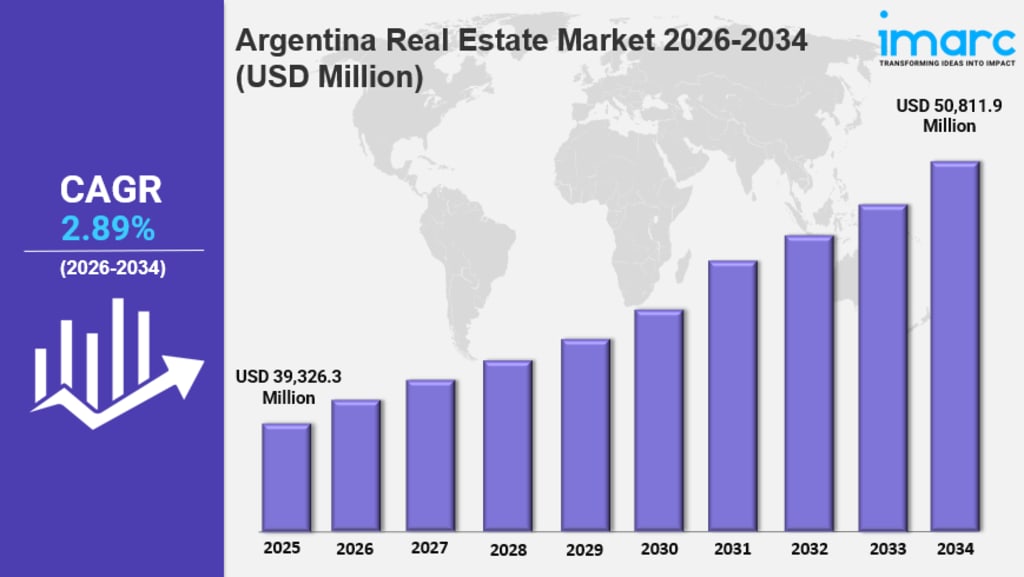
The Argentina real estate market is gradually stabilizing after years of macroeconomic fluctuations, creating selective but meaningful opportunities for institutional investors, developers, and cross-border capital. The market reached USD 39,326.3 million in 2025 and is projected to touch USD 50,811.9 million by 2034, expanding at a CAGR of 2.89% during 2026–2034.
Unlike high-growth emerging markets, Argentina’s real estate sector is shaped more by cycles of economic confidence than pure volume expansion. For B2B stakeholders, this means the focus is shifting toward value preservation, asset repositioning, and opportunistic investments rather than aggressive expansion. Demand for residential properties remains a core pillar, while selective interest in commercial and industrial assets is emerging in urban and logistics corridors.
Request a Sample Report with Latest 2026 Data & Forecasts:
Investment Outlook in the Argentina Real Estate Market: Residential, Commercial, and Industrial Segments
Investment activity in Argentina real estate is increasingly segmented. Residential properties continue to attract the highest share of local demand, primarily driven by urban population concentration and housing replacement needs. Mid-income housing and rental apartments are particularly relevant for developers targeting stable occupancy.
The commercial segment is more cautious but offers upside in prime urban locations, especially retail spaces that align with essential services. Office demand remains uneven, influenced by hybrid work adoption and cost optimization strategies by businesses.
Industrial real estate is gaining gradual attention, supported by logistics requirements, warehousing demand, and the need for improved supply chain infrastructure. For investors, this segment offers relatively more stability compared to office real estate, particularly around major transport and trade hubs.
Key Drivers Shaping the Argentina Real Estate Market Growth
The Argentina real estate market is influenced by a combination of demographic needs and economic adjustment cycles. Urbanization continues to drive housing demand in major cities such as Buenos Aires, where population density and migration patterns support residential development.
Another key driver is asset-based investment behavior. In an inflation-sensitive economy, real estate is often viewed as a store of value, encouraging both local and foreign participation in property acquisition.
Additionally, gradual infrastructure improvements and urban redevelopment projects are supporting localized growth pockets. These developments are helping improve connectivity, which in turn enhances property values in surrounding areas.
Foreign Direct Investment Trends in Argentina Real Estate Sector
Foreign direct investment in Argentina’s real estate sector remains selective but strategically important. International investors typically focus on undervalued assets, distressed properties, and premium developments in high-demand urban locations.
Currency fluctuations and economic cycles influence investment timing, making entry strategies more opportunistic. Investors with long-term perspectives tend to enter during periods of currency depreciation, aiming to benefit from future asset appreciation.
For institutional investors and real estate funds, partnerships with local developers and asset managers are becoming essential to navigate regulatory frameworks and operational complexities. This collaboration model reduces risk exposure while improving market access.
Rental Yield, Pricing Trends, and Capital Appreciation in Argentina Property Market
Rental yields in Argentina vary significantly depending on location and property type. Urban residential properties tend to generate more stable rental income, while premium commercial assets offer higher but more cyclical returns.
Pricing trends are closely linked to macroeconomic conditions, particularly inflation and currency valuation. In periods of economic uncertainty, nominal property prices may fluctuate, but real estate often retains its long-term value relative to local currency depreciation.
Capital appreciation potential exists in strategically located urban and redevelopment zones. Investors focusing on long-term holding strategies often prioritize asset quality and location over short-term price movements, especially in central business districts.
Risks and Challenges in the Argentina Real Estate Industry: Inflation, Currency, and Policy Impact
The Argentina real estate market operates within a complex macroeconomic environment. Inflation remains one of the most significant challenges, directly affecting construction costs, pricing stability, and investor returns.
Currency volatility also plays a critical role in shaping investment decisions. Foreign investors often face exchange rate risks, which can impact both entry valuation and exit returns.
Regulatory and policy changes further add to market uncertainty. Shifts in taxation, property regulations, and foreign ownership rules can influence investment appetite. As a result, risk assessment and timing become crucial factors for market participation.
Competitive Landscape and Key Developers in the Argentina Real Estate Market
The competitive landscape in Argentina’s real estate sector includes a mix of established local developers, construction firms, and international investors operating through partnerships. Key players such as IRSA Inversiones y Representaciones and Consultatio S.A. play a significant role in shaping large-scale residential and commercial projects.
Competition is largely project-driven rather than volume-driven, with developers focusing on high-demand urban zones and phased developments. Smaller regional developers also contribute by targeting mid-income housing segments and localized commercial spaces.
For investors and B2B stakeholders, competitive advantage depends on execution capability, land acquisition strategy, and the ability to adapt to macroeconomic cycles. Partnerships and joint ventures remain a key strategy for reducing risk and expanding market presence.
About the Creator
Kim Soo hyun
My name is Kim Soo hyun, and I am a research analyst at IMARC Group, specializing in market trends and data analysis to provide insights and support strategic decision-making.
Enjoyed the story? Support the Creator.
Subscribe for free to receive all their stories in your feed.
Comments
There are no comments for this story
Be the first to respond and start the conversation.