
Argentina Access Control Market Size Growth & Trends Industry Forecast 2034
The Argentina access control market reached USD 140.3 million in 2025 and is projected to grow to USD 303.3 million by 2034.

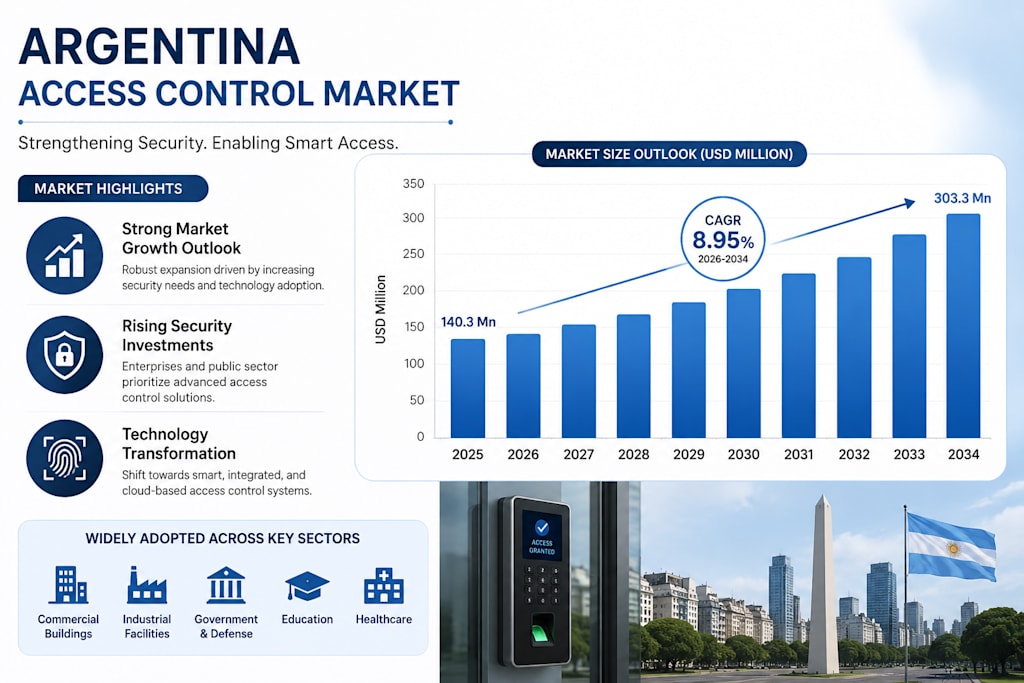
Argentina Access Control Market Size, Share, and Forecast (2026–2034)
The Argentina access control market is witnessing steady growth as organizations across commercial, industrial, and public sectors continue to prioritize security infrastructure and digital monitoring systems. The market reached USD 140.3 million in 2025 and is projected to grow to USD 303.3 million by 2034, expanding at a CAGR of 8.95% during 2026–2034.
The market is benefiting from increasing demand for secure identity management, rising urban infrastructure development, and growing awareness regarding workplace and facility security. Businesses are moving beyond traditional locking systems and investing in integrated access control solutions that offer centralized monitoring, automation, and real-time data visibility.
As digital transformation accelerates across industries, access control systems are becoming an important part of broader security and operational management strategies.
Request the Latest Market Report with 2026–2034 Forecast Insights
Key Trends Shaping the Argentina Access Control Market
One of the major trends influencing the Argentina access control market is the transition from conventional security systems to digital and cloud-connected platforms. Organizations are increasingly adopting systems that provide remote access management, centralized control, and real-time monitoring capabilities.
Demand for touchless and contactless authentication solutions is also increasing. This trend has gained momentum across offices, healthcare facilities, educational institutions, and transportation hubs where operational efficiency and hygiene standards are becoming more important.
Another notable trend is the growing integration of access control systems with video surveillance, alarm systems, and building management platforms. Businesses are looking for unified security ecosystems that improve visibility and reduce operational complexity.
The expansion of smart buildings and connected infrastructure projects is further supporting market growth, particularly in urban commercial developments.
Growth Drivers in the Argentina Access Control Industry
Several factors are contributing to the expansion of the access control industry in Argentina. Rising concerns related to security threats and unauthorized access are encouraging both public and private organizations to modernize security infrastructure.
Commercial facilities, manufacturing units, banks, and government institutions are increasing investments in advanced security technologies to improve asset protection and employee safety. In addition, the growth of corporate offices and industrial facilities is creating sustained demand for scalable access control systems.
Digital transformation initiatives are also acting as a major growth driver. Businesses are seeking automation tools that improve operational efficiency while strengthening security management. Access control systems with data analytics and monitoring features are helping organizations improve workforce management and facility oversight.
The increasing adoption of mobile credentials and cloud-based platforms is further supporting industry expansion by enabling flexible and remote access management.
Technology Trends in the Argentina Access Control Market: Biometrics, Cloud-Based Systems, and AI Integration
Technology innovation is reshaping the access control market in Argentina. Biometric authentication systems, including fingerprint, facial recognition, and iris scanning technologies, are becoming more common across commercial and institutional environments.
These systems provide enhanced security and reduce the risks associated with physical access cards or passwords. Biometric technologies are particularly gaining traction in high-security facilities and enterprise-level applications.
Cloud-based access control platforms are another important trend transforming the industry. These solutions allow organizations to manage security systems remotely, reduce hardware dependency, and improve scalability. Businesses with multiple locations are increasingly adopting cloud-enabled systems to centralize operations.
Artificial intelligence is also influencing the market through predictive monitoring, automated alerts, and intelligent behavior analysis. AI-enabled systems can identify suspicious activity patterns and improve response efficiency, making security infrastructure more proactive and data-driven.
Challenges in the Argentina Access Control Market: Cybersecurity, Integration, and Infrastructure Costs
Despite positive growth prospects, the market faces several operational and technical challenges. Cybersecurity remains one of the primary concerns, particularly as access control systems become more connected through cloud and IoT technologies.
Organizations must ensure that digital security systems are protected against data breaches, unauthorized access, and system vulnerabilities. This requires continuous software updates, secure data management practices, and investment in cybersecurity infrastructure.
Integration complexity is another challenge affecting adoption. Many businesses still operate with legacy systems that may not be fully compatible with modern access control technologies. Upgrading infrastructure often requires significant investment and technical expertise.
Infrastructure costs can also be a barrier for small and medium-sized enterprises. Advanced biometric and AI-enabled systems may involve high implementation expenses, limiting adoption among budget-sensitive organizations.
Investment Opportunities in the Argentina Access Control Market
The Argentina access control market presents significant opportunities for technology providers, system integrators, and security solution companies. Growing demand for smart infrastructure and digital security systems is creating opportunities across commercial, industrial, and institutional sectors.
Cloud-based access management platforms represent a key growth area, particularly for businesses seeking scalable and cost-efficient security solutions. Companies offering subscription-based and software-driven security models are expected to benefit from increasing digital adoption.
Biometric technologies also offer strong investment potential as organizations prioritize advanced authentication methods and operational efficiency. In addition, the expansion of smart city and infrastructure projects is likely to create long-term demand for integrated security systems.
Partnerships between technology firms, infrastructure developers, and enterprise customers are becoming increasingly important for market expansion and innovation.
Competitive Landscape and Leading Players in the Argentina Access Control Industry
The competitive landscape of the Argentina access control market includes global security technology providers, regional system integrators, and specialized software companies. Competition is largely based on technology capabilities, integration services, pricing strategies, and after-sales support.
Leading companies are focusing on expanding cloud-based offerings, biometric authentication solutions, and AI-enabled security platforms to strengthen their market position. Strategic partnerships and product innovation are also shaping competitive dynamics within the industry.
As customer requirements continue to evolve, businesses that can deliver scalable, secure, and easy-to-integrate solutions are expected to gain a stronger presence in the Argentina access control market.
About the Creator
Kim Soo hyun
My name is Kim Soo hyun, and I am a research analyst at IMARC Group, specializing in market trends and data analysis to provide insights and support strategic decision-making.
Enjoyed the story? Support the Creator.
Subscribe for free to receive all their stories in your feed.
Comments
There are no comments for this story
Be the first to respond and start the conversation.