
Amniotic Membrane Market Growth: How Regenerative Medicine and Advanced Wound Care Are Transforming Modern Healthcare
Rising adoption in ophthalmology, chronic wound treatment, and tissue regeneration is driving rapid growth in the global amniotic membrane industry

The healthcare industry is increasingly embracing regenerative therapies that promote natural healing while reducing complications associated with traditional treatments. Among the most promising biological solutions gaining widespread clinical acceptance is the amniotic membrane, a tissue-based therapy known for its remarkable healing and regenerative properties.
Used across ophthalmology, wound care, reconstructive surgery, and regenerative medicine, amniotic membrane products are helping clinicians address complex medical challenges by supporting tissue repair, reducing inflammation, and accelerating recovery.
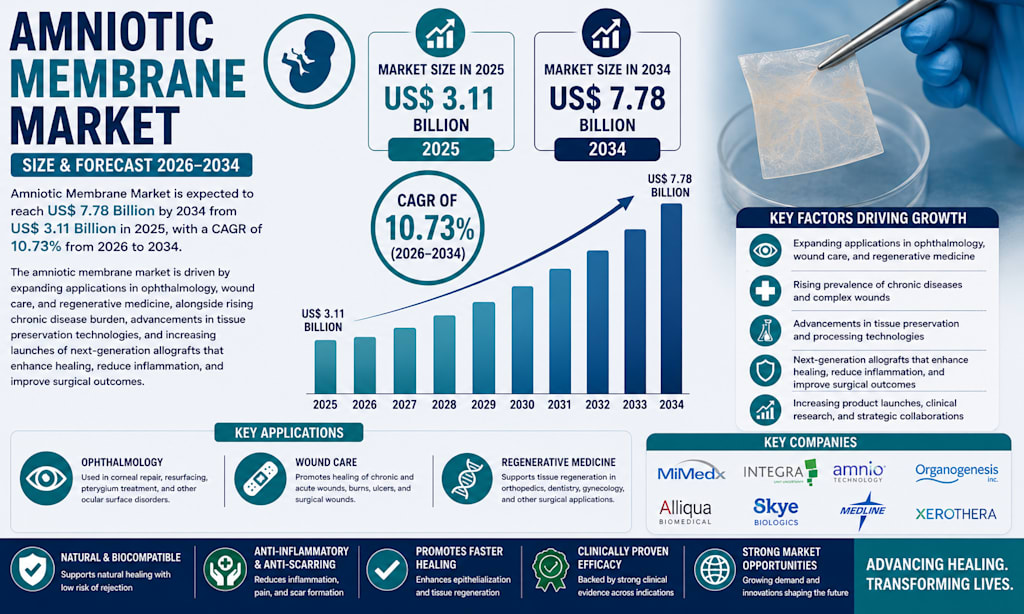
According to Renub Research, the global Amniotic Membrane Market is expected to grow from US$ 3.11 billion in 2025 to US$ 7.78 billion by 2034, registering a CAGR of 10.73% between 2026 and 2034. Growing applications in chronic wound management, ocular surface reconstruction, orthopedics, and advanced regenerative therapies are among the major factors driving market expansion.
As healthcare providers increasingly seek biological alternatives to synthetic graft materials, amniotic membranes are emerging as one of the most important innovations in modern regenerative medicine.
Understanding Amniotic Membranes
The amniotic membrane is the innermost layer of the placenta and possesses unique biological properties that make it highly valuable for medical applications.
These membranes contain naturally occurring:
- Growth factors
- Cytokines
- Structural proteins
- Anti-inflammatory compounds
- Antimicrobial components
As a result, they can support tissue repair and regeneration while minimizing scar formation and inflammation.
Amniotic membranes are commonly processed into several formats, including:
- Cryopreserved grafts
- Dehydrated grafts
- Lyophilized membranes
- Multi-layer allografts
These products are used across numerous specialties, including:
- Ophthalmology
- Wound care
- Orthopedics
- Dentistry
- Plastic surgery
- Regenerative medicine
Their ability to promote healing while reducing complications has positioned them as valuable tools in both surgical and non-surgical treatments.
Regenerative Medicine Is Driving Market Expansion
One of the most significant drivers of the amniotic membrane market is the rapid growth of regenerative medicine.
Healthcare providers are increasingly focused on therapies that help the body heal naturally rather than relying solely on synthetic materials or invasive interventions.
Amniotic membranes support this objective because they:
- Promote cellular growth
- Encourage tissue regeneration
- Reduce inflammation
- Minimize scarring
- Accelerate healing
These characteristics make them particularly useful in treating chronic wounds, surgical injuries, and degenerative conditions.
The global rise in chronic diseases is further increasing demand.
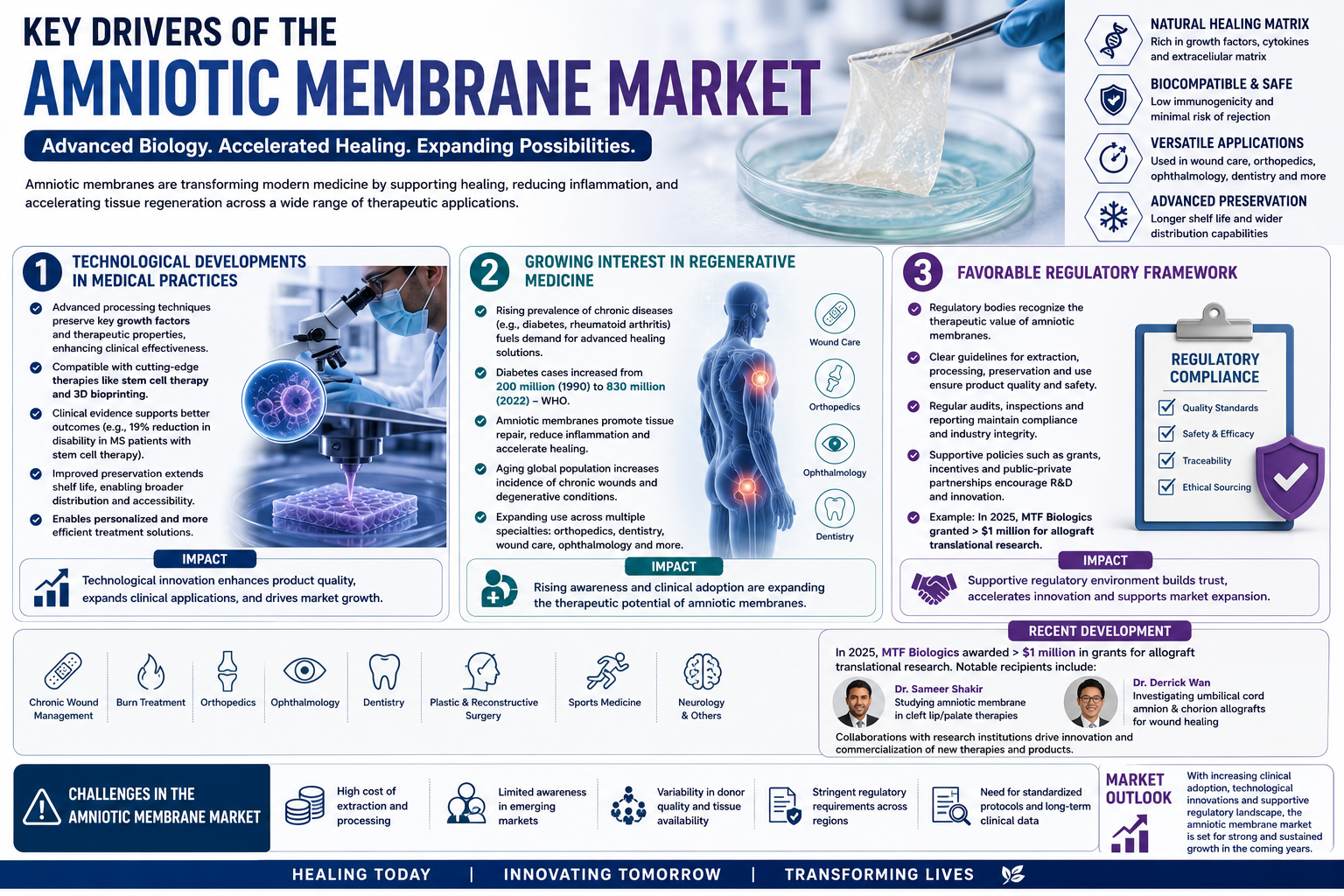
According to data referenced in the report, the number of individuals living with diabetes increased from approximately 200 million in 1990 to 830 million in 2022. Since diabetes is a major contributor to chronic wounds and diabetic foot ulcers, demand for regenerative wound-care products continues to grow.
As regenerative medicine continues evolving, amniotic membrane therapies are expected to become increasingly important across multiple healthcare disciplines.
Technological Advancements Are Enhancing Clinical Performance
Innovation in tissue preservation and processing technologies is significantly improving the effectiveness of amniotic membrane products.
Modern preservation techniques help retain critical biological components while extending product shelf life and improving distribution capabilities.
Advancements include:
- Improved cryopreservation methods
- Enhanced dehydration technologies
- Sterile processing systems
- Multi-layer graft engineering
These innovations allow healthcare providers to access products that maintain strong therapeutic properties while offering greater convenience and flexibility.
Researchers are also exploring combinations of amniotic membranes with emerging technologies such as:
- Stem cell therapies
- Three-dimensional bioprinting
- Tissue engineering platforms
- Advanced regenerative medicine systems
Such integrations have the potential to further expand clinical applications and improve treatment outcomes.
The continued advancement of preservation and processing technologies is expected to support broader adoption across healthcare settings worldwide.
Ophthalmology Remains a Major Application Area
The ophthalmology sector represents one of the most established and rapidly growing applications for amniotic membrane therapies.
Amniotic membranes are widely used in the treatment of:
- Corneal defects
- Ocular surface disorders
- Dry eye disease
- Chemical eye injuries
- Corneal reconstruction procedures
Their anti-inflammatory and regenerative properties help restore damaged ocular tissues while reducing discomfort and promoting healing.
The increasing prevalence of eye disorders is creating significant demand for advanced ophthalmic treatments.
In May 2024, BioTissue launched CAM360 AmnioGraft, a cryopreserved amniotic membrane product designed for ocular surface disorders including dry eye disease. The product utilizes proprietary preservation technology to maintain hydration and biological activity while supporting regenerative healing.
As awareness of ocular regenerative therapies continues to grow, ophthalmology is expected to remain one of the strongest contributors to market expansion.
Advanced Wound Care Is Creating Significant Opportunities
The treatment of chronic and complex wounds has become one of the most important applications for amniotic membrane products.
Healthcare providers increasingly use these biological grafts to manage:
- Diabetic foot ulcers
- Pressure injuries
- Venous leg ulcers
- Burn wounds
- Surgical wounds
Amniotic membranes help create an environment that supports faster tissue repair while reducing inflammation and infection risks.
Their natural biological properties make them attractive alternatives to many traditional wound-care materials.
Several product launches highlight this growing trend.
In October 2024, BioLab Holdings introduced Tri-Membrane Wrap, a triple-layer amniotic skin substitute designed specifically for deep and complex wounds. The product's multi-layer structure provides enhanced strength while supporting advanced wound healing.
Similarly, in January 2025, BioStem Technologies initiated a clinical trial evaluating its amniotic membrane-based product Vendaje for the treatment of non-healing diabetic foot ulcers.
These developments reflect growing confidence in amniotic membrane technologies within advanced wound management.
Surgical Applications Are Expanding Rapidly
Amniotic membranes are increasingly being used as biological dressings and graft materials during surgical procedures.
Their anti-scarring and anti-inflammatory properties make them particularly valuable in:
- Reconstructive surgery
- Orthopedic procedures
- Burn treatment
- Trauma management
- Plastic surgery
Surgeons often utilize amniotic membranes to:
- Protect tissues
- Prevent adhesions
- Support epithelialization
- Improve healing outcomes
As surgical volumes continue increasing globally, demand for biological graft materials is expected to rise correspondingly.
The growing popularity of minimally invasive procedures further supports market growth because clinicians increasingly seek materials that enhance recovery while minimizing complications.
Favorable Regulatory Support Is Encouraging Innovation
Regulatory organizations worldwide are increasingly recognizing the therapeutic value of amniotic membrane products.
Many agencies have established clearer frameworks governing:
- Tissue recovery
- Donor screening
- Processing methods
- Preservation standards
- Clinical applications
These guidelines help ensure product quality and patient safety while supporting industry development.
Regulatory support is also encouraging research and innovation.
According to the report, MTF Biologics awarded more than US$1 million in grants during 2025 for allograft translational research, including studies investigating the use of amniotic membranes in wound healing and craniofacial applications.
Such initiatives help accelerate scientific progress and expand clinical understanding of regenerative therapies.
Cryopreserved Products Continue to Lead the Market
Among available product categories, cryopreserved amniotic membranes remain particularly popular because they retain many of the tissue's natural biological characteristics.
Benefits include preservation of:
- Growth factors
- Cytokines
- Structural proteins
- Regenerative properties
These products are widely used in:
- Ophthalmology
- Surgical procedures
- Chronic wound care
- Regenerative therapies
Clinicians often favor cryopreserved membranes because they closely resemble native tissue and can provide strong therapeutic benefits.
Advances in cryopreservation technologies are further improving shelf stability while maintaining product effectiveness.
Challenges Facing the Industry
Despite strong growth prospects, the amniotic membrane market faces several challenges.
Regulatory Complexity
Manufacturers must comply with rigorous standards governing:
- Tissue sourcing
- Donor eligibility
- Product processing
- Sterility assurance
- Clinical validation
Compliance with FDA, EMA, and national tissue-banking requirements can be costly and time-consuming.
Limited Awareness
Although clinical evidence continues to grow, some healthcare providers remain unfamiliar with advanced amniotic membrane technologies.
Limited training and procedural familiarity can slow adoption rates, particularly in developing healthcare systems.
Reimbursement Challenges
Coverage policies for amniotic membrane therapies vary significantly among healthcare systems and insurance providers.
High product costs and inconsistent reimbursement frameworks can limit accessibility despite demonstrated clinical benefits.
Addressing these barriers will be important for achieving broader market penetration.
Regional Markets Driving Growth
United States
The United States remains one of the largest markets due to its advanced healthcare infrastructure and growing burden of chronic wounds. According to data cited in the report, chronic wounds affect approximately 2.5% of the U.S. population, while around 16 million Americans suffer from dry eye disease. These conditions continue supporting demand for amniotic membrane therapies.
United Kingdom
The UK market is expanding as regenerative therapies gain wider acceptance in wound care, ophthalmology, and reconstructive surgery. Growing surgical volumes, including cosmetic procedures, are increasing utilization of biological graft materials.
India
India represents a significant growth opportunity due to its large diabetic population and increasing prevalence of chronic wounds. The report notes a diabetic foot ulcer prevalence of approximately 6.2%, highlighting substantial demand for advanced wound-care solutions.
Saudi Arabia
Saudi Arabia's healthcare modernization efforts and high diabetes prevalence are supporting increased use of regenerative therapies. Approximately 18% of adults in the Kingdom are reported to live with diabetes, creating significant demand for advanced wound management products.
Final Thoughts
The global amniotic membrane market is emerging as one of the most dynamic segments within regenerative medicine and advanced healthcare.
With the market expected to grow from US$ 3.11 billion in 2025 to US$ 7.78 billion by 2034, the industry is benefiting from increasing adoption across ophthalmology, wound care, reconstructive surgery, and regenerative therapies.
Technological advancements, expanding clinical evidence, supportive regulatory frameworks, and rising demand for biological alternatives are creating strong momentum for future growth.
While challenges related to reimbursement, awareness, and regulatory compliance remain, continued innovation and investment are helping unlock new opportunities throughout the healthcare ecosystem.
About the Creator
Enjoyed the story? Support the Creator.
Subscribe for free to receive all their stories in your feed.
Comments
There are no comments for this story
Be the first to respond and start the conversation.