
America's Green Fuel Revolution: Why Biodiesel Is Becoming a Key Part of the Nation's Energy Future
As environmental concerns intensify and energy security becomes a national priority, biodiesel is emerging as one of the most practical renewable fuel solutions powering America's transition toward a cleaner future.


The global energy landscape is undergoing one of the most significant transformations in modern history. Governments, businesses, and consumers are increasingly searching for cleaner alternatives to traditional fossil fuels as concerns about climate change, air pollution, and energy security continue to grow. While electric vehicles and solar power often dominate headlines, another renewable energy source is quietly making substantial progress across the United States: biodiesel.
Derived from renewable biological materials such as vegetable oils, animal fats, and recycled cooking grease, biodiesel offers an immediate and practical way to reduce greenhouse gas emissions without requiring extensive modifications to existing diesel engines. This compatibility has made biodiesel an attractive option for industries seeking cleaner energy solutions while maintaining operational efficiency.
The market's growth reflects this increasing demand. According to Renub Research, the United States Biodiesel Market is expected to expand from US$ 14.84 billion in 2025 to US$ 23.06 billion by 2034, growing at a compound annual growth rate (CAGR) of 5.02% between 2026 and 2034. The expansion is being driven by favorable government policies, rising environmental awareness, technological advancements, and growing adoption across transportation and industrial sectors.
As America works toward a more sustainable energy future, biodiesel is becoming an increasingly important part of the conversation.
Understanding Biodiesel and Its Importance
Biodiesel is a renewable fuel produced from natural feedstocks such as soybean oil, animal fats, and recycled grease. Unlike petroleum-based diesel, biodiesel is biodegradable, non-toxic, and capable of significantly reducing harmful emissions.
One of biodiesel's greatest advantages is its compatibility with existing diesel engines. It can be used in various blends, including B5 and B20, without requiring extensive engine modifications. This allows businesses and consumers to adopt cleaner fuel solutions without making costly infrastructure changes.
The United States has embraced biodiesel as part of its broader strategy to reduce dependence on imported fossil fuels and lower greenhouse gas emissions. Biodiesel contributes to energy diversification while supporting domestic agriculture and manufacturing industries.
Its ability to address environmental concerns while maintaining operational practicality makes biodiesel one of the most accessible renewable fuel options available today.
Government Policies Continue to Drive Growth
Government support remains one of the most powerful forces behind the expansion of the biodiesel market.
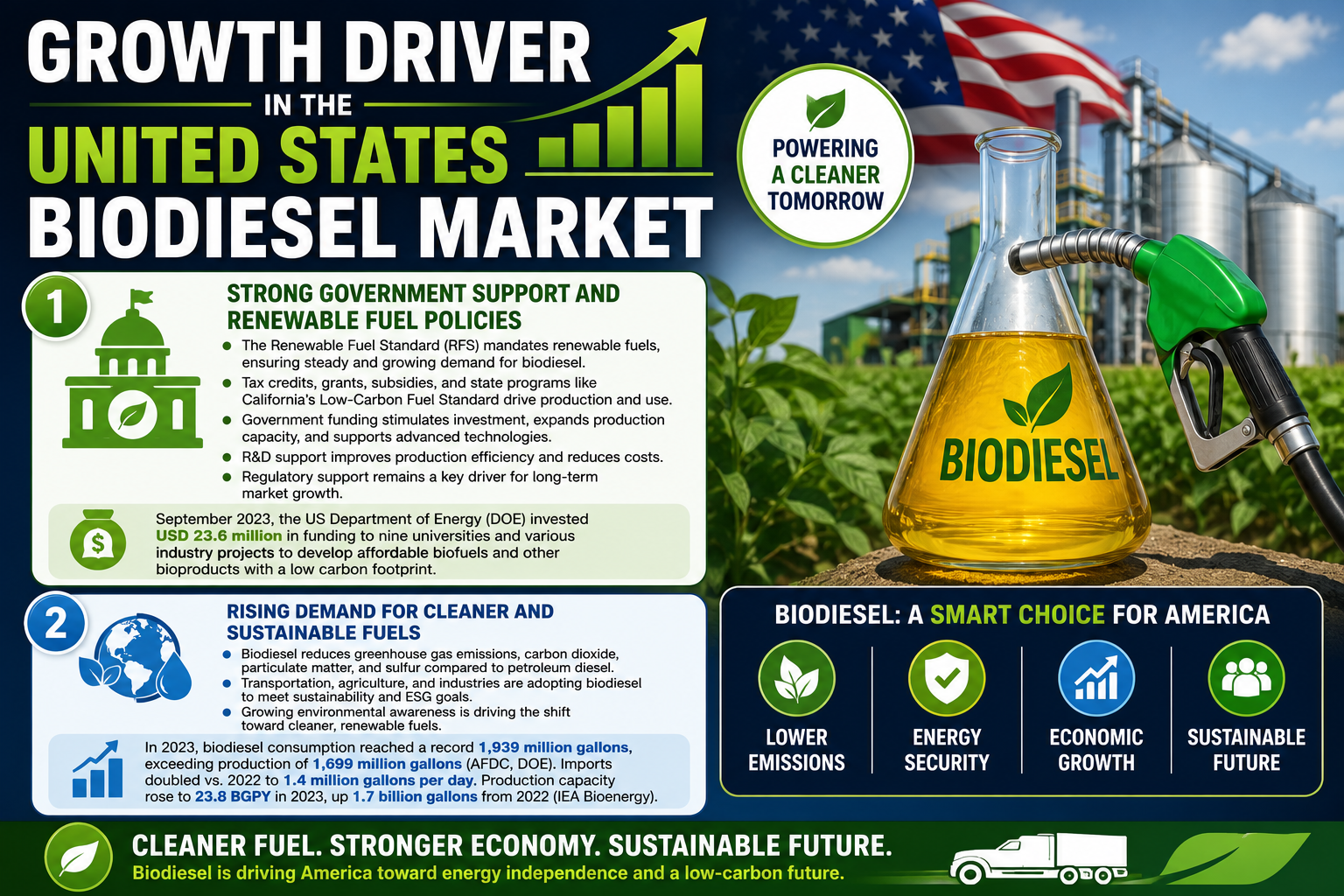
Federal initiatives such as the Renewable Fuel Standard (RFS) have established mandatory renewable fuel requirements within the national fuel supply. These policies create consistent demand for biodiesel while encouraging investments in production facilities and infrastructure.
In addition to federal regulations, state-level programs have further accelerated adoption. California's Low Carbon Fuel Standard, for example, has become a model for encouraging cleaner transportation fuels through market incentives.
Government grants, subsidies, and tax credits also help producers expand capacity and improve production efficiency. These financial incentives reduce investment risks while supporting innovation throughout the biodiesel value chain.
The importance of government support can be seen through significant investments in renewable fuel research. In September 2023, the U.S. Department of Energy invested approximately USD 23.6 million across universities and industry projects focused on developing affordable biofuels and low-carbon bioproducts.
As environmental regulations become increasingly stringent, policy support is expected to remain a cornerstone of market growth.
Rising Demand for Sustainable Fuels
The growing emphasis on sustainability has created strong momentum for biodiesel adoption throughout the United States.
Industries across transportation, logistics, agriculture, and manufacturing are under increasing pressure to reduce carbon emissions and meet environmental goals. Biodiesel offers a practical pathway toward achieving these objectives without disrupting existing operations.
Compared to conventional diesel fuel, biodiesel produces lower levels of carbon dioxide, particulate matter, and sulfur emissions. These environmental benefits make it an attractive alternative for organizations seeking to improve their sustainability profiles.
Many businesses now incorporate biodiesel usage into broader Environmental, Social, and Governance (ESG) strategies. Investors, regulators, and consumers increasingly expect companies to demonstrate measurable progress toward sustainability targets.
The transportation sector remains one of the largest adopters. Trucking fleets, public transportation systems, agricultural operators, and commercial vehicle owners are increasingly turning to biodiesel to reduce environmental impact while maintaining operational performance.
This shift reflects a broader movement toward cleaner energy solutions that can be implemented immediately rather than requiring decades of infrastructure transformation.
Consumption Continues to Reach New Heights
The demand for biodiesel in the United States continues to grow rapidly.
According to data cited in the market report, biodiesel consumption reached a record 1,939 million gallons in 2023, surpassing domestic production levels of 1,699 million gallons. To address this supply gap, imports doubled compared to previous years, reaching approximately 1.4 million gallons per day.
Production capacity is also expanding. The United States increased biofuel production capacity to 23.8 billion gallons per year in 2023, representing a substantial increase compared to 2022 levels.
These figures highlight the growing role biodiesel is playing within the nation's renewable energy portfolio.
As industries continue prioritizing sustainability and governments pursue aggressive emissions reduction targets, demand is expected to remain strong throughout the forecast period.
America's Agricultural Strength Creates a Competitive Advantage
One of the United States' greatest advantages in biodiesel production is its abundant supply of feedstocks.
The country possesses one of the world's most productive agricultural sectors, providing reliable access to soybean oil, animal fats, and recycled waste oils used in biodiesel manufacturing.
Soybean oil remains the dominant feedstock due to its widespread availability and well-established supply chains. The strong agricultural foundation helps reduce dependence on imported raw materials while supporting domestic farmers and rural economies.
In addition to traditional feedstocks, producers are increasingly exploring alternative sources such as waste cooking oil and agricultural residues. These innovations help improve sustainability while reducing production costs.
Technological advancements are further enhancing efficiency and profitability. Improved processing methods enable producers to generate higher yields while maintaining fuel quality standards.
The combination of abundant feedstocks and continuous innovation positions the United States as a global leader in biodiesel production.
Technology Is Expanding Biodiesel's Potential
Technological progress continues to reshape the biodiesel industry.
Researchers and manufacturers are developing more efficient production methods that improve fuel quality while reducing costs. Advanced processing technologies allow producers to utilize a broader range of feedstocks, increasing flexibility and supply resilience.
One notable example occurred in October 2025 when Honeywell introduced technology capable of converting agricultural and forestry waste into renewable fuels suitable for hard-to-decarbonize sectors such as maritime transportation. The innovation enables production of renewable marine fuels, gasoline, and sustainable aviation fuel from biomass sources including wood chips and crop residues.
These innovations demonstrate how technological advancement can unlock new opportunities for renewable fuels while improving environmental performance.
As research continues, biodiesel production is expected to become increasingly efficient, scalable, and economically competitive.
Challenges Facing the Biodiesel Industry
Despite strong growth prospects, the biodiesel market faces several significant challenges.
One of the most important concerns is feedstock price volatility. The cost of soybean oil, animal fats, and other raw materials can fluctuate significantly due to agricultural conditions, global demand, weather patterns, and competition from food industries.
These fluctuations directly impact production costs and profitability.
Competition for feedstocks also creates challenges. As food manufacturers, livestock industries, and renewable fuel producers compete for similar resources, supply constraints can emerge during periods of high demand.
Another challenge comes from competing renewable energy technologies.
Renewable diesel, which closely resembles traditional petroleum diesel, has gained popularity due to its performance advantages and broader compatibility with existing fuel infrastructure.
Meanwhile, electric vehicles continue to receive substantial government support and private investment. Improvements in battery technology and charging infrastructure may gradually reduce long-term demand for liquid transportation fuels.
To remain competitive, biodiesel producers must continue improving efficiency, reducing costs, and identifying new market opportunities.
Fuel Applications Continue to Dominate
Fuel applications represent the largest segment within the United States biodiesel market.
Transportation industries rely heavily on biodiesel blends because they provide a practical pathway toward emissions reduction without requiring significant equipment modifications.
Commercial trucking companies, public transportation systems, agricultural operators, and construction firms are among the largest users of biodiesel fuel.
Federal mandates and environmental regulations continue supporting adoption by encouraging cleaner alternatives to conventional diesel.
As fleet operators increasingly pursue decarbonization goals, biodiesel fuel is expected to maintain its dominant market position.
Growing Opportunities in Power Generation
Beyond transportation, biodiesel is finding new opportunities within the power generation sector.
Backup power systems, remote facilities, and off-grid operations increasingly use biodiesel-powered generators as sustainable alternatives to conventional diesel equipment.
Utilities and energy providers are also exploring biodiesel as part of broader strategies to diversify energy sources and reduce environmental impact.
Because biodiesel can be stored and transported similarly to conventional fuels, it offers flexibility that complements intermittent renewable energy sources such as wind and solar power.
As organizations seek reliable low-carbon energy solutions, biodiesel's role in power generation is expected to expand.
Regional Markets Leading Adoption
California remains one of the most advanced biodiesel markets in the country. Aggressive environmental policies, strong low-carbon fuel standards, and ambitious emissions reduction goals continue driving demand.
New York is also experiencing steady growth due to renewable energy initiatives, sustainability programs, and increasing investments in biodiesel infrastructure.
Washington State has emerged as another important market thanks to clean fuel standards and government support for renewable transportation fuels.
These state-level initiatives demonstrate how regional policies can accelerate adoption and create favorable conditions for industry growth.
As more states pursue aggressive climate goals, biodiesel demand is likely to expand across additional regions.
Final Thoughts
The United States biodiesel market represents a critical component of the nation's evolving energy strategy. While newer technologies such as electric vehicles and hydrogen often attract attention, biodiesel offers an immediate and practical solution for reducing emissions across industries that rely heavily on diesel-powered equipment.
Its compatibility with existing infrastructure, strong government support, abundant domestic feedstocks, and growing environmental advantages position biodiesel as a valuable tool in the transition toward cleaner energy.
With the market projected to grow from US$ 14.84 billion in 2025 to US$ 23.06 billion by 2034, biodiesel's role within America's renewable energy landscape is expected to strengthen significantly over the coming decade. As innovation continues and sustainability becomes an even greater priority, biodiesel will remain an important bridge between today's energy needs and tomorrow's cleaner future.
For businesses, policymakers, and consumers alike, biodiesel offers a reminder that meaningful progress toward sustainability often comes from practical solutions that can be implemented today.
About the Creator
Enjoyed the story? Support the Creator.
Subscribe for free to receive all their stories in your feed.
Comments
There are no comments for this story
Be the first to respond and start the conversation.