
All-Terrain Vehicle Market Gains Momentum as Adventure Tourism and Utility Demand Rise
Increasing demand for off-road recreation, agricultural utility applications, and technological innovation is expected to drive the global all-terrain vehicle market from US$ 4.73 billion in 2025 to US$ 6.29 billion by 2034, growing at a CAGR of 3.21% from 2026 to 2034.

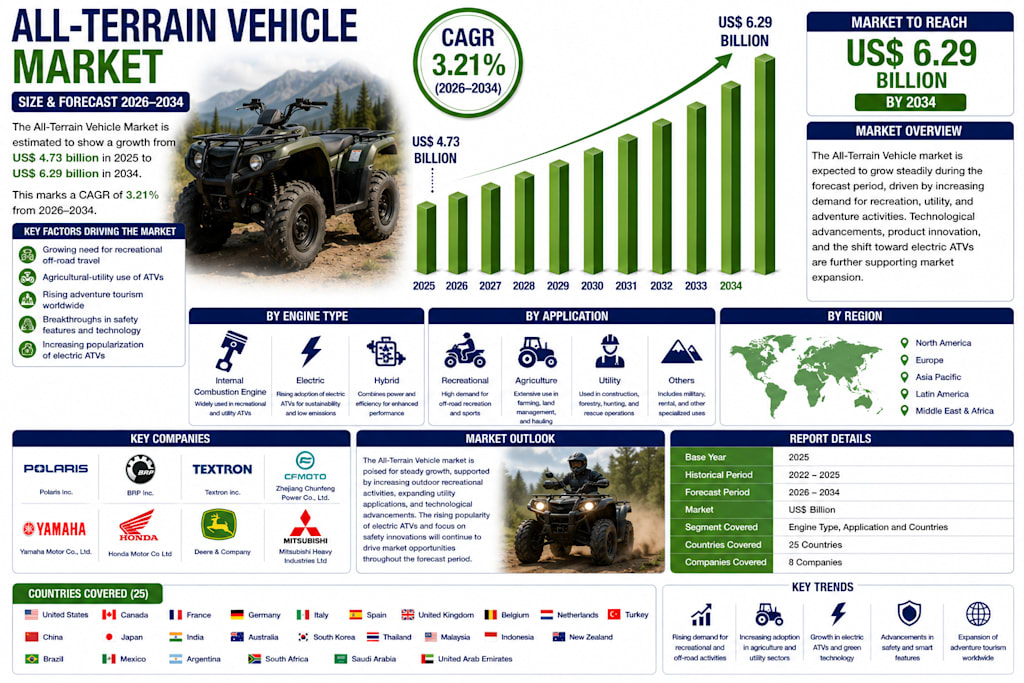
The global all-terrain vehicle (ATV) market is steadily expanding as demand grows across both recreational and utility applications. From off-road adventures and motorsports to agriculture, forestry, and defense, ATVs have evolved into versatile machines capable of handling diverse terrains and tasks.
According to Renub Research, the ATV market is projected to grow from US$ 4.73 billion in 2025 to US$ 6.29 billion by 2034, reflecting a compound annual growth rate (CAGR) of 3.21% during the forecast period. This growth is supported by rising interest in outdoor activities, expanding utility use cases, and continuous technological advancements.
All-terrain vehicles are off-road motor vehicles designed with four low-pressure tires, a wide base, and handlebar steering. These features enable them to operate effectively on challenging terrains such as sand, mud, snow, forests, and rocky landscapes. Over time, ATVs have evolved from lightweight recreational models to heavy-duty machines capable of towing, hauling, and supporting various industrial and agricultural operations.
Rising Demand for Adventure Tourism and Outdoor Recreation
One of the most significant drivers of the ATV market is the growing popularity of outdoor recreation and adventure tourism. Activities such as trail riding, desert exploration, off-road racing, and eco-tourism are increasingly attracting consumers seeking experiential travel.
In developed regions, higher disposable incomes and lifestyle shifts toward experiences over possessions are fueling demand for recreational ATVs. Dedicated off-road parks, adventure trails, and organized racing events are further boosting adoption.
In emerging markets, tourism operators are incorporating ATVs into their offerings, creating new revenue streams and expanding commercial demand. These vehicles are widely used in guided tours, particularly in deserts, forests, and mountainous regions.
As global tourism continues to evolve toward adventure-based experiences, ATVs are becoming an essential component of recreational travel ecosystems.
Expanding Utility Applications in Agriculture and Industry
Beyond recreation, ATVs are gaining traction in utility applications such as agriculture, forestry, construction, and disaster management. Their ability to navigate difficult terrains makes them ideal for tasks that conventional vehicles cannot perform efficiently.
Farmers use ATVs for activities such as crop spraying, equipment transport, livestock monitoring, and fence maintenance. Compared to larger vehicles, ATVs are more cost-effective, fuel-efficient, and easier to operate.
In forestry and conservation, ATVs enable efficient patrolling and monitoring in remote areas. They are also used in emergency response and rescue operations, where accessibility is critical.
The growing adoption of ATVs in these sectors is expanding the customer base and contributing significantly to market growth.
Technological Advancements and Electric ATVs
Innovation is playing a crucial role in enhancing the performance and appeal of ATVs. Manufacturers are investing in advanced technologies such as improved suspension systems, electronic fuel injection, traction control, and high-performance braking systems.
One of the most notable trends is the development of electric ATVs. These vehicles offer several advantages, including lower emissions, reduced noise, and lower maintenance requirements. As environmental regulations become stricter, electric ATVs are gaining popularity among both recreational and commercial users.
Additional features such as connectivity, customizable designs, and ergonomic improvements are enhancing user experience. These advancements are making ATVs more versatile and accessible, driving broader adoption across different segments.
Challenges: Safety Concerns and High Costs
Despite its growth potential, the ATV market faces several challenges. Safety concerns remain a major issue, as ATVs are associated with accidents and rollover risks. Governments in many regions have implemented strict regulations regarding usage, safety standards, and age restrictions.
These regulations can limit the use of ATVs in certain areas and increase compliance costs for manufacturers. Negative publicity related to accidents may also impact consumer perception and demand.
High purchase and maintenance costs are another challenge. Advanced models with high-performance features can be expensive, making them less accessible to price-sensitive consumers. Additional costs for accessories, safety gear, and maintenance further increase the total cost of ownership.
Economic uncertainty can also affect discretionary spending on recreational vehicles, impacting market growth.
Segment Insights: Diverse Applications and Engine Categories
The ATV market is highly segmented, reflecting its wide range of applications and user needs.
Recreational ATVs
This segment is driven by adventure tourism, off-road sports, and leisure activities. Performance, design, and comfort are key factors influencing consumer preferences.
Agricultural ATVs
Agricultural ATVs are widely used for farm operations, offering efficiency and cost savings compared to larger vehicles. They are particularly popular in regions with large rural populations.
400–800cc Segment
This category represents one of the most popular segments, offering a balance between power, affordability, and versatility. These ATVs are suitable for both recreational and utility applications.
Above 800cc Segment
High-performance ATVs in this segment cater to users seeking greater power and advanced features. While they offer superior performance, their higher cost limits adoption to specific user groups.
These segments highlight the versatility of ATVs and their ability to cater to diverse market needs.
Regional Insights Highlight Market Dynamics
The United States is one of the largest ATV markets, driven by a strong culture of outdoor recreation and widespread rural land use. Both recreational and utility applications contribute to demand.
Germany represents a more regulated market, with a focus on utility applications such as agriculture and forestry. Recreational use is limited due to strict environmental and land-use regulations.
India is an emerging market, supported by growing adventure tourism, increasing disposable incomes, and expanding use in agriculture and defense. However, regulatory challenges and high import costs remain barriers.
Saudi Arabia is experiencing strong growth, driven by its desert terrain, off-road culture, and expanding tourism sector. ATVs are widely used for recreational activities such as dune bashing and desert exploration.
These regional trends demonstrate the diverse drivers shaping the global ATV market.
Competitive Landscape and Key Players
The ATV market is competitive, with leading manufacturers focusing on innovation, performance, and product diversification. Key players include Polaris Inc., BRP Inc., Textron Inc., Yamaha Motor Co., Honda Motor Co., and Deere & Company.
Recent developments highlight ongoing innovation in the industry, including new product launches, advanced technologies, and strategic partnerships. Companies are also investing in electric ATVs and sustainable solutions to meet evolving market demands.
These efforts are strengthening competition and driving continuous improvement in ATV performance and user experience.
Final Thoughts
The all-terrain vehicle market is evolving steadily as demand grows across both recreational and utility applications.
Renub Research’s forecast of US$ 6.29 billion by 2034 reflects the market’s stable growth and long-term potential.
While challenges such as safety concerns and high costs remain, technological advancements and expanding use cases are expected to drive future growth.
Ultimately, ATVs represent a versatile and dynamic segment of the automotive industry, offering solutions for adventure, productivity, and mobility across some of the world’s most challenging terrains.
About the Creator
Enjoyed the story? Support the Creator.
Subscribe for free to receive all their stories in your feed.
Comments
There are no comments for this story
Be the first to respond and start the conversation.