
AI-Powered Prediction Markets: The Future of Forecasting or a Manipulation Crisis?
Artificial intelligence is reshaping how we bet on the future — but is it making markets smarter, or opening the door to coordinated chaos?

Artificial intelligence is reshaping industries at a pace that's hard to keep up with — and prediction markets are no exception. Once the domain of political junkies, sports bettors, and Wall Street quants, prediction markets are now being turbocharged by machine learning, real-time data processing, and autonomous trading bots.
But here's the question everyone is dancing around: Is AI making these markets smarter, or is it quietly turning them into a manipulation playground?
Let's break it down — the promise, the peril, and everything in between.
What Are Prediction Markets, Anyway?
Before diving into the AI angle, a quick primer. Prediction markets are platforms where participants buy and sell contracts based on the outcomes of future events — elections, economic indicators, sports results, even corporate earnings.
The price of a contract reflects the crowd's collective probability estimate. A candidate trading at $0.70? The market thinks they have a 70% chance of winning. Simple, powerful, and historically more accurate than polls or expert panels.
Why? Because people put real money on the line, which forces sharper thinking and faster belief updating.
Now imagine layering AI on top of that. That's where it gets interesting — and complicated.
The Upside: AI as a Forecasting Superpower
There's a genuinely compelling case for AI transforming prediction markets for the better. Here's what it brings to the table:
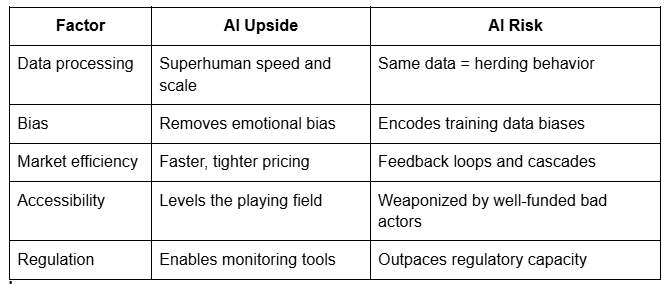
- Superhuman data processing — AI can digest satellite imagery, central bank statements, social media sentiment, historical trends, and earnings calls simultaneously — in milliseconds. No human analyst comes close.
- Elimination of emotional bias — AI doesn't panic after a bad news cycle or get overconfident after a winning streak. It processes probabilities without the psychological baggage humans carry.
- Faster price discovery — Markets become more efficient when AI can instantly identify mispricings and correct them before they linger.
- Democratization of insight — Individual forecasters now have access to analytical tools once reserved for hedge funds and intelligence agencies.
- Consistency — Unlike human traders who tire, get distracted, or go on holiday, AI models apply the same logic 24/7 without drift.
Early results back this up. AI-assisted forecasting models have shown measurable outperformance over human baselines in domains ranging from geopolitical conflict prediction to disease outbreak timelines.
If you want a deeper dive into how this is unfolding in real time, the full breakdown at AI and prediction markets is worth your time — it maps the opportunity and the risk with unusual precision.
The Dark Side: Manipulation Risks Nobody Wants to Discuss
Here's where things get uncomfortable. The same capabilities that make AI a brilliant forecasting tool also make it a devastating weapon for bad actors.
1. Coordinated Narrative Flooding
A well-resourced actor can deploy AI to generate thousands of seemingly independent news articles, forum posts, and social media threads — all nudging public sentiment in a particular direction. Shift sentiment, shift market prices, profit.
2. Liquidity Attacks
AI trading bots can execute thousands of trades per second, artificially moving prices to:
Trigger stop-losses and shake out smaller traders
Create the illusion of consensus where none exists
Manufacture momentum that other automated systems then chase
3. Feedback Loops Between AI Systems
When multiple AI models all read the same data and each other's outputs, self-reinforcing cycles emerge:
A small price movement → interpreted as a signal → bots trade on it → larger movement → interpreted as a stronger signal → price spirals far from rational probability
The result? Markets that look like wisdom-of-the-crowd but are actually just one algorithm's output, echoed at scale.
4. Model Homogeneity
When millions of forecasters use the same AI tools trained on the same datasets, the apparent diversity of the crowd becomes an illusion. Independent judgment — the entire theoretical foundation of why prediction markets work — quietly disappears.
The Regulatory Vacuum: A Ticking Clock
What makes all of this urgent is how dramatically regulation has lagged behind reality.
- Most prediction market platforms operate in legal grey zones
- Financial market rules (disclosure requirements, position limits, anti-manipulation laws) don't map cleanly onto event contracts
- Even where regulators have jurisdiction, they're chasing AI capabilities that advance faster than any rulemaking process
Some platforms are experimenting with their own safeguards:
- Behavioral anomaly detection
- Unusual volume alerts
- Identity verification for large positions
But these are piecemeal fixes to a structural problem. The actors most likely to exploit AI for manipulation are the ones with the resources and sophistication to stay ahead of enforcement.
What Good AI Integration Actually Looks Like
Not all AI involvement in prediction markets is created equal. There's a crucial distinction between AI that enhances human judgment and AI that replaces it.
The healthy model:
- AI surfaces relevant data and flags inconsistencies in price signals
- Humans remain in the loop, using AI as one input among many
- Forecasters use tools to identify their own blind spots — not outsource their thinking entirely
The risky model:
- Fully automated strategies execute positions with zero human review
- Speed and cost efficiency prioritized over judgment and accountability
- Vulnerable to feedback loops, cascade failures, and adversarial manipulation
The forecasting superpower or manipulation nightmare question ultimately hinges on which model dominates — and right now, market incentives are pushing hard toward automation.
Key Takeaways at a Glance
Final Thoughts
AI-powered prediction markets are neither the forecasting utopia their cheerleaders promise nor the manipulation disaster their critics fear — they're both, depending on how they're built and governed. The core tension is simple: these markets work because of independent human judgment. AI, applied carelessly, can hollow out that independence while leaving the appearance of it intact. Platform safeguards, smarter regulation, and an informed user base aren't optional extras — they're the difference between a genuinely powerful forecasting tool and a very sophisticated way to be manipulated. Watch this space closely.
About the Creator
Poly Punter
Poly Punter covers prediction market news, Polymarket trends, crypto forecasting, trader insights, and real-time event trading. We publish informative content about decentralised prediction markets and forecasting culture.
Enjoyed the story? Support the Creator.
Subscribe for free to receive all their stories in your feed.
Comments
There are no comments for this story
Be the first to respond and start the conversation.