
Adhesion Barriers Market Expected to Reach $2.15 Billion by 2034 as Surgeons Focus on Preventing Post-Operative Complications
Growing Surgical Volumes, Advancements in Biomaterials, and Rising Awareness of Adhesion-Related Risks Are Driving Market Expansion

Why Adhesion Prevention Is Becoming a Priority in Modern Healthcare
Every year, millions of patients undergo surgical procedures to treat chronic illnesses, injuries, and life-threatening conditions. While surgery often improves quality of life and health outcomes, it can also lead to complications that develop long after the operation is complete. One of the most common yet frequently overlooked complications is the formation of surgical adhesions.
Adhesions are bands of scar tissue that can develop between organs and tissues during the healing process following surgery. These scar tissues can cause organs to stick together, potentially leading to chronic pain, infertility, bowel obstruction, reduced mobility, and the need for additional surgeries. As awareness of these complications grows among healthcare professionals, the demand for preventive solutions is increasing rapidly.
One of the most effective approaches to reducing adhesion formation is the use of adhesion barriers. These specialized medical products create a temporary physical barrier between tissues during healing, helping to prevent abnormal scar tissue formation. As healthcare systems increasingly prioritize better patient outcomes and lower post-operative complications, adhesion barriers are becoming an important component of surgical care.
According to Renub Research, the global Adhesion Barriers Market was valued at US$ 1.27 billion in 2025 and is projected to reach US$ 2.15 billion by 2034, growing at a compound annual growth rate (CAGR) of 6.03% during the forecast period from 2026 to 2034.
Understanding the Role of Adhesion Barriers
Adhesion barriers are medical devices used during surgical procedures to prevent tissues and organs from adhering to one another as they heal. These barriers are available in several forms, including films, gels, liquids, and sprays. After application, they create a temporary separation between tissues, allowing healing to occur naturally while reducing the risk of adhesion formation.
Most modern adhesion barriers are bioresorbable, meaning they gradually dissolve and are absorbed by the body once healing is complete. This eliminates the need for removal procedures and enhances patient convenience.
The use of adhesion barriers has expanded significantly across abdominal, pelvic, gynecological, orthopedic, cardiovascular, and reconstructive surgeries. Their ability to reduce complications and improve recovery outcomes has made them increasingly valuable in both developed and emerging healthcare markets.
Rising Surgical Volumes Are Fueling Market Growth
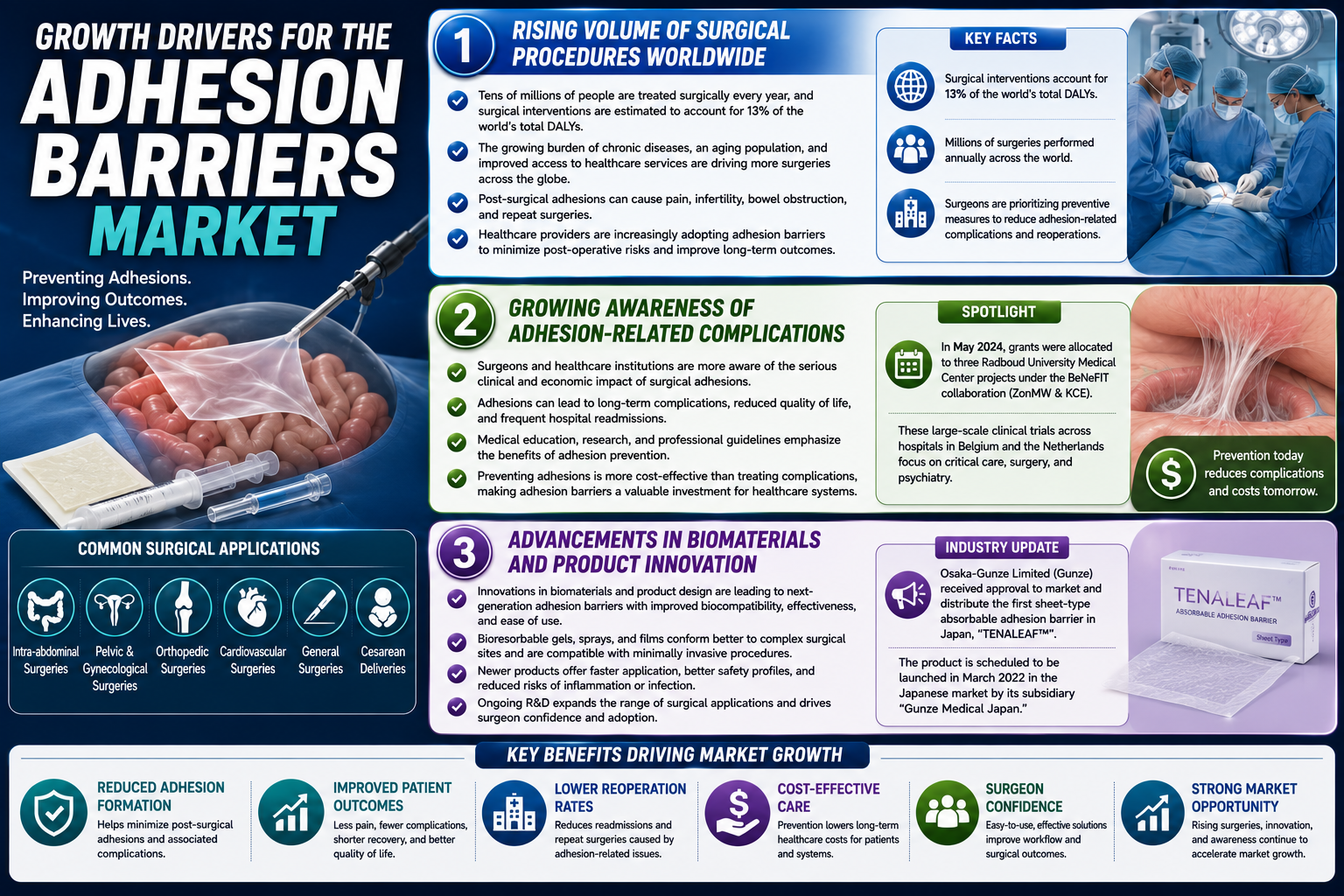
One of the strongest factors driving the adhesion barriers market is the increasing number of surgical procedures performed worldwide.
As populations age and chronic diseases become more prevalent, healthcare providers are performing greater numbers of surgeries across multiple specialties. Procedures involving the abdomen, pelvis, heart, joints, and reproductive organs are particularly associated with adhesion formation.
Healthcare professionals are becoming increasingly aware that preventing adhesions during surgery is often more effective and cost-efficient than treating complications later. This shift in surgical philosophy has encouraged broader adoption of adhesion prevention technologies.
The growing availability of healthcare services in developing economies is also contributing to higher surgical volumes, creating additional opportunities for market expansion.
Awareness of Adhesion-Related Complications Continues to Increase
For many years, surgical adhesions were often considered an unavoidable consequence of surgery. Today, medical research has significantly changed that perspective.
Healthcare providers now better understand the clinical and economic burden associated with adhesion-related complications. Chronic pain, infertility, bowel obstruction, repeated hospitalizations, and additional surgeries can dramatically affect both patients and healthcare systems.
Medical education programs, scientific studies, and professional guidelines increasingly emphasize adhesion prevention as an important component of surgical planning.
As awareness grows among surgeons and hospital administrators, adhesion barriers are becoming a routine consideration in many procedures, particularly those associated with a high risk of adhesion formation.
Innovation in Biomaterials Is Improving Product Performance
Technological innovation has played a major role in expanding the capabilities of adhesion barriers.
Researchers and manufacturers continue developing advanced biomaterials that offer improved safety, flexibility, and effectiveness. Modern products are designed to conform more closely to surgical sites while maintaining strong biocompatibility.
New generations of bioresorbable films, gels, and liquid formulations are easier to apply and better suited for complex surgical environments. These innovations improve surgeon confidence while enhancing patient outcomes.
Advancements in material science have also reduced concerns regarding inflammation, infection, and tissue irritation, further supporting adoption across a broader range of procedures.
As product performance continues to improve, healthcare providers are becoming more comfortable integrating adhesion barriers into standard surgical protocols.
The Growing Popularity of Minimally Invasive Surgery
The global healthcare industry has witnessed a significant shift toward minimally invasive procedures over the past decade.
Compared to traditional open surgery, minimally invasive techniques generally offer smaller incisions, shorter recovery times, reduced pain, and lower risks of complications.
The growing use of laparoscopic and robotic-assisted procedures has created demand for adhesion barriers specifically designed for these surgical environments.
Liquid and gel formulations have gained popularity because they can be applied easily through minimally invasive surgical instruments. Their ability to conform to irregular anatomical surfaces makes them particularly effective in complex procedures.
As hospitals continue investing in minimally invasive surgical capabilities, demand for compatible adhesion prevention technologies is expected to increase.
Synthetic Adhesion Barriers Continue to Gain Momentum
Synthetic adhesion barriers represent one of the largest product segments within the market.
These products are typically manufactured using engineered polymers that provide predictable performance characteristics and controlled degradation rates. Surgeons often prefer synthetic barriers because they offer consistent quality, reliable handling, and reduced risks of biological contamination.
Advances in polymer science have improved the flexibility, durability, and biocompatibility of synthetic barriers. These improvements have expanded their use across multiple surgical specialties.
As healthcare providers increasingly seek standardized and evidence-based solutions, synthetic adhesion barriers are expected to maintain strong market demand.
Gel and Liquid Formulations Are Expanding Their Presence
Gel-based adhesion barriers have gained widespread acceptance due to their versatility and ease of application.
These products can adhere effectively to irregular tissue surfaces and remain localized during the healing process. Their flexibility makes them especially useful in pelvic and abdominal procedures where precise coverage is essential.
Liquid adhesion barriers are also experiencing strong growth. Their ability to be sprayed or poured directly onto surgical sites provides surgeons with a convenient and efficient application method.
Because liquid formulations can conform naturally to complex anatomical structures, they are particularly valuable in minimally invasive procedures where traditional film placement may be challenging.
The growing preference for user-friendly surgical solutions is expected to support continued demand for both gel and liquid products.
Gynecological Surgery Represents a Major Opportunity
One of the most important application areas for adhesion barriers is gynecological surgery.
Procedures such as hysterectomies, myomectomies, and endometriosis surgeries carry significant risks of adhesion formation. In women, adhesions can contribute to infertility, chronic pelvic pain, and the need for repeat surgical interventions.
As awareness of these risks increases, many gynecological surgeons are incorporating adhesion barriers into routine surgical practice.
Growing attention to women's health and reproductive outcomes is expected to further strengthen demand within this segment.
Orthopedic Procedures Are Driving Additional Demand
The orthopedic surgery segment is emerging as another important growth area.
Adhesions can develop following procedures involving joints, tendons, ligaments, and spinal structures. These adhesions may limit mobility, increase pain, and complicate rehabilitation efforts.
As global populations age and rates of sports injuries and degenerative conditions continue rising, the number of orthopedic procedures is increasing steadily.
Healthcare providers are increasingly recognizing the value of adhesion prevention in supporting faster recovery and improved mobility outcomes.
Regional Markets Continue to Expand
The United States remains one of the most mature adhesion barrier markets globally. High surgical volumes, advanced healthcare infrastructure, and strong awareness of post-operative complications continue driving adoption.
The United Kingdom is also witnessing steady market growth, supported by increasing surgical activity and a strong emphasis on improving patient outcomes within the healthcare system.
India represents one of the most promising emerging markets. Rising healthcare investments, expanding hospital infrastructure, growing medical tourism, and increasing awareness among surgeons are creating significant opportunities for market expansion.
Saudi Arabia is experiencing notable growth as healthcare modernization initiatives and infrastructure investments increase access to advanced surgical technologies.
These regional developments demonstrate the global nature of demand for adhesion prevention solutions.
Challenges That Could Impact Future Growth
Despite strong growth prospects, several challenges remain.
The relatively high cost of adhesion barriers continues to limit adoption in certain healthcare systems, particularly in cost-sensitive regions where reimbursement support may be limited.
Clinical outcomes can also vary depending on surgical technique, patient characteristics, and proper product application. Variability in results may influence surgeon confidence and adoption rates.
Additionally, some healthcare providers continue relying on traditional surgical practices rather than incorporating newer adhesion prevention technologies.
Addressing these challenges through education, clinical evidence, and product innovation will be important for sustaining long-term market growth.
Future Outlook for the Adhesion Barriers Market
The future of the adhesion barriers market appears highly promising. Ongoing advancements in biomaterials, increasing surgical volumes, growing awareness of adhesion-related complications, and expanding adoption of minimally invasive procedures are expected to support steady market growth throughout the forecast period.
Manufacturers are likely to continue investing in research and development aimed at improving product performance, safety, and ease of use. At the same time, healthcare systems worldwide are becoming more focused on preventive approaches that improve patient outcomes while reducing long-term treatment costs.
With the market projected to reach US$ 2.15 billion by 2034, adhesion barriers are poised to play an increasingly important role in modern surgical care. Healthcare providers, patients, and healthcare systems alike stand to benefit from technologies that help reduce complications and improve recovery outcomes after surgery.
Final Thoughts
Adhesion barriers have evolved from specialized surgical products into essential tools for improving post-operative outcomes. As awareness grows regarding the long-term impact of surgical adhesions, healthcare providers are increasingly adopting preventive solutions that enhance patient recovery and reduce complications. Supported by technological innovation, rising surgical volumes, and greater focus on patient-centered care, the global Adhesion Barriers Market is expected to experience sustained growth throughout the coming decade.
About the Creator
Enjoyed the story? Support the Creator.
Subscribe for free to receive all their stories in your feed.
Comments
There are no comments for this story
Be the first to respond and start the conversation.