
80 Cinemas Sold Out for Table Tennis. That Was the Easy Part.
A new policy gives sports broadcasts in movie theaters a name. The hard part is building a business that works without one superstar.
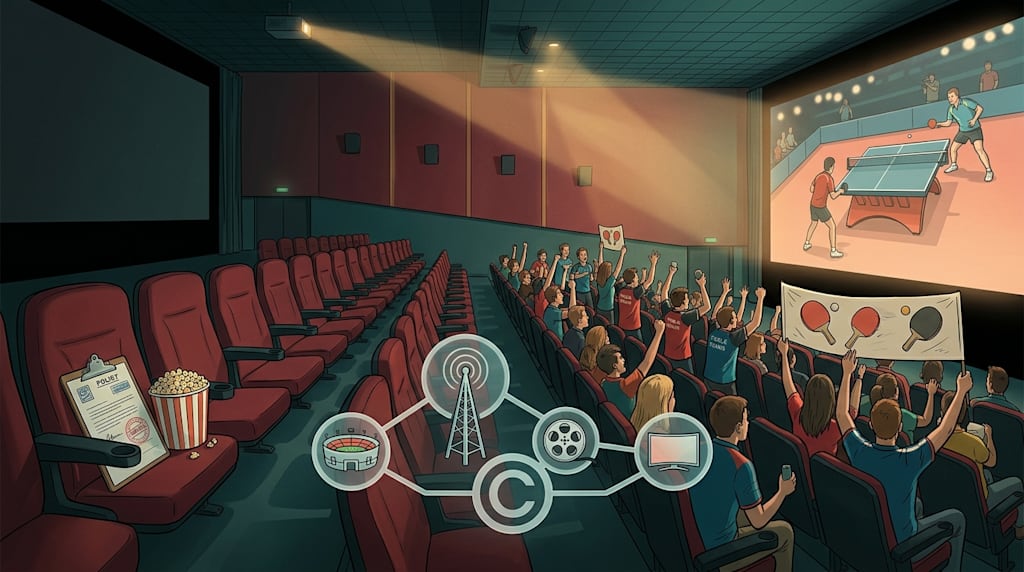
On Aug. 29, 2026, more than 80 Chinese cinemas listed a German table tennis match on their schedules. The screenings took 0.1% of the day’s slots. They filled 87.4% of seats, sold out in ten minutes, and brought in about 1.17 million yuan for one match. A week later, the fourth round expanded to 197 cinemas and 212 auditoriums. Two matches earned 2.824 million yuan combined. Fans traveled from Tianjin to Beijing and from Songjiang to Shanghai to watch on a big screen. Inside the auditoriums, some brought homemade banners. Some wore Fan Zhendong jerseys. During the interval, they queued for popcorn like any movie audience.
The National Film Administration and the General Administration of Sport later wrote this practice into a joint notice, “Follow the Movies into Sports.” The notice encourages cinemas to use idle time slots for major sports broadcasts. The policy did not create the demand. A market test had already shown it at low cost, and that test landed in a gap shared by two industries.
The screenings exposed a supply gap
The fan signal was direct. A German table tennis broadcast costs far less than a football Bundesliga broadcast. It can still turn 0.1% of screenings into 2.824 million yuan. The number shows what fans will pay for: a room full of people holding their breath, shouting, and reacting together. That experience does not exist on a phone. CCTV Finance put it plainly: athlete IP turned idle cinema seats into an offline second venue for fans.
The cinema signal was harder. In the first half of 2026, average national cinema occupancy fell from 10.9% in 2019 to between 5.4% and 6.6%. Non-prime weekday occupancy was below 2%. Auditorium vacancy exceeded 80%. In the first four months, 550 cinemas suspended operations. About 740 closed in 2025. Ticketing margins are thin. Leading chains now lean on non-ticketing revenue. Wanda Film’s merchandise and catering revenue reached 863 million yuan in the first half of 2025, with a 73.42% gross margin. Catering and retail gross profit exceeded its net profit for the quarter. Cinemas do not need another good movie. They need any reason to bring people back into the room and keep them there a little longer.
The Bundesliga screenings met both demands. Fans got a place to watch together. Cinemas got to fill idle hours. The policy then upgraded a market-validated practice from a fan experiment to an encouraged format. In June 2026, the National Film Administration and the State Administration for Market Regulation had already supported “diversified operations” for cinemas. That signal opened the door. “Follow the Movies into Sports” walked sports broadcasts through it.
Two paths answer two different questions
Youku’s Bundesliga screenings and the China Open’s two-year carnival are separate paths. Each answers a different question, and each shows a different limit.
The Bundesliga model turns a niche event into cinema content through star power. It is efficient. The rights cost is low, and the screenings reach core fans who will pay. The limit is the dependence on a person, not an event brand. Analysts put the chance of non-headline events landing in cinemas below 10%. The single-screening box office ceiling for those events is one-twentieth to one-tenth of headline events. The Bundesliga screenings proved the model can work. They did not prove it can scale, because it depends on a scarce athlete with cross-circle appeal.
The China Open carnival takes another route. In 2025 it set up nearly 40 “second venue” sites across Beijing and beyond. Eighteen commercial districts streamed matches. Cinemas offered “city box” viewing with high-bitrate feeds for the semifinals and finals, plus commemorative ticket stubs and limited souvenirs. The event became a traffic entry point for urban consumption. The strength is reach. The weakness is equally clear: second-venue broadcasts are free to the public. Free access and paid cinema screenings pull in different directions. The China Open model cultivates sports as an urban lifestyle. It does not directly test whether sports events can become regular paid cinema content.
The notice includes both paths without merging them. The Bundesliga path tests commercial viability. The China Open path tests consumption habits. At this stage, each does its own job. The notice’s ticket-stub tie-ins, two-way points, spending discounts, and sports lottery in cinemas, along with banks and payment institutions as promotion partners, build interfaces for both paths. They do not pick a winner.
Policy can build interfaces. It cannot remove two hurdles.
The interfaces exist. A Bundesliga screening can come with catering discounts and shopping discounts. That can multiply single-day spending. Cinema revenue math supports the direction. Popcorn and drinks alone support about 10% of total revenue. Adding catering can pull that share to 30%. The industry average for concessions is around 8%. If sports broadcasts bring foot traffic, non-ticketing spending can make the visit worth more than a ticket.
Two hurdles remain outside the policy text.
The first is copyright. A sports broadcast stacks rights from event organizers, broadcasters, content producers, and others. No single license covers the whole chain. After the 2020 Copyright Law amendment, broadcasters’ rights gained effect over internet retransmission. Court practice has clarified protection for sports broadcast images. That clarity also means every cinema broadcast needs a complete authorization chain. The Bundesliga screenings worked because Youku held the rights and led the implementation from signal acquisition to cinema distribution. The 2026 World Cup cinema broadcasts became the first lawful nationwide scaled operation because CCTV, as the exclusive all-media rights holder, worked with China Film Group to build a chain from FIFA to CCTV to compliant cinemas. More than 1,200 cinemas received authorization. Replicating that architecture for more events is a harder question than whether policy encourages it. The copyright chain gets more complex as the number of events grows.
The second hurdle is the gap between star dependence and event-brand dependence. The Bundesliga screenings worked because a star’s personal IP overwhelmed the event IP. Audiences came first to see Fan Zhendong, then to see the Bundesliga. That model fits table tennis because China has a rare athlete with cross-circle appeal. The policy targets major sports events as a whole. Most events do not have that single-point pull. For cinema broadcasts to become a lasting format, events need enough suspense and narrative continuity that audiences will enter a cinema for the match itself, even without one star. Very few event brands meet that condition today.
Sports films and event broadcasts face the same problem from opposite sides
Sports films must compress a sport into a human story. “Leap” earned 836 million yuan, the ceiling for a Chinese sports film. It did not break past the definition of sports the way “Dangal” did. The women’s volleyball spirit carries collective memory, but it has not been translated into an emotional entry point that anyone can use outside the sport. “Ping Pong: The Triumph” faced the same narrative constraint. Its release timing lacked an event atmosphere to boost it, and it stopped around 100 million yuan. “Pegasus 3,” a racing story, sparked unexpected discussion among table tennis fans. Audiences want sports wrapped inside a human story. They reject sports as the only protagonist.
Event broadcasts avoid that narrative problem. They do not need a complete story in ninety minutes. They offer a live, spoiler-proof room shared with strangers. Fans enter the cinema to become part of the match. Event broadcasts naturally possess what sports films struggle to create. The two paths point in the same direction. Sports in cinemas matter when the screen and the audience form a relationship that cannot be replaced. Films need to learn how to make someone who does not care about volleyball cry for “Leap.” Event broadcasts have already shown that people who care will pay more than a movie ticket to watch together.
The growth curve will not rise smoothly
“Follow the policy; if the direction is right, scale it up” holds as a direction. The growth path will likely be uneven.
Policy will build the compliance framework and consumption interfaces first. A small number of events with star pull or urban-scene embedding will produce replicable single-point models. Most events will still need trial and error under copyright costs and uncertain willingness to pay. The Bundesliga screenings began with an accident: an athlete’s choice, a fan base’s enthusiasm, and a platform’s business judgment collided at one moment. The practice moved from a fan festival to a policy format because that accident landed on a structural gap. The gap was already there. Cinemas were waiting. Fans were waiting. They needed something concrete to fill it. Fan Zhendong’s match was that concrete thing.
The policy has given the practice a formal name. It has not yet given it a self-sustaining business model. The next time the gap is filled, it should not require waiting for another accident. Cinemas are still waiting. Fans are still waiting.
About the Creator
Jin
Writer of reamstories
https://reamstories.com/jin
Enjoyed the story? Support the Creator.
Subscribe for free to receive all their stories in your feed. You could also become a paid subscriber, letting them know you appreciate their work.
Comments
There are no comments for this story
Be the first to respond and start the conversation.